Core Web Vitals vs User Experience: What Impacts SEO More in 2026?
Updated : May 16, 2026
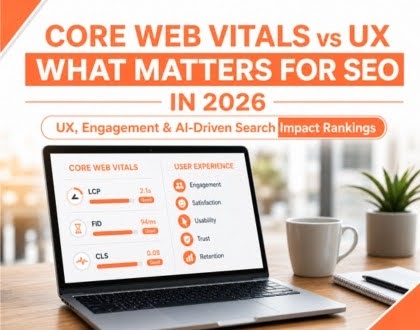
In 2026, user experience (UX) has a greater impact on SEO than Core Web Vitals (CWV). CWVs still play an important role, but mainly as a baseline requirement. User experience is what truly drives rankings today. Search engines now evaluate how users interact with content, how long they stay, and whether their intent is fully satisfied. Content that is clear, helpful, and easy to navigate consistently performs better, especially in AI-driven search results.
This blog explains how Core Web Vitals and user experience influence SEO in 2026, how their roles have evolved, and how to optimize for both to achieve better rankings.
The Evolution of SEO in 2026
SEO in 2026 is no longer just about optimizing for search engines. It is about optimizing for users, behavior, and AI systems simultaneously.
Over 60% of Google searches now end without a click, and top-ranking pages typically see 2–4 minutes of dwell time, showing that engagement and satisfaction are now core ranking signals.
From Traditional SEO to AI-Driven Search
Previously, SEO focused on:
- Keywords
- Backlinks
- Technical performance
Now, it prioritizes:
- Intent matching
- Content clarity and structure
- User engagement
- AI readability
Content is no longer just competing to rank. It is competing to be selected as the best answer.
The Rise of AEO and GEO
Modern SEO is shaped by:
- Answer Engine Optimisation (AEO), which focuses on direct, clear answers
- Generative Engine Optimization (GEO), which structures content for AI extraction and summarization
Both reward clarity, structure, and usefulness over traditional tactics.
What Are Core Web Vitals (CWV)?
Core Web Vitals are Google’s standardised metrics for measuring how fast, stable, and responsive a website feels to users. They focus on technical performance rather than content quality.
There are 3 Core Web Vitals Metrics:
1. Largest Contentful Paint (LCP)
Measures how quickly the page's main content loads.
- Ideal benchmark: under 2.5 seconds
- Directly impacts first impression
2. Interaction to Next Paint (INP)
Measures how quickly a page responds to user interactions like clicks or taps.
- Ideal benchmark: under 200 milliseconds
- Replaces First Input Delay (FID) in modern SEO
3. Cumulative Layout Shift (CLS)
Measures visual stability by tracking unexpected layout movements.
- Ideal benchmark: less than 0.1
- Prevents frustrating user experiences
The Limitation of Core Web Vitals
While important, CWVs only measure performance, not effectiveness.
A page can:
- Load in under 2 seconds
- Be perfectly stable
- Respond instantly
And still fail to rank if the content is unclear or does not satisfy user intent.
Where Core Web Vitals Stand
Core Web Vitals have little direct influence on whether your content is selected for AI-generated answers.
They still matter for:
- First impression – slow pages increase bounce rate
- Mobile performance – critical for mobile-first indexing
- Crawling – faster sites are easier to index
But they do not determine content selection in AI responses.
A 1-second delay in load time can reduce conversions by up to 7%, showing where Core Web Vitals still matter
The Real Role in 2026
In 2026, Core Web Vitals function as a baseline requirement rather than a competitive advantage.
- Poor scores can hurt rankings
- Good scores simply keep you competitive
- Exceptional scores rarely guarantee higher rankings
Once your site meets acceptable thresholds, further speed improvements have diminishing SEO returns.
This is why focusing only on performance is no longer enough. The real impact comes from how users interact with your content after the page loads.
What Is User Experience (UX)?
User Experience refers to how users interact with your website and how easily they can achieve their goal. It is not just about design, but about clarity, usability, and overall satisfaction.
Studies show that websites improving user experience can see up to 20–30% higher engagement, reinforcing its direct impact on SEO performance.
User engagement metrics are made up of multiple layers that work together:
1. Content Clarity
Is the information easy to understand?
2. Navigation
Can users find what they need quickly?
3. Design & Readability
- Clean layout
- Proper spacing
- Mobile-friendly
4. Engagement Signals
- Time on page
- Scroll depth
- Bounce rate
5. Intent Satisfaction
- Does the page fully answer the query?
- Does the user need to go back and search again?
Why UX Drives SEO in 2026
Search engines now evaluate what happens after the click:
- Do users stay?
- Do they engage?
- Do they find what they need?
Stronger engagement signals = better rankings
UX is no longer secondary. It is the main ranking driver. A fast page may get the click. A valuable experience is what keeps and ranks it.
What Good UX Looks Like in 2026
High-performing pages typically:
- Answer the query in the first few lines
- Use clear headings and structured formatting
- Avoid unnecessary complexity
- Guide the user step by step
This analysis is based on current SEO trends, user behavior data, and real-world performance patterns observed across high-ranking websites.
Core Web Vitals vs User Experience: Key Differences
| Factor | Core Web Vitals | User Experience |
|---|---|---|
| Nature | Technical metrics | Behavioral and perception-based |
| Focus | Speed, responsiveness, stability | Usability, clarity, satisfaction |
| Measurement | Fixed benchmarks (LCP, INP, CLS) | Engagement + AI evaluation |
| Data Type | Quantitative | Mixed (quantitative + qualitative) |
| Role in SEO | Baseline requirement | Primary ranking driver |
| Impact | Helps with eligibility to rank | Determines ranking and retention |
| Limitation | Does not measure content value | Harder to measure directly |
Quick Summary
- Core Web Vitals ensure your site performs properly
- User Experience determines engagement and rankings
- Meeting CWV standards is necessary, but not enough
- UX has a greater impact on SEO in 2026
- AI search prioritizes clear, structured, user-focused content
Which Impacts SEO More in 2026?
User Experience has a greater impact on SEO in 2026.
Core Web Vitals does not guarantee ranking. If your site fails performance standards, rankings will suffer. But once those standards are met, they stop being a major differentiator.
Search intent optimization is what drives actual ranking performance.
Why UX Matters More
Search engines now prioritize:
- User engagement
- Content usefulness
- Intent satisfaction
If users:
- Stay longer
- Interact with content
- Find their answer quickly
Your rankings improve.
If they leave quickly, rankings drop regardless of how fast your site is.
The Real Relationship
Core Web Vitals = entry requirement
page experience signals = ranking driver
Both matter, but they do not carry equal weight.
Final Take
Core Web Vitals help you qualify, but User Experience helps you win.
Real-World Scenario: Performance vs Experience
Scenario 1: Fast but Poor UX
- Page loads in 1.2 seconds
- Content is cluttered
- No clear answer
Result:
- High bounce rate
- Low engagement
- Ranking drops
Scenario 2: Slightly Slower but Excellent UX
- Loads in 2.8 seconds
- Clear headings
- Direct answers
- Strong readability
Result:
- Users stay longer
- Higher satisfaction
- Better rankings
In 2026, Google prefers Scenario 2. Search engines prioritize outcomes, not just performance.
How AI Search (GEO) Changes the Equation
The rise of AI-powered search has fundamentally changed how content is ranked and discovered. Search engines are no longer just listing results. They are generating answers.
This shift introduces a new layer of optimization called Generative Engine Optimization (GEO).
What AI Systems Prioritize
AI-driven search focuses on:
- Clear, direct answers
- Well-structured content
- Context and semantic relevance
- Ease of extraction and summarization
Example:
A page that answers a query in the first few lines and uses clear subheadings is more likely to be selected and summarized by AI than a long, unstructured article with the same information buried deeper.
How to Optimize for GEO:
- Answer the query within the first 2–3 lines
- Use clear, descriptive headings for each section
- Keep language simple and easy to extract
- Avoid filler content and unnecessary complexity
- Maintain strong semantic relevance throughout the page
The GEO Advantage
Well-optimized UX leads to:
- Higher chances of being featured in AI answers
- Better visibility in zero-click results
- Increased authority and trust signals
To stay competitive in AI-driven search, it’s essential to understand how to use AI for SEO and align your content with modern ranking signals.
UX Optimization: What Actually Works in 2026
Improving page experience signals is what drives real SEO gains in 2026. The focus is no longer on adding more content, but on making content easier to consume and more useful.
What Works Today
- Answer-first content
Start with a clear, direct answer before going into detail - Structured formatting
Use headings, short paragraphs, and bullet points - High readability
Simple language, clean layout, and proper spacing - Intent alignment
Match exactly what the user is searching for - Guided flow
Lead users step by step instead of overwhelming them
What to Avoid
- Long, unstructured blocks of text
- Overuse of keywords
- Design that looks good but confuses users
In 2026, UX > CWV because engagement and intent satisfaction directly influence rankings, while CWV only ensures baseline performance.
The Ideal Strategy: Combine Both
The winning approach in 2026 is combining Core Web Vitals with strong User Experience.
Simple Framework is
- Fix Core Web Vitals – ensure fast, stable performance
- Improve UX – clear, structured, easy-to-use content
- Optimize for GEO – make content AI-friendly and answer-focused
For growing brands, applying these principles alongside SEO Tips for small businesses ensures both visibility and long-term scalability.
Common Mistakes to Avoid
Many websites still fail because they focus on the wrong priorities, such as:
- Over-optimizing for speed
Cutting content just to improve load time hurts UX - Ignoring mobile experience
Poor mobile usability leads to ranking drops - Keyword stuffing
Reduces clarity and damages engagement - Design over usability
Good-looking pages that confuse users perform poorly
Optimizing for performance alone is not enough. If users struggle to understand or navigate your content, rankings will decline.
Turn Your Website Into a High-Ranking Growth Engine with Kaizen Global
In 2026, rankings are driven by experience, not just speed. If your strategy is still focused only on technical SEO, you are missing real growth opportunities.
At Kaizen Global, our expert SEO services combine Core Web Vitals, User Experience, and AI-driven optimization helping businesses improve rankings and engagement across competitive markets.
Get in touch today and turn your website into a high-performing growth engine.
FAQs
Do Core Web Vitals still matter in 2026?
Yes. They act as a foundation. Poor scores hurt rankings, but good scores don’t guarantee higher rankings.
Why is User Experience more important?
Because rankings now depend on engagement and intent satisfaction, not just performance.
Can a slower site still rank well?
Yes, if it meets basic speed standards and delivers clear, valuable content.
What is the ideal balance?
Meet Core Web Vitals, then focus on UX. Performance qualifies, UX ranks.
How does AI search affect this?
AI favors clear, structured content, making UX more important than speed.
What should you prioritize first?
Fix major speed issues, then optimize content and experience.
Turn Your Website Into a High-Ranking Growth Engine with Kaizen Global
Insights

Mobile Seo Checklist - A Complete Guide
Mobile SEO refers to optimizing your website to ensure it performs well on mobile devices, offering a seamless user experience ...

25-Step SEO Migration Checklist
Migrating your website can feel like a daring task filled with potential challenges. No matter if you're redesigning your site ...

Local SEO Checklist: Maximize Your Local Reach
Local search engine optimization (SEO) has become essential for businesses aiming to connect with their community and attract nearby ...