How Google AI Overviews Are Reshaping SEO in 2026: A Complete Guide to Rank, Get Featured & Stay Visible
Updated : May 1, 2026
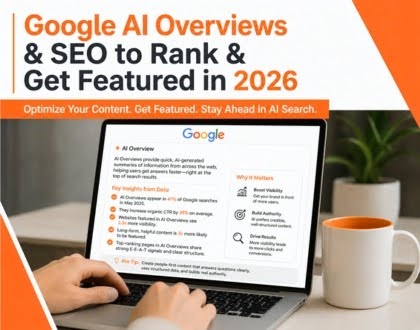
Google AI Overviews are fundamentally reshaping SEO in 2026 by shifting search from ranking websites to delivering direct answers. Powered by Google’s AI, these summaries appear at the top of search results, reducing clicks and prioritising clear, authoritative, and easy-to-extract content. As a result, traditional SEO focused on keywords and rankings is being replaced by a new approach in which success depends on being featured in AI-generated answers, not just on appearing in search results.
This guide explains how Google AI Overviews are reshaping SEO in 2026—and what you must do to adapt, get featured in AI-generated answers, and maintain visibility in a search landscape driven by Google’s evolving AI systems.
What Are Google AI Overviews?
Google AI Overviews are AI-generated summaries that appear at the top of search results, answering user queries instantly by synthesizing information from multiple sources.
What makes them different?
- They eliminate the need to click multiple links
- They prioritize context over keywords
- They reward clarity over content length
The shift:
From:
- Search → Click → Website → Answer
To:
- Search → AI Answer → (Maybe) Click
How Google Is Transforming Search Behavior with AI Overviews
With the introduction of AI Overviews, Google has significantly changed how users interact with search results. Instead of navigating through multiple links to find information, users are now presented with instant, AI-generated summaries that address their queries directly at the top of the page.
Traditional Search Journey:
- User enters a query
- Reviews multiple search results
- Clicks and compares different sources
- Extracts relevant information
AI-Driven Search Journey:
- User enters a query
- Receives a summarized, context-rich answer
- May explore sources only if deeper detail is needed
This evolution has streamlined the search process, making it faster and more efficient while reducing dependency on individual web pages.
When and Why Google Displays AI Overviews in Search Results
AI Overviews appear based on user intent, query complexity, and informational value. Understanding when they appear is essential for targeting the right opportunities.
Query Types That Commonly Trigger AI Overviews
AI Overviews are most likely to appear for queries that require explanation, comparison, or synthesis of information:
- Informational queries
- “What is AI SEO?”
- “How does Google ranking work?”
- How-to and problem-solving queries
- “How to improve website SEO in 2026”
- Comparative queries
- “SEO vs GEO vs AEO”
- Multi-layered questions
- Queries that require combining insights from multiple sources
These queries benefit from summarized answers, making them ideal for AI-generated responses.
Queries Less Likely to Trigger AI Overviews
- Some searches still rely on traditional results:
- Transactional queries
- “Buy laptop online”
- Navigational queries
- “Facebook login”
- Brand-specific searches
- Where users already know what they want
Sensitive (YMYL) Queries and AI Caution
- For topics related to:
- Health
- Finance
- Legal advice
Google applies stricter controls. AI Overviews may still appear, but they are:
- More limited
- Heavily sourced
- Focused on authoritative content
The goal is to align your content with queries where Google is most likely to generate AI Overviews—because that’s where visibility is rapidly shifting.
Real SERP Behavior: What Changes with AI Overviews
Industry data shows that over 50–60% of searches now result in zero clicks, with AI-driven features like Google AI Overviews accelerating this trend by providing instant answers directly on the results page. To fully understand the impact, it’s important to look at how search results actually behave.
Before AI Overviews
- 10 blue links dominate the page
- The top 3 results get the most clicks
- Users compare multiple sources
After AI Overviews
- AI summary appears at the top
- Only a few sources are cited
- Users often don’t scroll
Real Impact on CTR
- Industry observations show:
- Informational queries → significant drop in CTR
- Long-tail queries → higher AI Overview presence
- Branded queries → less affected
Studies indicate that informational queries can experience a 20–40% drop in click-through rates when AI-generated summaries appear at the top of search results.
How Google AI Overviews Select and Synthesize Content
They simply analyze, extract, and combine information from multiple sources to generate a complete answer.
How Content Is Selected
- Google’s AI systems evaluate content based on several key factors:
- Clarity of answers
- Content that directly addresses a query in simple, precise language
- Relevance to intent
Pages that closely match what the user is actually trying to understand
- Depth of coverage
- Content that explains the topic comprehensively, not superficially
- Authority and trust signals
Websites demonstrating strong E-E-A-T (Experience, Expertise, Authoritativeness, Trustworthiness)
How Content Is Synthesized
- Once relevant sources are identified, AI Overviews:
- Extract key points from multiple pages
- Combine them into a unified response
- Remove redundancy and prioritize clarity
- Present information in a structured format
This means your content may contribute to an answer even if it’s not ranked #1.
What Makes Content “AI-Friendly”
- Content that performs well in AI Overviews typically has:
- Clear headings and logical structure
- Concise, answer-focused paragraphs
- Well-organized lists and explanations
- Consistent topical relevance
The more easily your content can be understood, extracted, and trusted, the higher the chances it will be included in AI Overviews.
Generative Engine Optimization (GEO): The Core of SEO in 2026
GEO is the most important evolution in modern search. While traditional SEO focuses on rankings, GEO focuses on how AI systems retrieve, interpret, and generate answers.
How AI Overviews Actually Work (Deeper Layer)
- AI systems operate in two key stages:
1. Retrieval Phase
- Google identifies relevant content across the web
- Uses signals like authority, relevance, and structure
2. Generation Phase
- AI combines insights from multiple sources
- Rewrites them into a unified response
- Your content must succeed in both stages
What GEO Optimizes For
- Extractable answers (clear, structured content)
- Semantic completeness (covers topic fully)
- Entity relevance (connected concepts & brands)
- Trust signals (E-E-A-T)
The Role of Prompt-Driven Search
- Search behavior is becoming more conversational:
Examples:
- “Explain SEO in simple terms for beginners”
- “Best strategy for AI SEO in 2026”
- GEO requires optimizing for:
- Natural language queries
- Multi-intent questions
- Context-rich prompts
While most competitors still focus on keywords, high-performing content in 2026 is optimized for AI understanding and answer generation.
The AI Overview Ranking Framework (2026)
This framework breaks down the exact approach needed to increase your chances of inclusion.
Step 1: Use an Answer-First Content Model
Start every section with a direct answer.
- Bad:
- Long introduction → delayed answer
- Good:
- Immediate answer → explanation → depth
Step 2: Structure Content for Easy Extraction
- Use:
- Bullet points
- Numbered steps
- Short paragraphs (2–3 lines)
- Clear headings
AI prefers content it can “lift” easily.
Step 3: Build Semantic Depth (Not Just Keywords)
- Instead of repeating keywords, include:
- Synonyms
- Related concepts
- Contextual phrases
- Example:
- SEO → AI SEO → Generative search → AI ranking
Step 4: Establish Strong Topical Authority
AI Overviews favor websites that demonstrate expertise across an entire subject. Don’t write one article. Build a content ecosystem:
- Example Cluster:
- AI Overviews
- Future of SEO
- Voice search
- Technical SEO
Interlink them strategically.
Step 5:Optimize for Entity Recognition
Google increasingly relies on entities (people, brands, concepts) to understand content.
- Optimize by:
- Mentioning recognized brands
- Connect ideas logically
- Maintaining consistency
Step 6: Add Unique Insights and Expert Value
AI avoids repetitive, generic content.
- Include:
- Real-world observations
- Case-based thinking
- Expert opinions
If your content sounds like everyone else, AI will ignore it.
Practical Example: Optimized vs Non-Optimized Content
Query:
- “How AI affects SEO in 2026”
Weak Content:
- Long paragraphs
- No direct answer
- Generic statements
Strong Content:
- Direct explanation in the first 2 lines
- Structured breakdown
- Clear sections
- Supporting insights
Guess which one gets picked by AI?
Content Architecture That Wins in 2026
Creating a single well-optimized article is no longer enough. To consistently appear in AI Overviews, Google evaluates how deeply and consistently your website covers an entire topic.
The Pillar–Cluster Model includes;
1. Pillar Page
A comprehensive, in-depth page that covers a broad topic.
- Example:
- “SEO in 2026”
- This page should:
- Provide a complete overview
- Link to supporting content
- Target high-level queries
2. Supporting Articles
These are detailed articles that explore subtopics.
Examples:
- Google AI Overviews
- Generative Engine Optimization (GEO)
- Voice search trends
- Technical SEO updates
- Each article should:
- Focus on a specific query or angle
- Provide depth and clarity
- Link back to the pillar page
3. Internal Linking
Internal links connect your content into a unified structure.
- Link related articles naturally
- Use descriptive anchor text
- Ensure logical navigation between topics
Strong, connected content performs better than isolated pages in AI-driven search.
AI Overview Optimization Checklist 2026
- Use this before publishing:
- ✔ Answer appears in first 2–3 lines
- ✔ Headings are clear and descriptive
- ✔ Content is scannable
- ✔ Includes semantic keywords
- ✔ Covers topic depth
- ✔ Contains unique insights
- ✔ Demonstrates expertise
- ✔ Uses structured formatting
How to Measure SEO Success in the Era of AI Overviews
Traditional SEO metrics no longer tell the full story. As Google shifts toward AI-generated answers, success is increasingly defined by visibility and influence, not just clicks.
Key Metrics to Track
- Impressions for informational queries
- Brand mentions in SERPs
- Query dominance
- Engagement across channels
- Don’t rely only on:
- Click-through rate (CTR)
- Bounce rate
- Pageviews alone
From real-world SEO campaigns, companies like Kaizen Global are increasingly prioritizing visibility metrics such as query coverage and AI presence over traditional click-based performance.
Key Challenges and Opportunities in AI-Driven SEO
As AI Overviews reshape search, Google is creating both obstacles and new growth paths for businesses. Understanding both sides is essential to staying competitive.
Key Challenges
- Decline in Organic Traffic
- Instant answers reduce the need for users to click through to websites
- Increased Competition for Visibility
- Fewer sources are featured within AI summaries
- Content Commoditization
- Generic content is easily replaced by AI-generated responses
- Limited Attribution
- Content may be used without driving direct traffic
Emerging Opportunities
- Faster Authority Building
- High-quality content can gain visibility even without top rankings
- Improved Targeting of User Intent
- AI prioritizes relevance, leading to better-qualified audiences
- Expanded Brand Visibility
- Being featured increases trust and recognition, even without clicks
To take your strategy further, explore How to Use AI for SEO and learn how to apply AI tools to improve content, rankings, and visibility in modern search.
The Future of SEO Beyond 2026
The rise of AI Overviews is just the beginning. As Google advances its AI systems, search will become more personalized and context-driven.
What to Expect
1. Search Without Queries
- AI will anticipate user needs based on behavior
2. Personalized AI Results
Every user sees different answers.
3. Multi-Platform SEO
- Search will expand beyond Google into:
- AI tools
- Voice assistants
- Chat interfaces
Before making major site changes, follow a complete SEO Migration Checklist to ensure your rankings and visibility remain intact during the transition.
Build AI-Driven Visibility and Get Featured in Search with Kaizen Global
Brands that embrace AI-ready content, strong topical authority, and structured optimization will lead this new search landscape, while traditional approaches continue to lose impact.
At Kaizen Global, offers professional SEO services designed for the modern search landscape, combining advanced SEO techniques, GEO-focused strategies, and performance-driven content systems built to maximize AI visibility.
If you're ready to get featured, stay visible, and outperform competitors in 2026, now is the time to build a future-ready SEO strategy.
FAQs
Do AI Overviews reduce website traffic?
Yes, especially for informational queries. However, they increase brand visibility and authority when your content is featured.
How can content get featured in AI Overviews?
By providing clear answers, structured formatting, strong topical authority, and high trust signals.
Is SEO still relevant in 2026?
Yes, but it has evolved. SEO now includes AEO and GEO, focusing on visibility within AI-generated results.
What type of content performs best?
- Content that is:
- Answer-focused
- Structured
- Context-rich
- Insight-driven
Turn Your Brand Into a Powerful SEO Asset with Kaizen Global
Insights

Mobile Seo Checklist - A Complete Guide
Mobile SEO refers to optimizing your website to ensure it performs well on mobile devices, offering a seamless user experience ...

25-Step SEO Migration Checklist
Migrating your website can feel like a daring task filled with potential challenges. No matter if you're redesigning your site ...

Local SEO Checklist: Maximize Your Local Reach
Local search engine optimization (SEO) has become essential for businesses aiming to connect with their community and attract nearby ...