What Are SEO Tools? Categories, Platforms, and Buying Tips
Updated : September 9, 2026
SEO tools are software platforms that gather and analyze the data behind search rankings, turning signals like keyword search volume, backlink quality, crawl errors, and competitor positions into insights a marketing team can actually act on. This is data a person could never realistically collect by hand. A single audit tool can scan thousands of pages in minutes, checking every title tag and internal link at once, while a keyword tool can surface search volume for hundreds of phrases in the time it would take to research just one manually.
This guide covers the main SEO tool categories, names specific tools worth considering in each, and explains how to build a stack that fits a team's size, budget, and goals, along with the mistakes that quietly waste SEO budget even with good tools in hand.
Why SEO Tools Matter for Modern Search Visibility
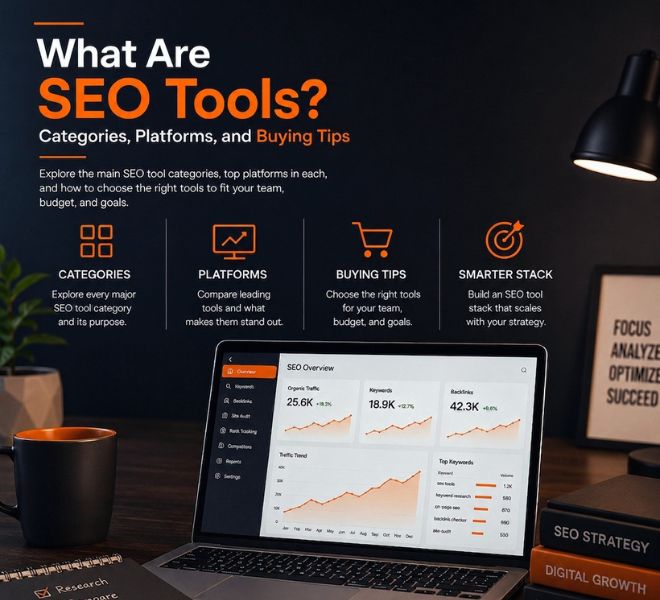
Search engines evaluate hundreds of signals when deciding which pages deserve a top position. These include:
- Page speed
- Content depth
- Backlink quality
- Mobile usability
- Internal linking
- Topical relevance
These factors cannot always be assessed accurately through manual review alone. A technical crawler can flag issues that a human reviewer might miss entirely, such as a broken canonical tag buried three levels deep in a site's architecture.
Search behavior has also expanded well beyond the traditional results page. AI-powered assistants and generative search experiences now summarize answers directly, pulling from sources they judge to be authoritative, well-structured, and topically complete. Search behavior has also expanded well beyond the traditional results page. AI powered assistants and generative search experiences now summarize answers directly. They pull from sources they judge to be authoritative, well structured, and topically complete. Tools built for this new layer of search are often grouped under generative engine optimization, known as GEO, or answer engine optimization, known as AEO. These tools track whether a brand is being cited or quoted inside AI generated answers, not just whether a page ranks on a traditional results page. A business that only measures classic rankings is missing a growing share of how people actually find information today. Beyond visibility, SEO tools give teams a shared source of truth. When a content writer, a developer, and a marketing manager all pull data from the same platform, disagreements about what is actually happening on a website become far easier to resolve. This shared visibility is part of what search engines reward under their E E A T framework. A site that consistently fixes real issues and publishes content grounded in verified data tends to build the kind of trust signals that both users and algorithms respond to over time.
The Main Categories of SEO Tools
SEO tools generally fall into distinct categories based on the stage of the search optimization process they support. Most SEO programs end up using a combination of tools from several categories rather than relying on a single platform.
Keyword Research Tools
Keyword research tools reveal what people are actually typing into search engines, how often they search for it, and how difficult it would be to rank for that phrase. These platforms typically show monthly search volume, competition level, related keyword suggestions, and questions people ask around a topic. Some also break keywords down by search intent, distinguishing between someone who wants information, someone comparing options, and someone ready to buy. Widely used keyword research tools include:
Google Keyword Planner
A free tool built into Google Ads that shows search volume ranges and keyword suggestions pulled directly from Google's own data, making it a reliable starting point even though its volume figures are less precise for accounts not running active campaigns.
Semrush
An all in one platform that combines keyword research with competitor keyword gap analysis, letting a business see which terms a rival ranks for that it does not, alongside detailed intent and difficulty scoring.
Ahrefs
Known for one of the largest keyword databases available, Ahrefs pairs keyword data with click through rate estimates and parent topic suggestions that help group related keywords under a single target page.
Ubersuggest
A budget friendly option that provides core keyword metrics, content ideas, and basic competitor insights, making it a practical choice for small businesses or solo marketers just beginning keyword research.
Moz Keyword Explorer
Offers a priority score that blends volume, difficulty, and expected click through rate into a single number, which helps teams quickly rank a long keyword list by likely payoff.
Answer The Public
Visualizes the actual questions, comparisons, and prepositions people search around a seed keyword, making it especially useful for uncovering the exact phrasing an FAQ section or content brief should address.
On Page SEO Tools
On page SEO tools analyze the elements within a webpage that influence how well it can rank, including title tags, meta descriptions, header structure, keyword placement, internal links, and readability. Many of these tools generate a checklist or a score as content is written, flagging missing elements before a page ever goes live. These tools matter because on page signals are among the few ranking factors a business has complete control over. A site cannot instantly build the same domain authority as a decade old competitor, but it can absolutely ensure every page has a clear title, a logical heading structure, and content that fully answers the query it targets. Common on page SEO tools include:
Yoast SEO
A widely used WordPress plugin that checks a page's title tag, meta description, keyword usage, and readability in real time as content is written, giving writers immediate green, yellow, or red feedback before a page is published.
Rank Math
Another popular WordPress plugin that covers similar on page checks to Yoast while adding built in schema markup options and a broader free feature set, which has made it a common alternative for teams wanting more configuration without extra cost.
Surfer SEO
Analyzes the top ranking pages for a target keyword and generates a content editor that scores a draft against those pages on factors like word count, keyword usage, and structure, making it useful for teams that want data backed guidance while writing rather than just after publishing.
On page checking features in Semrush and Ahrefs
Both platforms include on page audit modules within their broader SEO suites, scanning individual pages for missing tags, thin content, and optimization opportunities, which is convenient for teams that would rather manage on page checks inside the same tool they already use for keyword research and rank tracking.
Technical SEO and Site Audit Tools
Technical SEO tools crawl a website the way a search engine bot would, identifying issues such as broken links, duplicate content, slow loading pages, missing alt text, incorrect redirects, and crawl budget waste. Because these problems often exist deep within a site's code and structure, they are nearly impossible to catch through casual browsing. A site audit tool typically produces a prioritized list of issues, often sorted by how much they are likely to affect rankings. Fixing critical technical issues, such as pages accidentally blocked from indexing or a missing XML sitemap, can sometimes produce faster ranking gains than months of new content production, simply because it removes barriers that were preventing existing content from being found and understood by search engines in the first place. Popular technical SEO and site audit tools include:
Screaming Frog
A desktop based crawler that scans a website the way a search engine bot would, surfacing broken links, duplicate content, redirect chains, and missing tags in a single detailed spreadsheet, which makes it a favorite for hands-on technical audits.
Google Search Console
A free tool provided directly by Google that shows exactly how the search engine sees a site, including indexing status, crawl errors, core web vitals performance, and the actual queries a site already ranks for, making it an essential baseline before using any paid audit platform.
Sitebulb
A crawler similar to Screaming Frog but built around visual reports and prioritized recommendations, which makes technical findings easier to explain to non technical stakeholders without losing the underlying detail.
Semrush Site Audit
Runs scheduled crawls of a site and assigns an overall health score, grouping issues by severity so a team can tackle the highest impact fixes first without digging through raw crawl data manually.
Ahrefs Site Audit
Offers similar scheduled crawling and issue prioritization to Semrush, with the added benefit of sitting inside the same platform many teams already use for backlink and keyword data, keeping technical findings connected to the rest of their SEO metrics.
Backlink and Off Page SEO Tools
Backlink tools track which websites link to a given domain, how authoritative those linking sites are, and how a site's backlink profile compares to others targeting the same keywords. These platforms also help identify toxic or spammy links that could be dragging down a site's trustworthiness, along with opportunities for new, high quality links. Off page signals remain one of the strongest trust indicators search engines use, since a link from a respected industry publication functions similarly to a professional reference. Backlink tools make it possible to monitor this trust building process over time rather than relying on vague impressions of a brand's online reputation. Leading backlink and off page SEO tools include:
Ahrefs
Built around one of the largest and most frequently updated backlink indexes available, Ahrefs shows a site's full link profile alongside a domain rating score, making it a common choice for both auditing existing links and researching where competitors earn theirs.
Majestic
Uses two distinct metrics, Trust Flow and Citation Flow, to separate the quality of linking sites from the sheer quantity of links, which helps distinguish a small number of genuinely authoritative links from a large volume of low value ones.
Semrush Backlink Analytics
Pairs backlink data with the rest of the Semrush platform, allowing a team to review link profiles alongside keyword rankings and site audit findings in one place, along with a toxicity score that flags links worth investigating further.
Moz Link Explorer
Introduced Domain Authority, one of the earliest and still widely referenced metrics for estimating a site's overall link strength, and continues to offer link intersect and spam score features that help identify both opportunities and risks in a backlink profile.
Rank Tracking Tools
Rank tracking tools monitor where a website's pages appear in search results for a defined list of keywords, updating positions daily, weekly, or on demand. Many also track rankings across different devices, locations, and search engines, since results can vary significantly between a mobile search in one city and a desktop search in another. This category provides the clearest evidence of whether SEO work is actually producing results. A ranking increase from position fifteen to position four for a commercially valuable keyword is a concrete, measurable outcome that ties directly back to specific optimization decisions, making it one of the easiest SEO metrics to report to stakeholders. Well known rank tracking tools include:
Semrush Position Tracking
Tracks daily ranking movement for a defined keyword list and ties those positions back to the rest of the Semrush platform, making it easy to see whether a ranking change lines up with a recent content update or technical fix logged elsewhere in the same account.
Ahrefs Rank Tracker
Monitors rankings across multiple search engines, locations, and devices, and pairs each keyword with visibility and traffic estimates, giving a fuller picture of impact than a raw position number on its own.
AccuRanker
Built specifically for speed and scale, AccuRanker updates rankings quickly and handles very large keyword lists well, which makes it a common choice for agencies or enterprise sites tracking tens of thousands of terms at once.
Nightwatch
Focuses on flexible, shareable reporting alongside standard rank tracking, with features geared toward local pack tracking and white label client reports, making it a practical fit for agencies managing rankings across several client accounts.
Content Optimization Tools
Content optimization tools analyze top ranking pages for a target keyword and compare them against a draft, suggesting related terms, ideal content length, and structural elements the draft may be missing. Some also assess readability, tone consistency, and whether a piece of content demonstrates the kind of depth and originality that supports information gain, meaning it adds something genuinely new rather than repeating what already exists elsewhere online. These tools are especially useful for teams producing content at scale, since they help maintain consistency across many writers while still leaving room for original insight, examples, and expertise that a purely mechanical scoring system cannot generate on its own. They are also useful for identifying older pages that have started to slip in rankings, since a page that once performed well can lose ground as competitors publish newer, more complete content around the same keyword. For a closer look at fixing pages like that, see this guide on how to refresh old content for better SEO rankings. Commonly used content optimization tools include:
Surfer SEO
Generates a content score by comparing a draft against top ranking pages for a target keyword, recommending word count ranges, related terms, and structural elements, and doubles as an on page checker once the piece is live.
Clearscope
Focuses on natural language processing to surface the terms and concepts top ranking content tends to include, presenting them through a clean, writer friendly interface that fits well into editorial workflows with multiple contributors.
MarketMuse
Goes beyond single page optimization to model an entire topic cluster, identifying content gaps across a whole site and suggesting which new pages or updates would do the most to establish topical authority around a subject.
Frase
Combines content briefs, competitor content analysis, and an AI assisted writing feature in one workflow, which makes it useful for teams that want research, outlining, and drafting support within a single tool rather than switching between several.
Local SEO Tools
Local SEO tools manage business listings, monitor local search rankings, and track customer reviews across platforms like Google Business Profile. For businesses that depend on nearby customers finding them, such as service providers or physical retail locations, this category directly influences whether a business appears in local map results and how trustworthy it looks once found. These platforms often include citation management features, ensuring a business name, address, and phone number stay consistent across dozens of directories, since inconsistent listings can quietly undermine local ranking performance even when everything else about a site is well optimized. Businesses managing more than one location face an added layer of complexity here, since each location needs its own listing, its own set of local rankings, and its own consistent citation profile. For a closer look at how to structure that work, see this guide to local SEO for multiple locations. Popular local SEO tools include:
Google Business Profile
The free listing that controls how a business appears in Google Maps and the local pack, including hours, photos, reviews, and posts, making it the single most important local SEO asset a business manages since it directly shapes what nearby searchers see first.
BrightLocal
Built specifically for local search, BrightLocal tracks local pack rankings, audits and manages citations across directories, and monitors reviews across multiple platforms, making it a common core tool for agencies running local SEO for several clients at once.
Moz Local
Focuses on keeping business listings accurate and consistent across a wide network of directories, automatically pushing updates when a business changes its address, phone number, or hours so the information does not drift out of sync across the web.
Yext
Offers a broader listing management network with real time syncing across a large number of directories, apps, and voice assistants, which suits larger or multi location businesses that need centralized control over how every location appears everywhere at once.
Analytics and Reporting Tools
Analytics tools track how visitors behave once they reach a website, including which pages they visit, how long they stay, and whether they complete a desired action such as filling out a form or making a purchase. Reporting tools then compile data from multiple sources into dashboards that make performance trends easy to communicate to a broader team. Search visibility only matters if it eventually leads to real business outcomes, so pairing ranking data with behavioral and conversion data closes the loop between traffic and actual revenue or leads. Widely used analytics and reporting tools include:
Google Analytics
The standard free platform for tracking website behavior, including traffic sources, page level engagement, and conversion events, giving businesses the core data needed to connect search visibility to actual visitor actions on the site.
Google Search Console
Shows the queries a site actually ranks for, along with click through rates, impressions, and average position, making it the most direct free source of real search performance data straight from Google itself.
Looker Studio
A free reporting tool that connects to Google Analytics, Search Console, and many other data sources to build customizable, shareable dashboards, which helps teams turn raw numbers into visuals that are easy for stakeholders to review at a glance.
Databox
Pulls data from multiple marketing platforms into a single dashboard with automated goal tracking and scheduled reports, making it a practical option for teams that want ongoing performance snapshots delivered without manually assembling a report each time.
AI Search Visibility Tools
A newer category of tools has emerged specifically to measure how a brand performs inside AI generated answers, tracking whether a business is mentioned, cited, or recommended by AI assistants when users ask relevant questions. These platforms often analyze whether a site's content is structured in a way that AI systems can easily extract and summarize, and some evaluate a site's llms.txt file, a relatively new standard that helps AI crawlers understand which content on a site is meant to be referenced. As more search behavior shifts toward conversational and AI generated answers, this category is likely to become as standard as traditional rank tracking, since visibility inside an AI summary can influence a buying decision just as strongly as a high ranking on a traditional results page. Emerging AI search visibility tools include:
Profound
Tracks how a brand appears across AI assistants such as ChatGPT and other large language model powered search experiences, showing which prompts trigger a mention and how a brand's presence compares against competitors inside those generated answers.
Peec AI
Monitors brand visibility across multiple AI search engines and assistants, reporting on citation frequency and sentiment within AI generated responses, which helps a business understand not just whether it is mentioned but how favorably.
Semrush AI Toolkit
Extends the familiar Semrush platform into the AI search space, letting teams track AI generated answer visibility alongside the traditional keyword and ranking data they already monitor, keeping both forms of search performance in one place.
Otterly AI
Focuses specifically on tracking brand mentions inside AI chatbot responses over time, giving businesses a trend view of how consistently they are cited as search behavior shifts further toward conversational, AI generated answers.
How to Choose the Right SEO Tools
Choosing SEO tools should start with a clear picture of the biggest gaps in a current strategy rather than a desire to own every tool on the market. The right stack usually comes down to four factors.
Start with the biggest gap, not the longest feature list
A business unsure of what its audience searches for benefits most from strong keyword research capability. A business with years of content but stagnant rankings likely needs a technical audit first. Buying a platform because it covers everything is rarely the right move. Only one part of the strategy is usually holding results back.
Match the tool to team size and budget
A small business managing SEO alongside other marketing tasks generally needs an all in one platform. Consolidating several categories into a single dashboard keeps cost and complexity low. A larger team with dedicated specialists may prefer best in class tools for each individual function instead. That means accepting the added complexity of managing multiple subscriptions, in exchange for deeper capability in each area.
Check how the data is sourced and refreshed
Search volume estimates and ranking positions can vary meaningfully between platforms. A business making significant budget decisions based on this data should understand how a given tool sources and refreshes its numbers. Only then should those figures be treated as reliable.
Weigh ease of use as heavily as raw capability
A powerful tool that nobody on the team actually opens delivers zero value. A simpler tool that gets checked every week will outperform it every time, as long as it consistently informs decisions. Ease of use deserves more weight in the buying decision than most teams give it.
Free vs Paid SEO Tools
Free SEO tools, including options provided directly by search engines, offer genuinely useful data such as indexing status, core web vitals performance, and basic keyword suggestions. These are often sufficient for a small site early in its SEO journey or for spot checking specific issues without a full platform subscription. Paid tools generally provide larger keyword databases, more frequent data updates, competitor comparison features, and the ability to track a much larger volume of keywords and pages at once. For a business investing seriously in organic search as a growth channel, the depth and reliability paid tools provide typically justifies the cost, since the insights they surface can directly influence decisions worth far more than the subscription fee itself. Most mature SEO programs end up using a mix, relying on free tools for foundational technical monitoring while investing in one or two paid platforms for the deeper research and tracking work that free tools cannot match.
Common Mistakes Businesses Make With SEO Tools
Owning good tools does not automatically produce good results. The way a team uses them, and how much it trusts them, usually matters more than which tools it bought.
Tool sprawl
Many businesses end up paying for several tools that do the same job, with nobody quite sure which one is supposed to be used for what. This usually happens slowly. A new hire brings in a tool they used at their last job, a campaign needs a quick trial subscription, and neither ever gets cancelled. The result is wasted budget and conflicting numbers, since two platforms rarely report the exact same keyword volume or ranking position. The fix is simple. Once a quarter, list every SEO subscription, write down what it is actually used for, and assign one person to own it. Anything nobody can explain a clear use for gets cancelled.
Blind reliance on scores
Tools like content graders and audit checklists are built from patterns found across thousands of other websites. They are useful, but they do not know a specific business, its customers, or what makes its expertise different from a competitor's. The mistake is treating a high score as the goal itself. A writer chasing a perfect score can end up producing content that checks every box but says nothing original. That happens because the scoring tool rewards matching what already ranks, not adding something new. A better approach is to write with real expertise first. Run the score as a final check afterward, filling in anything genuinely missing rather than rewriting the piece to fit the tool.
Ignored technical debt
Publishing new content feels productive, so it is easy to keep writing while skipping the technical fixes an audit tool keeps flagging. The problem is that issues like slow page speed or broken internal links quietly cap how well every page on the site can perform, new or old. A business can publish excellent content for months and still see flat results if the site underneath it is holding everything back. The fix is a standing habit rather than a one time cleanup. Every quarter, clear the highest severity issues on the audit report before adding more content on top of the same foundation.
Frequently Asked Questions
Do small businesses actually need SEO tools, or is free data enough?
Small businesses can start with free tools for basic monitoring, but as competition for target keywords increases, paid tools become valuable for uncovering opportunities that free platforms simply do not surface, such as detailed competitor keyword gaps and more accurate search volume data.
How many SEO tools does a business realistically need?
Most businesses do well with a core stack covering keyword research, technical auditing, rank tracking, and analytics, often through a combination of two or three platforms rather than a separate tool for every single task.
What is the difference between an SEO tool and an analytics platform?
SEO tools generally focus on the factors that influence search visibility itself, such as keywords, backlinks, and technical health, while analytics platforms focus on what happens after a visitor arrives on a site, tracking behavior, engagement, and conversions.
How often should a business run a technical SEO audit?
A full technical audit every quarter is a reasonable baseline for most active websites, with lighter automated monitoring running continuously in between to catch urgent issues, such as a site going offline or a critical page accidentally being blocked from indexing, as soon as they occur.
Are AI search visibility tools worth adopting yet?
For businesses in competitive industries where buyers increasingly rely on AI assistants for research, adopting an AI search visibility tool early provides a meaningful head start, since understanding how a brand currently appears, or fails to appear, in AI generated answers is the first step toward improving that visibility deliberately.
Should every team member have access to the same SEO tools?
Access should generally match each role's responsibilities, with content writers needing keyword and content optimization tools, developers needing technical audit access, and managers needing reporting dashboards that summarize results across the full stack without requiring deep platform expertise.
Turn SEO Data Into Measurable Growth With Kaizen Global
Picking the right tools is only half the work. Turning that data into rankings, traffic, and revenue takes a team that knows how to read it and act on it. Kaizen Global's SEO Services start by identifying which tools and metrics actually matter for your business, then put that data to work fixing what is holding your site back and building on what is already performing. If your current tools are producing reports nobody has time to act on, book a call with our team and we will show you what a focused SEO strategy could look like for your business.
Turn SEO Data Into Measurable Growth With Kaizen Global
Insights

Mobile Seo Checklist - A Complete Guide
Mobile SEO refers to optimizing your website to ensure it performs well on mobile devices, offering a seamless user experience ...
25-Step SEO Migration Checklist
Migrating your website can feel like a daring task filled with potential challenges. No matter if you're redesigning your site ...
Local SEO Checklist: Maximize Your Local Reach
Local search engine optimization (SEO) has become essential for businesses aiming to connect with their community and attract nearby ...