AI Visibility Audit: How to Check If Your Brand Appears in ChatGPT, Gemini, and AI Overviews
Updated : July 6, 2026
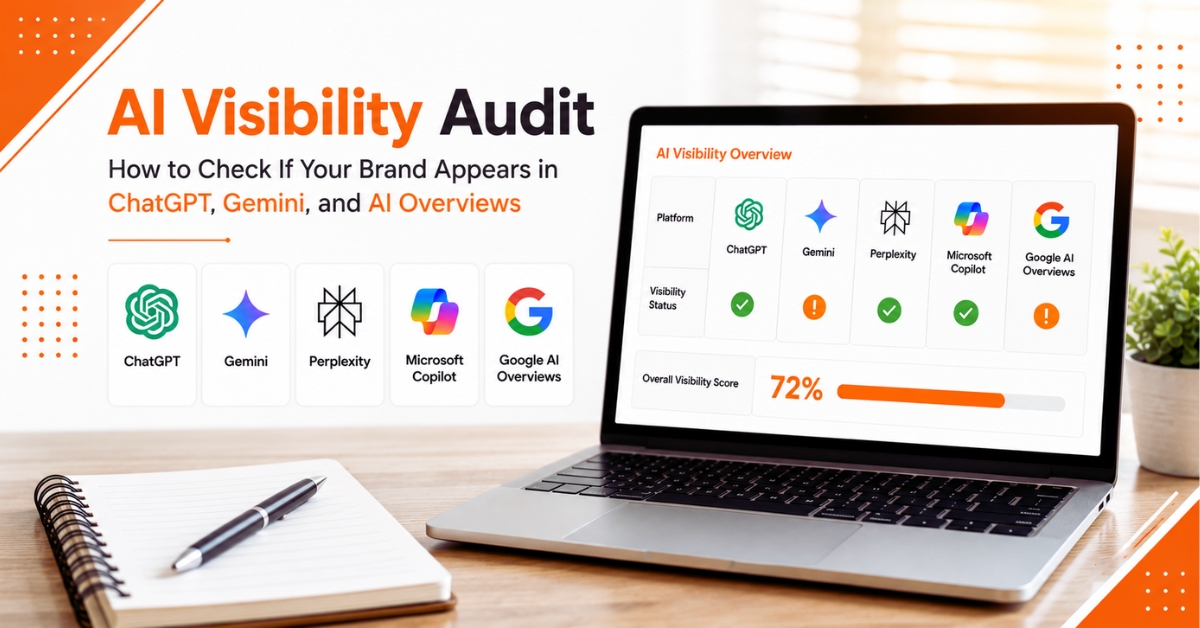
An AI visibility audit is the process of checking whether, how, and how favorably your brand appears across AI powered answer engines like ChatGPT, Gemini, Perplexity, and Google's AI Overviews. To check yours , build a list of real customer questions (not just your brand name), run them across each platform, and log whether you're mentioned, how you're positioned, and which sources get cited.
Here, we'll cover:
- Why AI visibility matters
- How these systems decide what to mention
- A step by step process for auditing your brand's AI visibility
No expensive tools are required to get started.
Why AI Visibility Is the Next Big Shift in Search
The Search Environment Has Changed
Search engines used to work like link directories. You typed a query. The engine handed you a ranked list of websites to click through.
Today, AI powered answer engines increasingly write an answer directly, often without requiring a click at all. Google's AI Overviews sit at the top of search results and summarize information from multiple sources. ChatGPT, Gemini, Claude, and Perplexity go a step further. They hold entire conversations and make specific recommendations, including product suggestions, service providers, and brand comparisons, based on training data, web search, and real time retrieval.
This means a new kind of "zero click" discovery has emerged. Imagine a potential customer asks, "What's the best project management software for a 10 person marketing team?" They might get a direct answer naming three tools. They never visit a search results page or a comparison blog at all. If your brand isn't one of the three tools mentioned, you've lost that customer before you even knew they were looking.
Traditional SEO Metrics Don't Capture This
You can rank well in Google's organic results and still be completely absent from AI generated answers. These systems don't all work like traditional ranking algorithms. Some pull from live web search. Some rely heavily on pre-trained knowledge. Some blend both. Visibility in one doesn't guarantee visibility in another.
This is why AI visibility deserves its own measurement, not a spot buried inside your regular SEO report. Some people call this discipline Generative Engine Optimization (GEO). Others call it AI Search Optimization (AISO) or Answer Engine Optimization (AEO). The name matters less than the practice.
How AI Engines Decide What to Mention
Before auditing your visibility, it helps to understand, at a high level, how different platforms generate their answers. This affects what you should look for and how you can improve your standing.
ChatGPT can operate in two modes. It can answer purely from its trained knowledge, or it can use live web search when browsing is enabled or the query clearly needs current information. When it browses, it tends to draw on a mix of authoritative sites, review platforms, and frequently cited sources. When it answers from memory, it reflects patterns baked into its training data. Brand mentions in widely distributed, well indexed content (news coverage, Wikipedia, major publications, popular review sites) tend to carry extra weight.
Google's AI Overviews are generated from Google's search index. They lean heavily on pages that already perform well in traditional organic search, along with structured data and content that directly answers common questions. Because AI Overviews sit on top of Google Search as a summarization layer, strong SEO fundamentals still matter here. Think clear headings, direct answers near the top of a page, and schema markup.
AI Overviews in particular have become one of the biggest disruptors of traditional rankings. We break down exactly how they work, and how to get featured in them, in How Google AI Overviews Are Reshaping SEO in 2026.
Gemini, both as a standalone assistant and inside Google products, also draws on Google's index and knowledge graph, with its own weighting for authority, freshness, and structured content.
Perplexity is searched first by design. It cites sources directly and favors content that is well structured, recently updated, and easy to pull clear facts from.
Across all these platforms, a few common threads show up. Being mentioned often and consistently across the web, in a variety of independent sources, correlates strongly with being surfaced. These systems are, in effect, aggregating a kind of consensus about what's relevant and trustworthy. Third party validation such as press coverage, review sites, forums like Reddit, and comparison articles carries real weight.
Step by Step: How to Audit Your Brand's AI Visibility
Here's a practical framework you can start using today. It doesn't require specialized software, though we'll mention where tools can help you scale the process later.
Step 1: Build a Query Bank
Start by listing the actual questions your potential customers are likely to ask an AI assistant. Don't just think about your brand name. Think about the problems your product or service solves.
Organize your queries into a few categories:
- Category or solution queries. "What's the best CRM for a small business?" "What tools help with email marketing automation?"
- Comparison queries. "Your Brand vs Competitor" or "alternatives to Competitor"
- Direct brand queries. "What is Your Brand?" "Is Your Brand Good?" "Your Brand reviews"
- Use case queries. "What software do freelance designers use to invoice clients?"
- Local or service queries (if applicable). "Best accounting firm in your city"
Aim for at least 15 to 25 queries that reflect how a real prospect, at different stages of awareness, might phrase a question relevant to your business.
Step 2: Run the Queries Across Platforms
Manually test your query bank across the major platforms:
- ChatGPT, with and without web browsing enabled, since answers can differ
- Google Gemini
- Google Search, checking specifically whether an AI Overview appears and what it includes
- Perplexity
- Microsoft Copilot
For each query on each platform, record:
- Is your brand mentioned at all? Yes or no.
- Where in the response does it appear? First mentioned, buried in a list, or absent?
- What's the sentiment or framing? Positive, neutral, or with caveats?
- What sources are cited? If the platform shows citations, note which websites are being pulled from.
- Which competitors are mentioned, and how are they positioned relative to you?
A simple spreadsheet works well here, with rows for each query and columns for each platform.
Step 3: Identify the Sources That Are Actually Being Cited
This is arguably the most useful part of the audit. When a platform cites its sources, as ChatGPT with browsing, Perplexity, and AI Overviews often do, you get a direct window into what content is shaping the answer. Look for patterns.
- Are the same three or four websites showing up again and again? Those are the sources you need to be present on, or emulate the structure of.
- Are review platforms like G2, Capterra, Trustpilot, or Yelp driving the answer? If so, your review profile and star ratings on those platforms matter enormously.
- Is Reddit or a forum showing up? AI systems often pull from Reddit threads, treating them as a proxy for authentic, crowd sourced opinion.
- Is Wikipedia present? If your brand has, or could reasonably have, a Wikipedia entry, that's often a heavily weighted source, particularly for ChatGPT's non browsing responses.
Step 4: Check for Accuracy and Hallucination Risk
While running your queries, pay close attention to whether the AI describes your brand accurately. It's common to find outdated pricing, discontinued features, incorrect founding dates, or even confusion between your brand and a similarly named competitor.
Document any inaccuracies you find. These represent both a risk, since misinformation could reach your prospects, and an opportunity. A clear, well optimized source of truth about your brand could correct the record over time.
Step 5: Benchmark Against Competitors
Run the same query bank, but focus specifically on how your top three competitors appear. This tells you whether the issue is that AI engines don't know your category well, or whether it's specifically your brand that's underrepresented compared to similar competitors.
If a much smaller competitor consistently outranks you in AI answers, that's a strong signal. They're doing something right in the source ecosystem, such as a heavier PR presence, more reviews, or stronger comparison content.
Step 6: Score and Prioritize
Once you've gathered this data, create a simple visibility score. For example:
- 0 points. Brand not mentioned at all.
- 1 point. Mentioned but buried or framed neutrally or negatively.
- 2 points. Mentioned prominently with positive or neutral framing.
- 3 points. Mentioned first or recommended as a top choice.
Add up scores across your query bank and platforms to get a baseline. This becomes your benchmark for tracking improvement over time.
What to Do With the Results
An audit only helps if it leads to action. Based on common findings, here are the highest leverage improvements most brands can make.
1. Strengthen Third Party Presence
Since AI engines heavily weigh independent sources, focus energy on getting mentioned in comparison articles, "best of" roundups, and industry publications relevant to your space. Digital PR and earned media matter more in an AI search world than they have in years.
This kind of third party validation is part of a larger pattern: brand signals now play a growing role in how both traditional search and AI systems evaluate trust. We cover this in more detail in Brand SEO in 2026: Why Brand Signals Matter More Than Ever.
2. Actively Manage Reviews
Encourage satisfied customers to leave reviews on platforms like G2, Capterra, Trustpilot, or industry specific review sites. A higher volume of recent, detailed, positive reviews doesn't just help human buyers. It directly feeds the data these AI systems draw from.
3. Publish Clear, Extractable Content
Structure your own website content so it's easy for AI systems to lift accurate, direct answers. Use clear headers, concise definitional statements early in a page (for example, "Product is a category that helps audience do outcome"), FAQ sections, and structured data markup through schema.org. Avoid burying your core value proposition in marketing fluff.
4. Build or Improve a Wikipedia Presence
If your brand meets Wikipedia's notability guidelines, a well maintained, neutral entry can meaningfully shape how models describe you. Wikipedia is heavily represented in most models' training data.
5. Participate Authentically in Community Discussions
Given the weight platforms like Reddit and niche forums carry, genuine, non spammy participation in relevant communities, through customers, employees, or brand representatives, can influence how your brand is discussed in the sources these AI tools draw from.
6. Monitor and Correct Inaccuracies
Where you find factual errors in AI generated descriptions of your brand, publish clear, authoritative, up to date information on your site, in press materials, and in your own knowledge base. Over time, this can help correct the record as models and retrieval systems refresh their sources.
7. Re Audit Regularly
AI models and their retrieval systems update frequently, sometimes weekly, sometimes with major model version changes. What's true about your visibility today may shift within a few months. Treat this as an ongoing practice, not a one time project. Many teams run a lighter version of this audit monthly, with a deeper competitive benchmark quarterly.
Common Mistakes to Avoid
Even a well planned AI visibility audit can produce misleading results if you overlook these common pitfalls.
Testing only branded queries.
Questions like "What is Your Brand?" or "Is Your Brand good?" only show how AI describes your brand when users already know it. What matters more is whether your brand appears when people ask broader questions, such as "What's the best tool for X?" If your brand isn't mentioned, you're missing potential customers before they even discover you. Build most of your test queries around customer problems and product categories, not your brand name.
Testing once and assuming it's static.
AI answers can vary between sessions, model versions, and even due to randomness in generation. Test each query multiple times, and re-audit periodically.
Ignoring the citation sources.
Don't ignore the sources AI cites. They reveal where the AI is getting its information and which websites are shaping your brand's visibility. If the same review sites, comparison platforms, or industry blogs appear repeatedly, focus your PR, outreach, and content efforts there. Think of the citation list as an action plan, not just a reference.
Focusing only on ChatGPT.
ChatGPT tends to get the most attention because it's the most widely used consumer AI tool, but it's far from the only one shaping how your brand gets discovered. Gemini, Perplexity, Microsoft Copilot, and Google's AI Overviews each pull from different indexes, weight sources differently, and can surface entirely different brands for the same query. A strong showing on one platform can mask a near total absence on another. Auditing across all of them is the only way to get an accurate, complete picture.
Treating this as purely a marketing task.
It's easy to hand an AI visibility audit to the content or SEO team and consider the job done. However, AI doesn't rely only on your marketing content when generating answers. Product information, pricing clarity, customer support quality, user reviews, and general public sentiment all feed into how AI systems describe you.
Poor customer support, outdated pricing information, and negative public reviews can hurt your AI visibility just as much as weak content. Improving AI visibility isn't just a marketing job. It requires collaboration between your product, customer support, PR, and marketing teams.
Assuming a good score means the work is done.
AI visibility isn't a one time fix. Models retrain, indexes refresh, and competitors keep working to improve their own standing. A strong result today can quietly erode within months if nobody's watching. Track AI visibility on a recurring cadence, just like organic rankings or paid search.
Copying keywords straight from your SEO strategy.
Traditional SEO keywords are usually short, such as "best CRM software." However, people interacting with AI search tools often ask longer, more conversational questions, such as "What CRM should a 10 person sales team switch to after outgrowing a spreadsheet?" If you only test short SEO keywords, your results won't reflect how real users search and may give you an overly optimistic view of your AI visibility.
Not distinguishing between browsing and non browsing responses.
Tools like ChatGPT can answer from trained knowledge alone or from live web search, and the two can produce very different results for the same brand. Test both modes separately, since strong performance in one doesn't guarantee the other.
Letting internal bias creep into scoring.
It's easy to judge your own brand more positively than you would someone else's. That's why you should create clear criteria before you begin. Define what counts as a positive, neutral, or negative mention so everyone evaluates responses the same way. Review a few results regularly to make sure your scoring stays consistent.
Skipping the "why" behind a poor result.
Don't just record when your brand isn't mentioned and move on. Find out why. Was your website missing important information? Did a competitor provide a better answer? Or did the AI rely on stronger third party sources? Treat every missed mention as an opportunity to improve your visibility, not just another result to track.
Ignoring emerging and niche platforms.
It's easy to focus only on the best known tools, but AI search is expanding into browsers, shopping assistants, and industry specific tools that can matter a lot to your audience. Periodically scan for new, relevant platforms and add them to your rotation.
Build a Stronger AI Search Presence with Kaizen Global
AI visibility audits are quickly becoming as fundamental to a modern marketing strategy as traditional SEO audits have been for the past twenty years. The core idea is simple. If you don't know whether, and how, your brand shows up in ChatGPT, Gemini, Perplexity, and AI Overviews, you can't manage or improve it.
Build a solid query bank. Test systematically across platforms. Track the sources these systems cite. Benchmark against competitors. Do this, and you can move from guessing to a data informed strategy for AI era discoverability.
The brands that start treating AI visibility as seriously as they've treated search rankings will have a real head start. More and more potential customers will meet their first impression of a category not through a search results page, but through a conversation with an AI.
At Kaizen Global, our Digital Marketing Services help businesses prepare for the future of search through AI ready SEO strategies, Answer Engine Optimization (AEO), technical SEO, structured data implementation, and authoritative content that improves visibility across both search engines and AI platforms.
Want to know how your brand performs in AI search? Contact Kaizen Global for an AI visibility assessment and discover practical opportunities to strengthen your presence across the next generation of search.
Improve Your Brand Visibility Across AI Search with Kaizen Global
Insights

Mobile Seo Checklist - A Complete Guide
Mobile SEO refers to optimizing your website to ensure it performs well on mobile devices, offering a seamless user experience ...
25-Step SEO Migration Checklist
Migrating your website can feel like a daring task filled with potential challenges. No matter if you're redesigning your site ...
Local SEO Checklist: Maximize Your Local Reach
Local search engine optimization (SEO) has become essential for businesses aiming to connect with their community and attract nearby ...