LLMs.txt for SEO: Do Websites Really Need It in 2026?
Updated : July 6, 2026
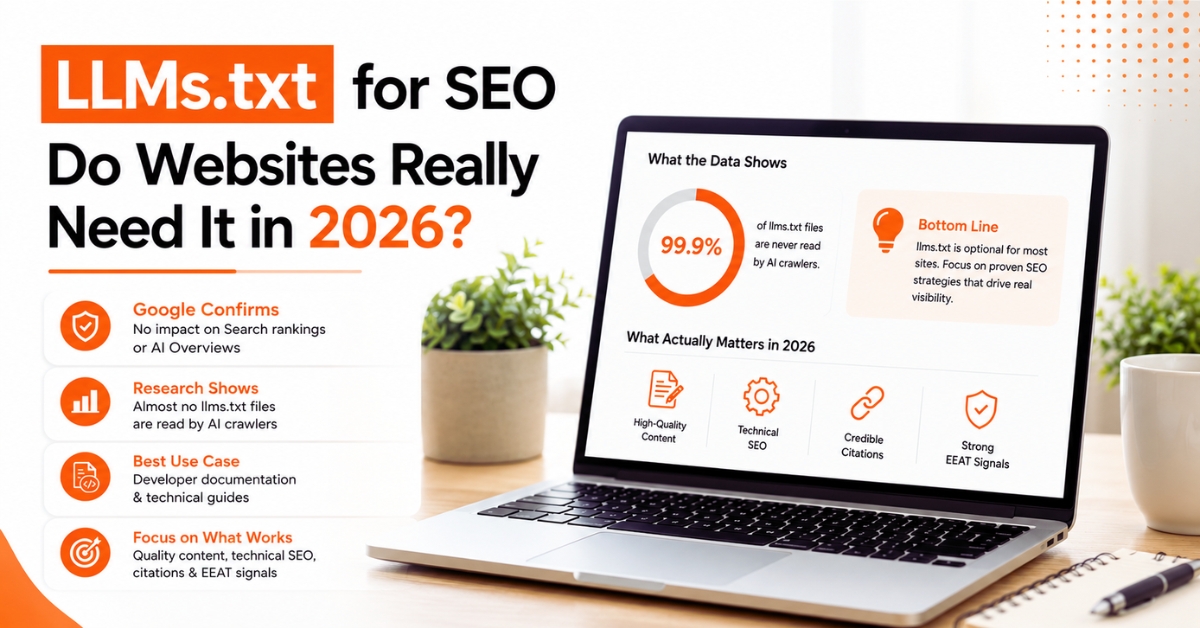
No, most websites do not need an llms.txt file in 2026. Google has confirmed in its official documentation that the file has no impact on Search rankings or AI Overviews. Independent research on tens of thousands of domains found that almost none of the files are ever read by AI crawlers. The only setting where llms.txt has a clear, practical use is developer documentation, where AI coding assistants benefit from a short, curated map of technical pages.
That said, adding the file is low effort and carries little risk, so it is not something to actively avoid either. The real priority for AI visibility in 2026 is the same as it has always been for SEO: clear, well structured content, strong technical foundations, credible third party citations, and genuine EEAT signals.
This guide breaks down exactly what llms.txt is, what the data actually shows, where it fits (and does not fit) into a modern SEO strategy, and what to focus on instead.
What Is llms.txt?
Llms.txt is a proposed website file meant to help large language models understand a site's content more efficiently. It was introduced by developer Jeremy Howard in September 2024 as an informal proposal, not an official web standard.
The idea is simple. A site places a markdown file called llms.txt at its root, similar to how robots.txt or sitemap.xml sit at a domain's root. This file lists the site's most important pages, often with short descriptions, and can link out to further markdown versions of individual pages. The goal was to give AI systems a clean, distraction-free summary of a site's content instead of forcing them to parse full HTML pages full of navigation menus, ads, and scripts.
On paper, this sounds useful. In practice, adoption and impact have looked very different from what many marketers expected back in 2024.
How Is llms.txt Different From Robots.txt and Sitemap.xml?
This is where a lot of confusion starts, so it's important to understand the difference.
Robots.txt is an official, decades old standard respected by every major search engine and most reputable crawlers. It tells bots which parts of a site they are allowed or not allowed to access. It is enforceable in the sense that well behaved crawlers check it before requesting a page.
Sitemap.xml is also a long established standard. It gives search engines a structured list of a site's URLs, helping with discovery and crawl efficiency.
Llms.txt is neither of these things. It has no formal governing body, no required compliance from crawlers, and no confirmed adoption by any major AI company for search or indexing purposes. It does not control access the way robots.txt does. It simply offers a curated list of pages that a site owner would like an AI system to prioritize, if that system happens to look for the file at all.
That last part matters most. Robots.txt works because crawlers are built to check for it. Llms.txt only works if a crawler is specifically built to look for it, and right now, almost none are.
What Google Actually Says About llms.txt in 2026
For most of 2025, the SEO industry treated llms.txt as an open question. That changed in May 2026, when Google published its first official generative AI optimization guide, part of a new Generative AI fundamentals section inside Search Central.
The guide states plainly that site owners do not need to create special machine readable files to appear in Google Search or AI Overviews.
A month later, in June 2026, Google added a dedicated section specifically addressing llms.txt, after growing confusion in the SEO community made it clear the topic needed direct clarification. The update confirms:
- llms.txt has never been used as a Search ranking input.
- It continues to have zero effect, positive or negative, on visibility in Google Search or AI Overviews.
Google's John Mueller has also weighed in directly. When asked why some of Google's own developer properties still carry an llms.txt file, he explained that the file is not built for search at all. He described it as:
- A minor convenience for AI coding tools that parse developer documentation.
- Useful for saving processing effort in that narrow context.
- Not something most businesses need to think about.
It is worth noting that Google also used this same guidance to debunk a broader set of so called AI SEO hacks that had been circulating, including:
- Artificial keyword stuffing for AI parsing.
- Manufactured brand mention campaigns.
The consistent message is that generative engine optimization and answer engine optimization are, at their core, still just SEO.
For a deeper look at how these disciplines relate to each other, see our guide on SEO vs AEO vs GEO in 2026.
Why Chrome Lighthouse Now Checks for llms.txt
Here is where things get genuinely interesting, and where a lot of surface level coverage of this topic misses important nuance.
In May 2026, Chrome Lighthouse version 13.3.0 promoted a new "Agentic Browsing" audit category from experimental status into its default configuration. This means that anyone running a standard Lighthouse report, or checking PageSpeed Insights or Chrome DevTools, now automatically sees a set of agent readiness signals, including a check for whether a site has an llms.txt file.
At first glance, this looks like a direct contradiction of Google's own guidance that llms.txt does not matter. It is not. These two signals come from separate Google teams focused on separate problems. Search ranking and AI Overviews are handled by the Search team, and that team has been explicit that llms.txt plays no role there. The Agentic Browsing audit comes from the Chrome team, which is focused on a different, emerging use case entirely: AI agents that browse and act on the web on a user's behalf, not search engines retrieving and ranking content.
This distinction is important because it explains why llms.txt isn't needed for SEO, even if you occasionally see it referenced in Google's own tools.
What Google Is Actually Investing In: WebMCP
If llms.txt is not where Google's real attention is going, where is it going? The answer is WebMCP, short for the Web Model Context Protocol.
WebMCP was announced in Chrome Canary in February 2026, featured prominently at Google I/O 2026, and is currently running an origin trial in Chrome 149.
WebMCP takes a very different approach from llms.txt. Rather than providing a static description of a website, it lets websites declare structured, functional tool contracts directly through HTML attributes or JavaScript. This allows AI agents to interact with a live session on a site, completing tasks like filling out a form or checking availability instead of scraping pages or simulating clicks through screenshots.
The distinction matters a great deal for anyone planning ahead. Llms.txt describes a site. WebMCP lets an agent operate a site. As agentic browsing becomes more common, a structured, functional interface is a far more durable investment than a flat descriptive file sitting quietly at a site's root. Businesses that want to stay ahead of this shift should treat WebMCP, not llms.txt, as the technical trend worth watching closely over the next year.
What the Data Actually Shows About llms.txt Adoption
Beyond Google's official position, independent research paints an even clearer picture of how little llms.txt is actually used in practice.
One widely cited analysis looked at roughly 38,000 domains with a published llms.txt file and found that 97 percent received zero requests for that file over an entire month. No search engine bots, no AI crawlers, and no human visitors accessed it at all.
A separate, larger study examined 137,000 sites and found that 28 percent had implemented an llms.txt file, yet the same overwhelming 97 percent figure held true. The files were sitting there, unread.
A third analysis, covering roughly 300,000 domains, looked specifically for a correlation between having an llms.txt file and being cited or mentioned in AI generated answers. It found none. Sites with a well built llms.txt file were no more likely to show up in ChatGPT, Gemini, or Perplexity responses than sites without one.
Taken together, these numbers tell a consistent story. Llms.txt adoption has grown, largely driven by SEO plugins and CMS defaults that make it easy to switch on, but actual usage by AI systems has not followed. Adoption skews heavily toward developer focused companies. Documentation heavy platforms like Stripe, Cloudflare, Vercel, Supabase, and Anthropic are among the most visible adopters, which lines up closely with Mueller's comments about the file's real purpose.
Who Actually Benefits From an llms.txt File
None of this means llms.txt is useless in every context. It has one legitimate, narrow use case: developer documentation.
If your site is a SaaS product, an API provider, or anything with extensive technical documentation, AI coding assistants may genuinely benefit from a clean, curated markdown summary of your docs. These tools often parse documentation to help developers write integration code, and a well organized llms.txt file can reduce the noise they have to sift through. This is a real, if limited, efficiency gain, not an SEO or visibility play.
For ecommerce stores, local service businesses, publishers, agencies, and most content driven websites, this use case simply does not apply. There is no documentation heavy workflow for an AI coding tool to simplify, and as the data above shows, general purpose AI crawlers are not reading the file anyway.
What Actually Drives AI Visibility in 2026
If llms.txt is not the lever to pull, what is? The honest answer is that the fundamentals have not changed nearly as much as the AI search hype suggests. The same signals that build trust with traditional search engines are the ones that earn citations and mentions from ChatGPT, Gemini, Perplexity, and Google's AI Overviews.
Clear, direct content that answers real questions. AI systems pull from pages that state their point plainly, near the top of the page, in language a model can extract cleanly. Burying your core answer under paragraphs of preamble makes it harder for both readers and AI systems to find what they need.
Structured data and schema markup. Machine readable markup helps both search engines and AI systems understand what a page is actually about, reducing ambiguity and improving the odds of accurate representation in generated answers. Our technical SEO checklist covers this in more depth.
Genuine EEAT signals. Experience, expertise, authoritativeness, and trust remain Google's foundational framework for evaluating content quality, and this has carried directly into how generative systems weigh sources. Author credentials, transparent sourcing, accurate and current information, and a track record of expertise all feed into this.
Third party citations and reviews. AI models lean heavily on independent validation, not just what a brand says about itself. Coverage in industry publications, comparison articles, and review platforms like G2, Trustpilot, or industry specific sites often carries more weight than owned content alone. This is part of a broader shift toward brand signals as a trust factor, which we cover in detail in Brand SEO in 2026.
Strong, clean technical SEO. Fast load times, mobile friendliness, logical site architecture, and clean crawlability remain the backbone of both traditional and AI driven visibility. None of this is new, and none of it depends on any experimental file format.
Fresh, accurate, well maintained content. Outdated pages are a common source of factual errors in AI generated answers about a brand. Keeping content current is one of the most reliable ways to reduce that risk.
For a broader look at how Google's own AI Overviews specifically decide what to feature, our guide on Google AI Overviews and SEO covers the mechanics in detail.
Should You Still Create an llms.txt File?
With all of this in mind, here's the recommended approach. If you already have structured, well organized content, particularly technical documentation, creating an llms.txt file is quick, low risk, and mildly useful for the narrow AI coding assistant use case. There is little harm in adding it.
If you are considering spending real time, budget, or development resources specifically to build one out for general SEO or AI visibility purposes, that time is better spent elsewhere. The return on investment simply is not there yet, and Google's own documentation confirms it directly.
For teams that want to create one anyway, here is a simple, low effort approach.
- Start with a clear title and short summary. At the top of the file, state your site or company name, followed by a brief, plain language description of what you do.
- List your most important pages. Under clear headings, link out to the pages you consider most valuable for an AI system to understand, such as documentation, key product pages, or foundational guides. Keep descriptions short and factual.
- Use standard markdown formatting. Headings, bullet lists, and plain links are sufficient for most sites. Larger, more complex sites might use additional structural elements like subheadings or tables, but simplicity is generally more useful than complexity here.
- Keep it updated, or do not bother at all. A stale, outdated llms.txt file is arguably worse than no file, since it risks pointing AI systems toward pages that no longer reflect your current offering. If you are not going to maintain it, it is reasonable to skip it entirely.
- Do not treat it as content protection. Llms.txt does not restrict access the way robots.txt does. If your goal is to prevent AI systems from using proprietary content, this is not the right tool. Proper access controls, licensing terms, and legal protections are far more effective for that purpose.
Common Misconceptions About llms.txt
Many claims about llms.txt are based on assumptions rather than official guidance. Let's separate the myths from the reality.
"Llms.txt is the new robots.txt." Many people compare llms.txt to robots.txt, but the two are very different. Robots.txt is an established standard that search engines recognize and follow. In contrast, llms.txt is an unofficial proposal, and there is no confirmed evidence that major AI companies use it for crawling or indexing websites.
"Major AI companies are adopting it." As of mid 2026, no major AI provider, including OpenAI, Anthropic, Google, Meta, or Mistral, has confirmed using llms.txt for crawling, training, or retrieval. Server log analysis across large studies backs this up directly.
"It will eventually become as important as robots.txt." This is a common assumption, but the comparison is misleading. Robots.txt became an industry standard because search engines were designed to recognize and follow it from the beginning. Llms.txt is different. There is currently no evidence that major AI companies use it in the same way, and Google's 2026 guidance indicates that this format is unlikely to become a ranking or visibility factor.
"Having llms.txt helps you get cited more in ChatGPT or Perplexity." Large scale studies looking specifically for this correlation have not found one. Citation behavior in these tools appears far more closely tied to content quality, third party validation, and how easily a page's information can be extracted, not the presence of a curated file most systems never request.
"It can't hurt, so everyone should add it." This part is broadly true, but it is worth pairing with a caveat. An outdated or poorly maintained llms.txt file adds no protection and could, in theory, make it slightly easier for automated scraping tools to quickly locate a site's most valuable content. For most businesses, this is a minor consideration, but it is not entirely without any downside.
Let Kaizen Global Help You Focus on What Actually Works
Llms.txt is not the missing link between your website and AI search visibility that early 2024 predictions suggested it might become. Google's own 2026 documentation confirms it has no bearing on Search rankings or AI Overviews. Independent research across hundreds of thousands of domains shows the file is overwhelmingly unread. The one genuine use case, developer documentation for AI coding tools, applies to a small slice of the web.
What actually earns visibility in AI generated answers in 2026 is unchanged from what has always mattered: clear content that directly answers real questions, strong technical SEO, credible third party citations, and genuine EEAT signals built over time. If you have the resources to add an llms.txt file quickly, it will not hurt. But it should sit far down your priority list, well behind the fundamentals that continue to determine whether your brand shows up, and shows up accurately, across Google, ChatGPT, Gemini, and every other place your customers are searching.
Not sure where your website currently stands on any of this? As an IT Service Company, Kaizen Global helps businesses build the technical foundations, content strategy, and brand signals that improve visibility in both traditional and AI-driven search. Get in touch with our team to discover where your website needs improvement and where it already has a competitive advantage.
Build Stronger AI Search Visibility with Kaizen Global
Insights

Mobile Seo Checklist - A Complete Guide
Mobile SEO refers to optimizing your website to ensure it performs well on mobile devices, offering a seamless user experience ...
25-Step SEO Migration Checklist
Migrating your website can feel like a daring task filled with potential challenges. No matter if you're redesigning your site ...
Local SEO Checklist: Maximize Your Local Reach
Local search engine optimization (SEO) has become essential for businesses aiming to connect with their community and attract nearby ...