Does SEO Still Work in a Recession?
Reviewed by Hassan Khan, SEO Expert at Kaizen Global | Last updated: October 23, 2026
Yes, SEO still works in a recession, and it often becomes more valuable. It keeps bringing in customers without a charge for every visit, while competitors cut back their marketing. Demand does not disappear in a downturn. It shifts toward cheaper, more practical, and more carefully researched purchases, and search is where that research happens.
SEO is not an emergency fix for a business with weeks of cash left, because results take months to build. For any business planning to operate through the downturn and into the recovery, though, it is one of the most cost-efficient channels to keep running.
Why Does SEO Keep Working When the Economy Slows?
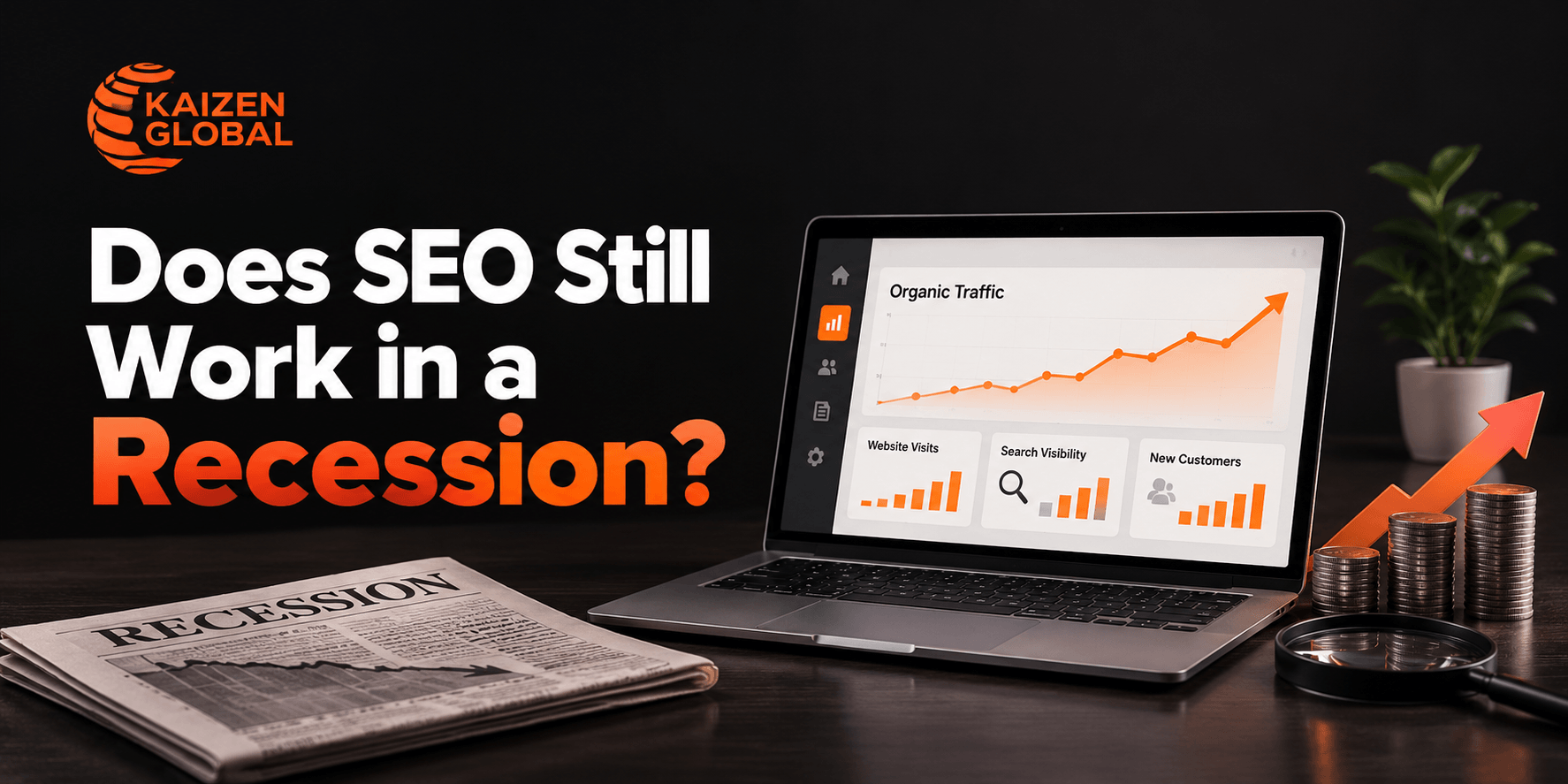
SEO works in a recession because it rests on needs that do not stop. People still need repairs, healthcare, software, legal help, and household goods. What changes is how they search, how long they compare, and how much they are willing to spend.
Captures Demand That Still Exists
Recessions reduce spending, but they rarely erase a need. A homeowner who postpones a kitchen remodel still needs a plumber when a pipe bursts. A company that freezes hiring still needs payroll software that works.
These buyers turn to search first, and they often search more than before because every purchase feels riskier. A business that ranks for those needs keeps getting calls and orders while broader demand softens.
Costs Less per Lead as Traffic Grows
Paid search charges for every click, so its cost rises in step with traffic. LocaliQ’s 2026 Google Ads benchmarks, drawn from more than 13,000 campaigns, put the average cost per lead across industries at $66.69.
Organic traffic works differently. Once a page ranks, each additional visitor costs nothing extra, so the cost of each lead tends to fall the longer the page performs. Paid visibility also ends the day spending stops, while a well-built page can keep bringing in leads for months with periodic updates. That makes SEO one of the few investments that keeps returning value even if budgets shrink again later.
Gains Ground That Lasts Into the Recovery
When rivals pause content, link building, and site maintenance, there are fewer businesses actively improving their positions. Pages that would struggle to move in a crowded market have a better chance to climb.
Those gains carry forward. When spending returns, competitors restarting their SEO have to displace pages that have spent the downturn building history, links, and reviews.
Builds Trust When Buyers Grow Cautious
Cautious buyers read more reviews, compare more options, and look for proof before committing. Helpful content, transparent pricing pages, and strong reviews answer those concerns directly.
These trust signals also support visibility. Brand signals that influence rankings, such as branded searches and positive mentions, tend to favor businesses that stay present when others go silent.
How Does Search Behavior Change During a Recession?
Search activity does not simply drop in a downturn. It moves toward savings, value, and careful comparison, and the 2008 recession shows this clearly.
comScore found that searches for “coupons” rose 161 percent between December 2007 and December 2008, reaching 19.9 million. Searches for “discount” rose 26 percent over the same period. A 2009 Pew Research Center analysis found that seven in ten Americans had gone online for recession-related information. Among those searching for economic reasons, 67 percent were looking for low-priced items.
The same shift shows up in specific intent patterns today.
| Search Shift | Example Searches | Content That Captures It |
|---|---|---|
| Repair over replace | “fix leaking water heater,” “laptop battery replacement” | Repair service pages, maintenance guides |
| Value over premium | “affordable dentist near me,” “budget CRM software” | Pricing pages, value-focused service pages |
| Comparison before purchase | “X vs Y,” “is X worth it” | Honest comparison pages, buyer guides |
| Financing and flexibility | “payment plans,” “monthly pricing” | Clear financing and plan pages |
| Do it yourself | “how to clean HVAC coils” | Helpful how-to content that builds trust |
| Longer research cycles | Several searches over weeks before a decision | Content that answers each stage of the decision |
These patterns vary by industry. Before reshaping a content plan, compare query trends in Google Trends with the business’s own Search Console data to confirm which shifts are happening in its market.
What Does the Evidence Show About Marketing Through Downturns?
Past downturns offer two useful lessons. Visibility gets cheaper when others pull back, and businesses that keep investing selectively tend to come out ahead.
Ad Prices in the 2020 Slowdown
When the pandemic hit in early 2020, many advertisers paused spending. WordStream reported that auctions became less competitive and cost per click declined as a result. Merkle’s Q2 2020 report found that retailers’ Google search cost per click fell 22 percent year over year.
The discount did not last. Tinuiti’s benchmark data showed cost per click falling 17 percent in Q2 2020 but only 1 percent in Q3, as large advertisers returned. Downturns open a short window of cheaper paid visibility, while organic positions built during that window keep their value after ad prices recover.
Long-Term Research on Recession Strategy
In “Roaring Out of Recession,” Harvard Business Review researchers studied 4,700 public companies across three recessions. Only about 9 percent flourished afterward, outperforming rivals by at least 10 percent in sales and profit growth. The winners balanced selective cost cutting with continued investment, while the firms that cut fastest and deepest had the lowest odds of pulling ahead.
A widely cited McGraw-Hill Research study of 600 B2B companies points the same way. Firms that maintained or increased advertising during the 1981 to 1982 recession grew sales 256 percent more by 1985 than those that cut back. The study is decades old and shows correlation rather than proof, but both studies reward disciplined, targeted investment. SEO fits that profile because its spending can be focused on the pages closest to revenue.
Which Businesses Benefit Most From SEO in a Downturn?
Every business with an active market can benefit, but the right focus depends on how its demand behaves in a slowdown. The table below shows typical patterns.
| Business Type | Typical Recession Demand | SEO Priority |
|---|---|---|
| Repair and maintenance services | Often steady or rising as people fix instead of replace | Repair service pages and strong local visibility |
| Healthcare and essential local services | Needs-based and relatively stable | Business Profile, reviews, and service pages |
| Ecommerce | Price-sensitive and comparison-heavy | Category pages, comparison content, and value messaging |
| B2B and SaaS | Longer sales cycles and tighter approvals | Content that helps buyers justify cost |
| Luxury and discretionary brands | Often shrinking | Branded search, loyal customers, and high-intent niche terms |
| Agencies and consultancies | Clients cut budgets but still need results | Results-focused content and flexible service offers |
Local businesses have a particular advantage, because nearby customers still need services and the map pack rewards consistent effort. Agencies facing tighter margins often turn to white label SEO to keep delivering for clients without adding payroll.
Where Should an SEO Budget Go When Money Is Tight?
A smaller budget means choosing the work with the fastest and surest return. The Kaizen Recession SEO Priority Ladder puts that work in order, so spending flows to the top tiers before anything new is attempted.
Tier 1: Protect Pages That Already Rank
Existing rankings are the cheapest traffic a business has. Refreshing top pages with current information, fixing broken elements, and keeping them fast stops competitors from taking positions that already bring in revenue. This guide to refreshing old content shows how to update pages without losing what made them rank.
Tier 2: Fix Pages That Get Traffic but No Leads
Pages with steady visitors and few conversions are leaking money. Clearer calls to action, visible pricing, faster forms, and stronger trust signals can lift leads without any new traffic.
Tier 3: Target Searches Closest to a Purchase
Searches that include words like “near me,” “cost,” “price,” “vs,” or “best for” come from people close to buying. Pages built for these searches return value faster than broad educational content.
Tier 4: Strengthen Local and Branded Visibility
Business Profile updates, consistent listings, and a steady flow of reviews deliver local results at very low cost, as covered in this local SEO checklist. Support content and strong branded search results also help keep existing customers, who are cheaper to retain than new ones are to win.
Tier 5: Expand Into New Topics Last
New content clusters build long-term authority, but they take the longest to pay back. In a tight year, this tier gets whatever budget remains after the first four are covered.
How Should a Business Set and Measure a Recession SEO Budget?
The right recession budget is the smallest one that still protects revenue and proves its return. Consistency matters more than size, because a modest effort sustained for a year usually outperforms a large one that stops and starts.
Setting the Minimum Effective Budget
A practical floor covers Tiers 1 through 3. That means keeping top pages current and technically sound, fixing the biggest conversion leaks, and building a small number of pages for high-intent searches each month.
Tracking also belongs on the floor. Without analytics and call tracking, there is no way to prove which channels still pay off, and that proof is exactly what a recession budget review demands.
Measuring Return on Every Dollar
The clearest measure is cost per organic lead. Divide the monthly SEO cost by the number of leads, calls, or orders that came from organic search that month. Then compare the result with the cost per lead from paid campaigns.
Two supporting measures complete the picture: revenue attributed to organic search, and branded search volume as a sign of growing trust. When the cost per organic lead falls below the paid figure, the case for SEO is made in the business’s own numbers.
What Should a Business Avoid Cutting?
Some cuts save money now and cost far more later. These are the ones that most often backfire.
- Cutting technical maintenance lets a slow or broken site lose rankings quietly, and fixes cost more once traffic has already dropped. A technical SEO checklist covers the essentials worth keeping.
- Replacing expert content with mass-produced, unedited pages can drag down the whole site under Google’s quality systems.
- Buying cheap links violates Google’s spam policies and can lead to lost visibility or removal from results.
When Should a Business Scale SEO Back?
SEO is not the right priority in every situation, and honest planning means knowing when to reduce it. A smaller effort makes sense in three cases.
- The business has only weeks or a few months of cash runway, so immediate revenue has to come first.
- Demand for the product is shrinking structurally, not just cyclically, so more visibility will not restore sales.
- The website has no working foundation, such as broken tracking or no clear service pages, and needs basic fixes before any growth work.
Even then, a full stop is rarely the best choice. Rankings erode as competitors keep publishing, and restarting later means paying to recover lost positions before any new growth begins. Reducing the effort to Tier 1 maintenance usually protects far more value than it costs.
How Can SEO and Paid Ads Work Together in a Downturn?
SEO and paid search are not competing choices in a recession. Each covers a weakness of the other.
| Role | SEO | Paid Search |
|---|---|---|
| Speed | Builds over months | Works immediately |
| Cost behavior | Cost per lead falls as rankings grow | Cost rises with every click |
| Recession pricing | Unaffected by auction prices | Can fall when advertisers pull back, then recover |
| Best recession use | Long-term demand capture and lower blended cost | Proven high-converting terms and short-term cash flow |
A sensible downturn approach runs ads only on searches that reliably convert, and takes advantage of lower click prices while they last. Meanwhile, SEO builds organic visibility for those same terms. As organic positions grow, ad spend on overlapping keywords can shrink, and paid conversion data shows which pages deserve organic investment first.
Frequently Asked Questions
How should ecommerce stores adjust SEO in a recession?
Value-focused category pages, such as sale or under-a-price-point collections, match how shoppers search in a downturn. Products that go out of stock are usually better kept live with clear alternatives than deleted, because removing them throws away rankings. This ecommerce SEO checklist covers the core structure worth protecting.
Should service pages show prices during a recession?
Transparent price ranges, starting prices, or payment options usually help, because cautious buyers search for cost before they call. Pages that hide pricing entirely often lose these visitors to competitors who answer the question. Showing value, such as what is included and what results to expect, matters as much as the number itself.
Does SEO work for B2B companies in a recession?
Yes, but the content focus shifts. B2B buyers face stricter approval processes in a downturn, so content that helps them justify a purchase becomes more valuable. Examples include return-on-investment explanations, cost comparisons, and implementation guides. Pages that help an internal champion make the case to finance often convert better than general feature pages.
Can a small business handle SEO itself to save money?
Much of the basic work can be done in-house. Google’s own guidance on hiring an SEO notes that small local businesses can often handle a large share of the work themselves. These small business SEO tips show where to start before deciding what to outsource.
Does AI search change whether SEO is worth it in a recession?
AI search raises the value of strong SEO rather than replacing it. AI-generated answers draw on pages that are well structured, trustworthy, and already visible in search. The differences between these channels are explained in SEO vs AEO vs GEO.
Can AI tools lower SEO costs during a downturn?
AI tools can speed up research, outlining, and data analysis, which reduces hours spent on routine tasks. Expert review is still needed for accuracy and originality. Practical uses are covered in how to use AI for SEO, and broader workflow savings are possible through AI automation services.
Ready to Turn the Slowdown Into Your Advantage?
Kaizen Global builds recession-ready SEO programs that put the budget where it returns the most. That means protecting pages that already rank, fixing conversion leaks, targeting searches closest to a purchase, and reporting tied to leads and revenue. Every engagement starts with an audit that shows which work will pay back fastest for the business and its market.
Explore our SEO services or book a free consultation. Prefer to reach out directly? Call +92 312 4422229, email info@thekaizenglobal.com, or send us a message.
Protect Your Search Visibility — Request an SEO Consultation
Insights

Mobile Seo Checklist - A Complete Guide
Mobile SEO refers to optimizing your website to ensure it performs well on mobile devices, offering a seamless user experience ...
25-Step SEO Migration Checklist
Migrating your website can feel like a daring task filled with potential challenges. No matter if you're redesigning your site ...
Local SEO Checklist: Maximize Your Local Reach
Local search engine optimization (SEO) has become essential for businesses aiming to connect with their community and attract nearby ...