What Is White Label SEO? How It Works, What It Costs, and How to Choose a Partner
Updated : September 9, 2026
White label SEO is a partnership where a specialist provider does the actual search engine optimization work while an agency delivers and brands that work as its own. The agency keeps the client relationship, the invoicing, and the credit. The provider stays invisible, handling the strategy, execution, and reporting behind the scenes. For agencies that want to offer SEO without building an entire in-house department, this model has become one of the fastest ways to add a profitable service line. This guide breaks down how white label SEO works, what a typical engagement includes, current 2026 pricing, and what separates a reliable partner from a risky one.
What Is White Label SEO?
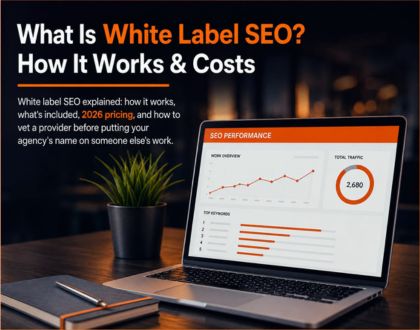
White label SEO is a service arrangement where a specialist provider performs search engine optimization work on behalf of an agency, and the agency presents that work to its own clients under its own brand name. The client hires the agency, not the provider. Every report, strategy call, and deliverable is branded as the agency's own work. The provider stays entirely behind the scenes, and the client never interacts with them directly. This differs from casual subcontracting. A true white label relationship runs on consistency: the provider follows the agency's brand guidelines, uses the agency's report templates, and sometimes joins client calls under an agency email address. The goal is for the client to have no reason to suspect anyone outside the agency touched their account.
How White Label SEO Actually Works
The mechanics are fairly consistent across providers, even though the scope of services varies widely. A typical engagement moves through the same sequence:
- The client comes to the agency. A business asks its existing agency, whether that's a web design firm, a PPC shop, or a marketing consultancy, whether it can also handle SEO.
- The agency scopes and sells the engagement. The agency sets the retail price, signs the client, and owns every part of that relationship going forward.
- The agency briefs the white label provider. This includes the client's goals, industry, current site condition, and any specific requirements or brand voice notes.
- The provider researches and builds a strategy. This covers keyword and competitor research, a technical audit, and a plan for content and link building.
- The provider executes the work. Technical fixes, content production, and link building happen behind the scenes, invisible to the client.
- Deliverables and reports come back branded. Work is handed to the agency through a shared dashboard or scheduled handoff, already formatted with the agency's logo and identity.
- The agency reviews and delivers to the client. The client sees a finished, professional result with no indication anyone outside the agency touched it.
Working Example
Picture a five-person web design agency that just landed a client wanting more organic traffic. The agency has no SEO specialist on staff, so it briefs a white label partner with the client's site, target market, and goals. The provider runs a technical audit, builds three months of content, and secures a handful of relevant backlinks, then hands back a branded report each month. The agency reviews it, forwards it to the client under its own letterhead, and the client never learns a second company was involved. Some partnerships go further than fulfillment alone. A handful of white label providers also support presales work, supplying pitch decks, case studies, and even joining sales calls to help the agency close new business, all still under the agency's name.
Who Handles What
The division of labor depends on the agreement, but a common split looks like this. The agency owns client communication, contracts, pricing, and account management. The provider owns strategy execution, technical work, content creation, link building, and the underlying data behind reports. Where the line falls can shift: some agencies want full control of client conversations, while others let the provider handle reporting calls directly, still branded as the agency.
| Responsibility | Typically Owned By |
|---|---|
| Client relationship and contracts | Agency |
| Pricing and invoicing | Agency |
| Strategy execution | Provider |
| Technical audits and fixes | Provider |
| Content creation | Provider |
| Link building | Provider |
| Report branding and delivery | Agency (built by Provider) |
| Presales support (pitch decks, case studies) | Varies by agreement |
White Label SEO vs. SEO Reseller Programs vs. General Outsourcing
These three terms get used interchangeably, but they describe different arrangements. An SEO reseller program typically means buying access to a fixed set of packaged services, often software-driven, at a set wholesale price with limited customization. White label SEO is broader and more flexible. It usually involves a custom strategy built around each client's specific site and goals, not a standardized package. General outsourcing, meanwhile, doesn't require brand invisibility. The end client may know a third party is involved, and the work may not follow the agency's branding at all. Understanding this distinction matters when evaluating providers, since a reseller platform and a true white label fulfillment partner solve different problems.
| <br> | White Label SEO | SEO Reseller Program | General Outsourcing |
|---|---|---|---|
| Client sees the provider's brand | No | No | Sometimes |
| Strategy is custom to the client's site | Yes | Rarely | Varies |
| Delivery format | Fully branded to the agency | Standardized package | Not necessarily branded |
| Flexibility | High | Low | Varies |
What's Included in White Label SEO Services
Most white label engagements cover a mix of technical, content, and off-page work, tailored to the client's site and competitive landscape.
Technical SEO
This covers crawlability, indexation, site speed, mobile usability, structured data, and Core Web Vitals, including Interaction to Next Paint. These metrics matter, but they function more as a baseline than a ranking advantage on their own; Core Web Vitals vs. user experience breaks down why passing scores alone rarely outrank a page that genuinely satisfies search intent. A thorough technical audit typically catches issues that block a site from ranking regardless of how strong the content is.
On-Page and Content Optimization
This includes title tags, meta descriptions, header structure, internal linking, and semantic keyword integration, aligning each page with what search engines and readers actually expect to find there. Providers typically audit existing pages first, mapping which ones already rank close to page one and which need a rewrite versus a light edit. Internal linking gets special attention here, since it signals topical relationships to search engines and helps distribute ranking authority across a site rather than concentrating it on the homepage alone.
Content Creation and Topical Strategy
Beyond individual articles, this involves building out topic clusters and addressing gaps in a site's existing coverage so it can demonstrate depth on a subject rather than touching it once and moving on.
Link Building and Digital PR
Earning links from relevant, authoritative sites remains one of the stronger off-page signals. This can include outreach, guest content, and PR-driven placements, depending on the provider's approach. Quality matters more than volume here. A handful of links from sites with genuine topical relevance and traffic tends to move rankings further than a large batch from low-authority directories, and reputable providers will typically show the actual domains being pursued before work begins, rather than reporting a link count with no visibility into where they came from.
Local SEO and Google Business Profile Management
For location-based businesses, this covers profile optimization, citation building, and location-specific content, which matters heavily for multi-location clients. Work usually includes keeping business information consistent across directories, building out location-specific landing pages rather than one generic page for every city served, and managing reviews and posts on the Google Business Profile itself. For a business with several branches, this is often the difference between showing up in the local map pack for each location and only ranking near a single headquarters address. Agencies can use our local SEO checklist to build stronger multi-location visibility and improve map pack rankings for each branch.
Reporting, Dashboards, and Analytics
Branded dashboards, monthly performance summaries, and integration with analytics and search console data let the agency show clear, trackable progress to its clients. Most providers offer a white-labeled version of their reporting platform, meaning the agency's logo and colors appear throughout, with no reference to the provider anywhere the client can see. Good reporting goes beyond ranking positions to include organic traffic trends, conversion data where available, and a plain-language summary of what changed and why, since raw numbers alone rarely explain value to a client who isn't an SEO specialist.
AI Search and Visibility Monitoring (GEO and AEO)
What GEO and AEO Cover As more searches happen through AI tools and chat-based assistants, some providers now track how a brand appears in AI-generated answers alongside traditional rankings. Generative Engine Optimization (GEO) focuses on getting content cited inside AI-generated summaries, the kind that now appear at the top of Google's AI Overviews before a user ever reaches a traditional search result. Answer Engine Optimization (AEO) focuses on structuring content to directly answer a specific question. The naming is still settling across the industry, but the underlying skill is the same: writing and structuring content so both search engines and AI systems can find, parse, and cite it accurately. Why It's Tied to Technical SEO AI systems favor websites that are fast, well-structured, and easy to understand. Core Web Vitals, structured data, clear headings, and direct answers improve visibility in both traditional search and AI-generated results. Strong brand signals also help AI systems prioritize trusted sources. Providers should track brand mentions and AI citations, while agencies should ask how AI visibility is measured, as tracking standards are still evolving.
Why Agencies Use White Label SEO
Building an in-house SEO team is expensive and slow. Current 2026 salary data puts a full-time SEO specialist's pay in the range of 55,000 to 95,000 dollars a year in the United States, before benefits, tools, and training are factored in. Salaries, tool subscriptions, and training add up before a single client campaign even launches. White label SEO lets an agency skip that buildout and start delivering results immediately, using a partner's existing expertise and infrastructure. It also solves a scaling problem. An agency that lands three new SEO clients in a month doesn't need to hire three new specialists. The fulfillment side stretches to match demand, while the agency focuses on sales, strategy conversations, and client relationships, the parts of the business that are hardest to outsource. There's a competitive angle too. Agencies that can offer SEO alongside web design, social media, or paid ads look more like a full-service partner, which increases the odds a client for one service will hand over the SEO for that expanded budget as well. The core advantages generally come down to:
- Lower upfront cost compared with hiring, training, and tooling an in-house SEO team
- Faster time to delivery, since the provider already has the expertise and workflows in place
- Scalability, adding or dropping client capacity without changing headcount
- Access to specialized tools and expertise the agency doesn't have to license or train for itself
- Stronger positioning as a full-service partner rather than a single-service vendor
- More time for client relationships and sales, the work that's hardest to hand off
| Factor | White Label SEO | Building an In-House Team |
|---|---|---|
| Setup time | Days | Weeks to months of hiring |
| Upfront cost | Wholesale service fee | Salaries, tools, training |
| Scalability | Scales instantly with demand | Limited by headcount |
| Access to specialists | Full bench across disciplines | Depends who gets hired |
| Brand credit | Agency, always | Agency, always |
| Risk if it doesn't work out | Switch providers | Layoffs or retraining |
Who Should Use White Label SEO
White label SEO tends to be the strongest fit for a specific set of situations, and less useful in others.
Strong Fit
- Web design agencies whose clients ask for SEO alongside a new site build
- PPC or paid media agencies rounding out their organic offering
- PR and content agencies adding a technical layer to their service
- Freelance consultants who want to grow revenue without growing a team
- Agencies whose small business clients still need the fundamentals covered, from a claimed Google Business Profile to consistent contact information, the kind of groundwork our tips to do small business SEO walks through before a white label partner layers on more advanced strategy
Weaker Fit
- Agencies that need absolute, hands-on control over every execution detail may find the handoff model frustrating
- Agencies with a strong in-house SEO team they're looking to sharpen rather than replace usually don't need a full partnership, though some still use one selectively to cover overflow during busy periods
The question worth asking is simple: do clients need SEO, and does the agency currently have the capacity and expertise to deliver it profitably in-house? If the answer is yes to the first and no to the second, white label SEO is usually the right move.
What White Label SEO Costs in 2026
Pricing in this space has never been fully standardized, but four models dominate the market, and understanding the actual numbers behind each one makes it much easier to budget and set retail prices with confidence.
Per-Keyword Pricing
Some providers still charge a monthly fee for each targeted keyword, generally landing between 75 and 300 dollars per keyword depending on how competitive that term is. A local business targeting ten keywords might run 1,000 to 2,000 dollars a month under this model. It's becoming less common, since modern search engines evaluate topics and intent rather than isolated keywords, which makes per-keyword billing feel increasingly disconnected from how SEO actually works.
Hourly Billing
Hourly rates typically range from 75 to 200 dollars, with the lower end more common for offshore teams and the higher end for specialized domestic work. This model suits smaller, well-defined projects better than ongoing campaigns.
Flat Monthly Retainers
This is the most common structure today. Entry-level local SEO packages generally run 300 to 900 dollars a month. Mid-market accounts land between 900 and 2,500 dollars. Enterprise or ecommerce scopes, especially those covering large product catalogs or highly competitive industries, can run 2,500 to 6,000 dollars or more. The spread within each tier usually comes down to the volume of content, the number of backlinks, and how frequently technical audits are performed.
Wholesale to Retail Markup
The business model rests on the gap between what an agency pays a fulfillment provider and what it charges its own client. Agencies typically mark up wholesale pricing by 2 to 3 times when setting retail rates, which generally produces gross margins in the 45 to 60 percent range.
| Pricing Model | Typical Range | Best Fit For |
|---|---|---|
| Per-keyword | $75 to $300 per keyword/month | Narrow, well-defined keyword targets |
| Hourly | $75 to $200 per hour | Smaller, well-scoped projects |
| Local retainer | $300 to $900/month | Single-location small businesses |
| Mid-market retainer | $900 to $2,500/month | Multi-service or regional businesses |
| Enterprise/ecommerce retainer | $2,500 to $6,000+/month | Large catalogs, highly competitive industries |
How to Choose a White Label SEO Partner
The provider an agency chooses affects client retention as much as it affects the agency's own margins, so the selection process deserves real scrutiny.
Reputation and Communication
Check reviews on third-party platforms rather than testimonials on the provider's own site, since those are curated. Then test communication directly: a provider that's slow or vague answering pre-sales questions will be worse once real client deadlines are on the line.
Reporting Transparency
Ask to see a sample report before signing. A partner that explains what was done, why, and what it produced builds trust over time; one that hands over jargon-heavy dashboards makes it harder for the agency to justify value to its own client.
Contracts, SLAs, and Confidentiality
A solid contract spells out turnaround times, what happens if a deadline slips, and how quality disputes get resolved, plus a signed NDA covering the agency's client list and account details. Favor month-to-month terms for a new partnership; long lock-ins remove the agency's exit if fulfillment quality doesn't hold up.
Red Flags to Rule a Provider Out
A lower wholesale price looks appealing at first, but agencies that chase the cheapest quote often run into slow turnarounds and client churn once results fail to materialize; the real cost shows up months later, not on the first invoice. A harder line applies to tactics that risk getting a client's site penalized outright: keyword stuffing, cloaking, bulk-bought links, hidden text, and duplicate content across sites. A provider that hedges when asked directly about any of these is one to walk away from, since the penalty lands on the agency's reputation, not the provider's.
Questions to Ask Before Signing
- Can you show results from a client in a similar industry or market?
- What's your process when a campaign underperforms for two months straight?
- Who's my direct point of contact, and what's the escalation path if they're unavailable?
- Do you use any tools or tactics you wouldn't disclose to a client directly?
- What happens to reporting and account access if we end the contract?
Common Mistakes Agencies Make with White Label SEO
A few patterns show up repeatedly among agencies that struggle with this model:
- Underpricing the retail package, often from not accounting for account management time on top of the wholesale fee
- Skipping quality control before work reaches the client, since even strong providers occasionally need a second look
- Treating the partnership as fully hands-off, which weakens strategy alignment since the provider can only work as well as the brief it receives
- Vague onboarding briefs that leave the provider guessing at goals, audience, or brand voice
- No process for reviewing results together, which makes it harder to catch and fix underperformance early
Frequently Asked Questions
Is it legal to resell SEO work you didn't personally perform?
Yes. No law requires the party invoicing a client to be the one doing the work. It's standard practice across professional services, from law to accounting, where subcontracting is routine as long as the finished work meets an acceptable standard.
Am I required to tell my client their SEO is outsourced?
There's no general legal requirement in most jurisdictions specific to SEO. The real obligation comes from the agency's own contract with the client: if it promises fully in-house delivery, disclosure becomes a contractual issue rather than a legal one.
How much hands-on time does managing a white label partnership take each week?
For an established partnership, it's usually a few hours a month per client spent reviewing deliverables and translating findings into client-facing language. The heavier time cost comes during onboarding, either a new client or a new provider, not in the ongoing relationship.
What happens to a client's rankings and reporting history if the agency switches providers?
Rankings themselves don't reset, since they belong to the website rather than the provider. Reporting dashboards and historical tracking data usually don't transfer between providers, though, so it's worth exporting that history before ending a contract.
How many clients does an agency need before white label SEO becomes profitable?
Because the model runs on wholesale-to-retail margin rather than fixed overhead, profitability can start from the very first client. The real question is whether the retail price covers account management time on top of the wholesale fee, not how many clients are on the books.
Does outsourcing SEO put a client's site at greater risk of a Google penalty?
Not inherently. Penalty risk comes from the tactics used, not from who performs the work. A provider following Google's guidelines carries the same risk profile as an in-house team using the same methods.
How long does it typically take to see results after switching to a white label provider?
Most agencies see meaningful ranking movement in the first three to six months, though a site with a strong technical foundation already in place can show gains sooner, and one recovering from past penalties or a major redesign usually takes longer regardless of provider quality.
Ready to Add SEO to Your Service Lineup?
Kaizen Global offers professional SEO services and helps agencies and businesses build SEO strategies that hold up over time, from technical audits to content built for both search engines and today's AI-driven discovery. If you're weighing whether to build an in-house team or bring in a partner who already knows the landscape, we're happy to walk through what a fit would look like for your business. Book a consultation with our team to get started.
Ready to Add SEO to Your Service Lineup?
Insights

Mobile Seo Checklist - A Complete Guide
Mobile SEO refers to optimizing your website to ensure it performs well on mobile devices, offering a seamless user experience ...
25-Step SEO Migration Checklist
Migrating your website can feel like a daring task filled with potential challenges. No matter if you're redesigning your site ...
Local SEO Checklist: Maximize Your Local Reach
Local search engine optimization (SEO) has become essential for businesses aiming to connect with their community and attract nearby ...