Home Healthcare SEO: How to Increase Online Visibility and Generate More Leads
By Hassan Khan, SEO Expert at Kaizen Global | Updated October 17, 2026
Home healthcare SEO helps agencies generate more leads by ranking for what families, referral partners, and caregivers search for, then converting those visits into consultations, referrals, and applications. That takes a correctly configured service-area Google Business Profile, a dedicated page for each service and community, accurate answers on cost and coverage, and fast intake follow-up.
Non-medical home care and Medicare-certified home health need different SEO approaches, so this guide separates the two wherever it matters.
What Is Home Healthcare SEO and Why Does It Matter Now?
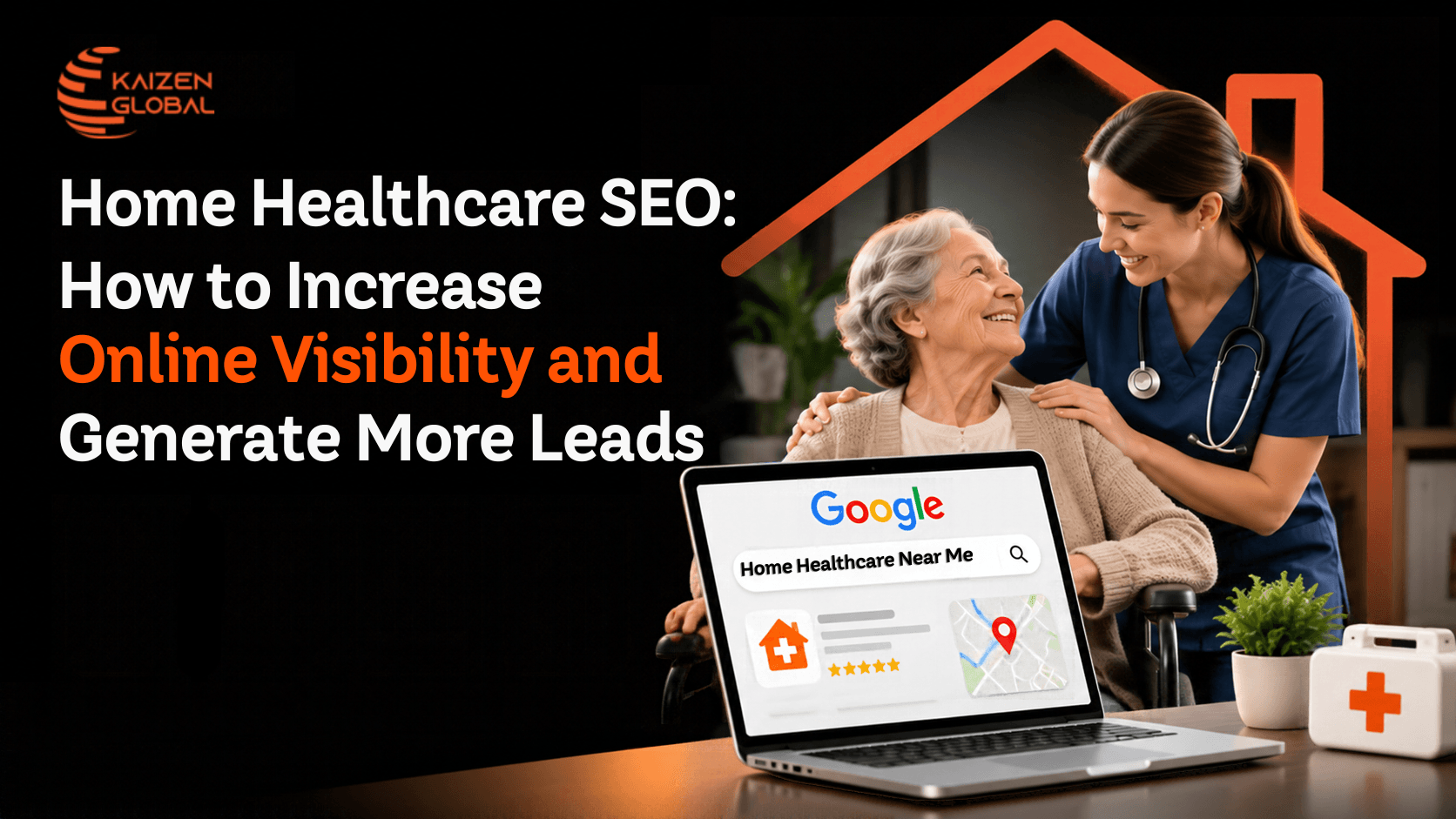
Home healthcare SEO covers every signal that tells Google an agency is relevant, available, and trusted in a given area. It spans the Business Profile, the agency website, directory listings, reviews, referral partner mentions, and recruiting pages.
Searches That Signal Intent to Hire Care
Many home care searches happen in the days after a fall, a hospital discharge, or a new dementia diagnosis. A search like "home care after hip surgery in Tampa" signals a family ready to act this week, while "how to choose a home care agency" signals a family still comparing options. Both deserve a page, but they need different pages.
Challenges Unique to Home Healthcare Agencies
Most agencies have no storefront, which makes them service-area businesses with special rules on Google. They compete with franchise brands, national lead aggregators, and directory sites that often outrank agency websites. Staffing levels also cap how many new clients an agency can accept, so recruiting visibility matters as much as client visibility.
Audiences a Home Healthcare Website Must Serve
Families are the largest audience, and many are adult children arranging care for a parent who lives in another city or state. Referral sources such as discharge planners, physicians, and case managers drive most home health admissions. Caregiver applicants form the third audience and often decide how fast an agency can grow.
How Do Home Care and Home Health SEO Differ?
Non-medical home care and Medicare-certified home health share a search category but almost nothing else. Treating them as one topic produces pages that rank weakly for both.
| Factor | Non-Medical Home Care | Medicare-Certified Home Health |
|---|---|---|
| Typical searcher | Family member | Patient, family, or referral source |
| Payer | Private pay, long-term care insurance, VA benefits, Medicaid waivers | Medicare, Medicaid, private insurance |
| Core keywords | companion care, personal care, 24-hour care | skilled nursing at home, home health physical therapy |
| Lead source mix | Organic search, directories, word of mouth | Physician and hospital referrals, then organic search |
| Trust signals | Caregiver screening, state license, reviews | Medicare certification, Care Compare star ratings |
Keyword Differences Between the Models
Home care keywords describe daily support, such as "companion care for seniors" or "overnight caregiver near me." Home health keywords describe skilled clinical services, such as "home health occupational therapy" or "wound care at home." Mixing both on one page confuses searchers and search engines about what the agency actually provides.
Trust Signal Differences Between the Models
Home care families want proof that caregivers are screened, trained, insured, and supervised. Home health patients and referral sources look for Medicare certification, accreditation, clinical staff credentials, and public quality ratings.
Structure Differences for Agencies Offering Both
Agencies providing both services should build separate sections with their own navigation, service pages, and calls to action. Each section should target its own keyword set so the two halves never compete for the same search.
How Should a Home Healthcare Agency Audit Its Local Competitors?
A competitor audit shows which agencies families actually see and what those agencies do differently. Kaizen Global starts every home care engagement here, because the gaps it reveals decide whether the first month goes to the profile, the website, or reviews.
Understanding How Google Ranks Service-Area Agencies
Google confirms that local results depend mainly on relevance, distance, and prominence, and its local ranking guidance notes that review count and score factor in. For service-area businesses, distance appears to be judged from the agency's verified location even when the address is hidden. That is why organic service-area pages, not the map pack, become the main growth path in distant towns.
Recording Results Across the Service Area
Search the agency's five most valuable terms from several ZIP codes across the territory. Results for "home care near me" can change completely from one neighborhood to the next, and a grid-based rank tracker makes the pattern visible.
Comparing Profiles, Reviews, and Landing Pages
Record the same fields for every agency in the top three, then compare them with the agency's own profile.
| Data Point | What to Record | What a Gap Usually Means |
|---|---|---|
| Primary category | Exact category name | A category mismatch with the search |
| Review count and rating | Total reviews and average | A prominence gap to close over months |
| Review recency | Dates of the latest five reviews | A request process that has stalled |
| Landing page | The URL the profile links to | A homepage link where a service page would fit better |
| Business name | Name as shown on the listing | Possible keyword stuffing to report |
| Listing type | Independent, franchise, or aggregator | A different competitive strategy needed |
Spotting Aggregators, Franchises, and Spam Listings
Senior care directories and referral services often hold the top organic positions, while franchises and independents split the map pack. Fake listings and keyword-stuffed names appear often in home care, and Google's Business Redressal Complaint Form accepts reports backed by screenshots.
How Should a Home Healthcare Agency Set Up Its Google Business Profile?
For a service-area agency, profile setup carries real suspension risk. A suspended profile disappears from Maps entirely, so getting the rules right matters more than any optimization tactic.
Choosing Categories for Home Care and Home Health
Pick the primary category that most closely matches the core service, such as "Home health care service," and check which categories the top three competitors use. Secondary categories should reflect only services the agency actually provides.
Setting Up a Service-Area Profile Correctly
Google's business representation guidelines direct businesses that serve clients at their homes to hide the address and list service areas instead. Virtual offices and coworking addresses generally do not qualify as a business location. Service areas should stay within a realistic driving distance of the office, not stretch across a whole state.
Writing the Description and Services List
The description should state who the agency helps, what services it provides, and where, in plain family language. Each service should be listed individually with a short, specific description.
Before: "We provide compassionate, quality care with a personal touch for your loved ones."
After: "Licensed in-home care agency serving Clearwater, Largo, and Dunedin. Personal care, dementia care, respite care, and 24-hour care, with free in-home consultations and caregivers matched within days."
Keeping Photos and Posts Current
Upload real photos of the care team, office, and community events, using caregiver photos only with written consent. Identifiable client photos require signed authorization. Google Posts work well for open caregiver positions, community events, and new service areas.
Managing Multiple Offices and Franchise Territories
Every licensed office with its own staff needs its own verified profile, location page, phone number, and review stream. Franchise locations should match their contractual territories exactly and confirm whether the franchisor or franchisee owns each profile, since unclear ownership often leaves profiles unmanaged. A deeper guide shows how to scale local SEO across multiple locations.
Which Keywords Should Home Healthcare Agencies Target?
Strong keyword lists combine services, situations, payment questions, and geography. Intake call notes are the best starting point, because they record the exact words families use.
Service Keywords
Service searches name the type of care, such as "personal care services," "respite care," or "skilled nursing at home." Each major service deserves its own page.
Situation Keywords
Situation searches describe what triggered the need, such as "home care after hospital discharge" or "in-home dementia care." These searches carry urgency and often convert faster than generic service terms.
Payer and Eligibility Keywords
Payment searches include "does Medicare cover home care," "Medicaid waiver home care," "VA Aid and Attendance home care," and "long-term care insurance home care." Medicaid waiver searches are especially valuable for non-medical agencies, since Medicaid reports that 47 states and DC operate at least one 1915(c) home and community-based services waiver, and program names vary by state.
Long-Distance Family Keywords
Adult children often search from another state using phrases like "home care for elderly parent in Sarasota." These searchers never trigger a "near me" result, so location pages and situation content carry the full weight.
The worked map below assigns each search term to one page so two pages never compete for the same query.
| Search Term | Model | Page Type | Assigned URL |
|---|---|---|---|
| home care Clearwater FL | Home care | Location page | /home-care-clearwater/ |
| in-home dementia care | Home care | Service page | /services/dementia-care/ |
| Medicaid waiver home care Florida | Home care | Guide | /guides/medicaid-waiver-home-care/ |
| skilled nursing at home Pinellas County | Home health | Service page | /home-health/skilled-nursing/ |
| does Medicare cover home health | Home health | Guide | /guides/medicare-home-health-coverage/ |
| how to refer a patient to home health | Home health | Referral page | /referrals/ |
How Should a Home Healthcare Website Be Structured for Search?
A strong home healthcare site gives each audience a clear path and loads quickly on the phone of a stressed family member. The core structure runs from the homepage to service pages, service-area pages, a referral section, a careers section, and guides that link back to services.
Building One Page per Service
Each service page should explain what the care includes, who it helps, how scheduling works, how payment works, and how to start. A single "Services" page listing everything in short paragraphs rarely ranks for any specific service.
Building Service-Area Pages That Earn Their Place
A service-area page earns its place when it contains information a family in that town could not find on any other page of the site.
Before: "Sunrise Care proudly serves Largo. We offer personal care, companion care, and dementia care in Largo. Call us today for home care in Largo."
After: "Sunrise Care covers Largo ZIP codes 33770 through 33778, with caregivers based in the area for faster start-of-care. Our team works with discharge planners at nearby hospitals, offers dementia care and overnight care in Largo, and holds free consultations at the client's home or by video for families out of state."
Writing Title Tags That Earn Clicks
Title tags should lead with the service and location, then the agency name, in roughly 60 characters. Clear, specific titles also help families scanning results on a small screen.
Before: "Home | Sunrise Care Services"
After: "In-Home Dementia Care in Clearwater, FL | Sunrise Care"
Speeding Up Mobile Pages
Heavy image sliders, oversized stock photos, and stacked chat widgets are the usual reasons home care sites load slowly on phones. Google's Core Web Vitals give clear targets for load time, responsiveness, and layout stability, and teams can follow a technical SEO checklist for the rest of the technical audit.
Protecting Inquiry and Referral Forms
Inquiry and referral forms can collect protected health information, so they need secure handling and HIPAA-capable form providers. Advertising pixels on those pages can transmit data to third parties and should be reviewed with a compliance lead.
How Do Home Healthcare Agencies Earn Referrals, Links, and Mentions?
For Medicare-certified home health, referral partners drive most admissions. The same relationships also produce the local links and mentions that strengthen prominence in search.
Building a Referral Partner Page
Discharge planners and physician offices need a fast way to refer. A dedicated page should list referral methods, required documents, insurance accepted, service areas, intake hours, average start-of-care time, and a direct intake phone number.
Publishing Resources for Discharge Planners and Physicians
Short guides on face-to-face documentation, homebound criteria, and what happens after a referral save referral partners time. These pages attract searches from clinicians and give the agency's liaisons something useful to share during visits.
Partnering With Hospitals and Aging Networks
Hospital discharge resource guides, Area Agency on Aging directories, and senior center provider lists often link to local agencies. Each listing is both a referral channel and a local signal Google can read.
Sponsoring Community Caregiver Events
Dementia caregiver support groups, fall prevention workshops, and senior health fairs produce event pages and sponsor mentions. Hosting a free family caregiver workshop at a library or senior center often earns a link from the host's events page.
Offering Expertise to Local Media
Local reporters cover caregiving costs, heat safety for older adults, and holiday visits with aging relatives. An owner or nurse who answers quickly on deadline earns repeat quotes and links.
How Do Home Healthcare Agencies Turn Search Traffic Into Leads?
Families in a care crisis usually contact several agencies at once, so the first clear response often wins the client. Every page should make the next step obvious for each audience.
Answering Calls Around the Clock
Care needs rarely follow office hours, and many families search in the evening after a difficult day. A live answering option or trained on-call staff member keeps after-hours calls from going to a competitor.
Simplifying Forms, Chat, and Text Inquiries
Family inquiry forms should ask only for a name, phone number, location, and type of care needed. Many families prefer text or chat over calling, so a click-to-text option or monitored chat widget captures leads that a form alone misses.
Matching Calls to Action to Each Audience
Each audience needs its own next step. Family pages work best with "Schedule a Free Care Consultation," referral pages with "Send a Referral," and careers pages with "Apply to Join Our Team."
Following Up Before Families Choose Another Agency
An inquiry left unanswered until the next day is often lost. A written follow-up process with call, text, and email steps keeps leads from going cold.
How Can Home Healthcare SEO Support Caregiver Recruitment?
Most agencies can only grow as fast as they hire, which turns recruiting visibility into a growth lever rather than an HR detail. Strong job pages bring applicants from search instead of relying entirely on paid job boards.
Building Job Pages That Rank Locally
Create a page for each role and primary city, such as "Home Health Aide Jobs in Largo," with pay, schedule, requirements, training, and a short application. JobPosting structured data can make listings eligible for Google's job search features, and a growing number of states require pay ranges in job postings.
Keeping Recruiting and Client Pages Separate
Recruiting pages should target job terms such as "caregiver jobs" or "CNA jobs near me," while client pages target care terms. Separate URLs, titles, and navigation stop a careers page from ranking for a family search, and the reverse.
How Do Credentials and E-E-A-T Affect Home Healthcare Rankings?
Home healthcare content touches health, safety, and money, which places it among the topics Google holds to its highest quality standards. Experience, Expertise, Authoritativeness, and Trust signals carry more weight here than in most local niches.
Showing Licensing, Certification, and Accreditation
Display the state license number, Medicare certification for home health agencies, and any accreditation, with links to public verification where available. Claims families can verify carry far more weight than generic trust badges.
Presenting Care Compare Ratings Accurately
Medicare-certified agencies appear on Care Compare, where CMS publishes home health star ratings for quality of patient care and patient survey results. Link to the agency's public profile rather than restating ratings that change over time.
Adding Clinical Review to Educational Content
Pages about Medicare eligibility, dementia care, or post-surgical recovery should carry a visible review line naming a nurse or clinician, their credentials, and the review date. That line separates agency content from anonymous caregiving articles.
Introducing Leadership and Care Teams
Real bios for the owner, director of nursing, and care coordinators show families who stands behind the service. A clear explanation of caregiver screening, background checks, and training answers the most common family concern before it is raised.
How Do Citations and Directories Support Home Healthcare Visibility?
Citations are listings of the agency's name, phone number, and service details on other websites. They help Google confirm the agency is real and help families find it on the platforms they already trust.
Building One NAP Record
Write the official name, address, and phone number once, in one exact format, and use it everywhere it appears. Even with a hidden address on Google, state licensing records and some directories still show it, so it must match.
Prioritizing Senior Care and Healthcare Directories
Start with Care Compare for Medicare-certified agencies, state licensing lookups, Caring.com, Care.com, Yelp, Apple Business Connect, and Bing Places. Area Agency on Aging resource lists and hospital discharge guides deserve attention too, since case managers rely on them.
Weighing Paid Lead Aggregators Against Owned Leads
Senior care referral services and lead marketplaces often rank above agency websites for broad searches. Their leads can fill a schedule quickly, but they are often shared with several agencies and carry a recurring fee. Many agencies use aggregators as a bridge while organic visibility grows, then shift budget toward owned channels as search leads increase.
How Can Home Healthcare Agencies Earn Reviews While Staying HIPAA Compliant?
Families read reviews closely before inviting a caregiver into a parent's home, and Google uses review count and score in local ranking. A deeper analysis helps agencies learn how reviews affect rankings.
Asking Families at the Right Moment
The best time to ask is after the care plan has settled in and the family has seen consistent visits, not during the first stressful week. Under the FTC's consumer reviews rule in effect since October 2024, agencies cannot buy reviews or reward only positive ones, and Google prohibits review gating, which means asking only satisfied families.
Responding to Reviews Without Disclosing PHI
Replies must never confirm that the reviewer received care, mention a condition, or describe a visit. HHS settled with a New Jersey provider for $30,000 in 2023 over exactly that, calling it "a clear violation of both patient trust and the law." A safe reply reads:
"Thank you for sharing this. Privacy laws prevent us from discussing any individual situation online, but we take every concern seriously. Please call our care director at [phone] so we can talk directly."
Reviews posted by current or former caregivers on the client-facing profile fall under Google's conflict-of-interest policy and can be flagged. Workplace feedback belongs on employer review sites such as Indeed and Glassdoor.
What Content Generates Leads for Home Healthcare Agencies?
The content that produces leads answers the questions families ask in the week before they call. Medicare rules and cost data change, so a quarterly review helps agencies refresh aging care guides before they lose accuracy and rankings.
Answering Cost and Decision Questions
Cost is among the most searched home care topics, and a cited benchmark builds instant credibility. The 2025 CareScout Cost of Care Survey put the national median for non-medical in-home caregivers at $35 per hour, and a guide that compares that figure with the agency's local rates, plus what changes the price, answers the question families most want answered first.
Explaining Medicare, Medicaid, and Payment Options Accurately
Per Medicare.gov, Medicare covers home health when a patient is homebound, needs part-time or intermittent skilled care, has a face-to-face visit with a doctor or other allowed provider such as a nurse practitioner, and receives care from a Medicare-certified agency. It generally does not cover ongoing non-medical personal care, which is where Medicaid waivers, VA benefits, and long-term care insurance come in. Explaining that distinction clearly resolves the most common family misunderstanding.
Writing for Long-Distance Caregivers
Families arranging care from another state need different help, such as how to evaluate an agency remotely, what to ask on a video consultation, and how updates will be shared. Few agencies publish this content, so it faces light competition.
Publishing Video and Multilingual Pages
Short videos of the owner, care coordinators, or a caregiver explaining the first visit help families trust the people they are about to let into a home. Agencies with bilingual staff can add pages for core services in other languages, written or reviewed by a fluent speaker and tagged with hreflang.
Writing Answers AI Search Can Quote
AI Overviews and assistants increasingly answer questions like "how much does home care cost in Clearwater" before a family clicks. Guides that open with a direct, sourced answer and consistent agency details across directories are easier for AI tools to cite, and a broader guide covers how to earn citations in AI Overviews.
How Can an Agency Measure Whether SEO Produces Clients?
Rankings matter only when they produce start-of-care visits, referrals, and hires. Reporting should track each audience separately.
Tracking Leads by Source and Audience
Track family inquiries, referral submissions, and job applications separately, by landing page and source. One intake question asking how the family found the agency fills gaps that analytics miss, and monthly reviews catch a broken form or suspended profile before it costs weeks of leads.
Comparing Organic and Aggregator Lead Costs
Divide monthly SEO spend by the client starts it produces, then compare that figure with what each aggregator lead costs once conversion rates are included. That comparison shows when it makes sense to shift budget from paid leads toward owned search visibility.
Reading Search Console Data for Quick Wins
Google Search Console’s Performance report helps identify which search queries trigger a page, along with impressions, clicks, click-through rate, and average position. At Kaizen Global, we use this data to identify opportunities to improve existing home healthcare service pages and attract more relevant traffic.
For a home healthcare client, we reviewed search queries related to in-home dementia care to identify opportunities for better rankings and content improvements.
| Query | Impressions | Clicks | CTR | Avg. Position |
|---|---|---|---|---|
| In-home dementia care | 4,200 | 126 | 3.0% | 6.8 |
| Dementia care Largo FL | 1,900 | 19 | 1.0% | 11.4 |
| Memory care at home cost | 1,300 | 13 | 1.0% | 14.2 |
The first query is performing as expected for its position. The second shows strong local demand, but the page sits just off the first page because it never mentions Largo in a meaningful way. Adding a Largo section to the service page and linking to it from the Largo service-area page is a faster fix than creating a new page, which would split signals between two URLs.
The third query exposes a content gap rather than a ranking problem. Families searching for cost are landing on a page with no pricing information, so the right move is a dedicated cost guide that links back to the service page.
What Does Home Healthcare SEO Cost and What Does a 90-Day Plan Look Like?
Pricing and timelines depend on territory size, competition, and how much the profile and site need repair. A clear plan matters more than the monthly fee, because it shows exactly what the agency is paying for.
Comparing Pricing Models
Providers typically charge a monthly retainer, a project fee for a rebuild or cleanup, or an hourly consulting rate. Ask for a list of deliverables, such as service pages written, listings corrected, referral resources built, and reports delivered.
Setting Realistic Timelines
Profile corrections and new reviews can shift map visibility within weeks, while service-area pages and referral links usually take several months to reach full effect. A separate guide helps agencies set realistic local SEO timelines by market type.
Following the Kaizen Home Healthcare SEO Sequence
The sequence below puts intake and profile fixes first, since they protect leads the agency already gets, then builds pages and relationships that compound.
| Phase | Focus | Key Deliverables |
|---|---|---|
| Days 1 through 30 | Diagnosis and foundation | Competitor audit, service-area profile setup, NAP record, directory and aggregator review, after-hours intake process |
| Days 31 through 60 | Pages and conversion | Keyword-to-page map, service pages, service-area pages, referral partner page, credentials, mobile and form fixes |
| Days 61 through 90 | Referrals and growth | Hospital and aging network partnerships, cost and payment guides, recruiting pages, lead tracking by audience |
Adapting the Plan for New and Established Agencies
A new agency should spend its first month on licensing visibility, directory setup, referral relationships, and a review process from the first client onward. An established agency usually gains more from cleanup, such as fixing duplicate listings, outdated service areas, and pages competing with each other. Both can work through a full local SEO checklist alongside the plan.
Which SEO Mistakes Cost Home Healthcare Agencies the Most Leads?
The costliest mistakes trigger no warning, and the agency notices only when inquiries slow down.
Profile Mistakes
- Showing a home address when clients never visit the office
- Letting former marketing vendors keep owner access
- Ignoring Google-suggested edits that change categories or hours
Website Mistakes
- Using stock photos instead of the real care team
- Publishing Medicare guides with no review date
- Linking every directory listing to the homepage
Lead Handling Mistakes
- Sending after-hours calls to a full voicemail box
- Treating referral calls the same as general inquiries
- Never asking new clients how they found the agency
Ready to Turn Search Into Steady Home Healthcare Leads?
Kaizen Global helps home care and home health agencies get found by the families, referral partners, and caregivers already searching in their service area. Our SEO services start with a competitor audit showing where leads are slipping to nearby agencies and aggregators, then move straight into the fixes with the fastest return.
Reach out today to see what a 90-day plan would look like for your agency.
Frequently Asked Questions About Home Healthcare SEO
Is SEO or paid advertising better for a new home care agency?
Most new agencies need both at first. Paid search produces inquiries immediately while SEO builds, and budget can shift toward organic search as rankings and reviews grow.
Should a home care agency publish its own prices?
Publishing typical hourly rates or price ranges usually helps, because pricing pages attract high-intent searches and pre-qualify families before the first call. Agencies worried about competitors can publish a starting rate and explain what changes the final price.
Should an agency copy the same description to every directory?
Writing a unique description for major directories is the safer approach. Tailored descriptions give each listing a better chance of ranking on its own and avoid repeating identical text across dozens of sites.
Can a franchise location build its own website for SEO?
That depends on the franchise agreement, and many franchisors restrict separate websites. Franchisees can usually still strengthen their location page, Business Profile, citations, and reviews within brand rules.
How many reviews does a home care agency need to compete locally?
No fixed number guarantees a position. The useful benchmark is the review count and recency of the agencies in the local top three, with a steady monthly pace aimed at closing that gap.
How often should a home care agency publish new content?
Consistency matters more than volume. One well-researched guide per month, plus quarterly updates to Medicare, Medicaid, and cost pages, usually outperforms frequent short posts.
Grow Home Healthcare Leads — Request an SEO Consultation
Insights

Mobile Seo Checklist - A Complete Guide
Mobile SEO refers to optimizing your website to ensure it performs well on mobile devices, offering a seamless user experience ...
25-Step SEO Migration Checklist
Migrating your website can feel like a daring task filled with potential challenges. No matter if you're redesigning your site ...
Local SEO Checklist: Maximize Your Local Reach
Local search engine optimization (SEO) has become essential for businesses aiming to connect with their community and attract nearby ...