Do Google Reviews Help SEO?
Updated : September 9, 2026
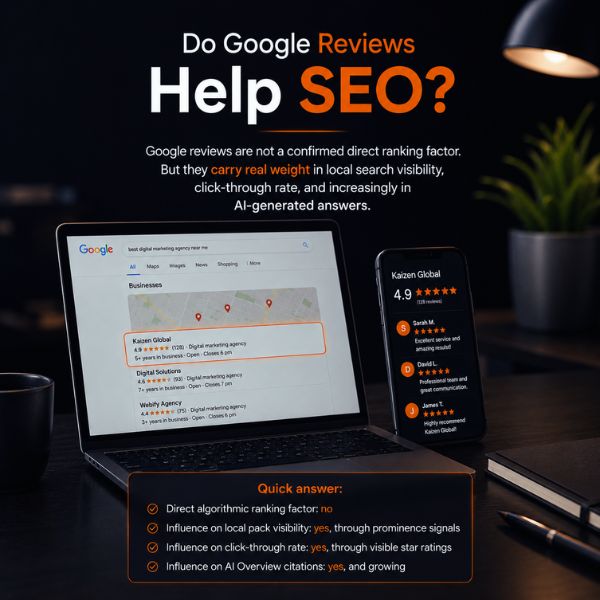
Google reviews are not a confirmed direct ranking factor. But they carry real weight in local search visibility, click-through rate, and increasingly in AI-generated answers.
That distinction matters. Most businesses either dismiss reviews as irrelevant to SEO or treat them as a guaranteed ranking shortcut. Neither view holds up once the actual mechanics are laid out.
Quick answer:
- Direct algorithmic ranking factor: no
- Influence on local pack visibility: yes, through prominence signals
- Influence on click-through rate: yes, through visible star ratings
- Influence on AI Overview citations: yes, and growing
The rest of this guide breaks down exactly how reviews connect to each of these outcomes, where structured data fits, and how to build a review strategy that holds up to Google's own guidelines.
Where Reviews Actually Sit in Google's Local Algorithm
Google ranks local results using three official pillars.
The Three Pillars
- Relevance: how well a business profile matches what someone searched for
- Distance: how close the business is to the searcher or the searched location
- Prominence: how well known and how well regarded a business is, both online and offline
Reviews live inside prominence, alongside backlinks, citations, press mentions, and general web presence.
What Google Has Actually Said
Google has stated that a high number of quality reviews can improve a business's visibility. But it has never listed review count or star rating as a direct algorithmic input the way it has for backlinks in traditional web ranking.
The honest framing: reviews are one of several inputs Google uses to judge whether a business deserves to be shown prominently. They are not a lever that moves rankings on their own.
The EEAT Connection
This connects to how Google evaluates experience, expertise, authoritativeness, and trust. A steady stream of detailed, specific reviews functions as third-party validation that a real business is delivering a real experience to real customers.
Google's quality evaluation process places significant weight on this kind of external validation, since it is much harder to fabricate at scale than on-page content alone. A business with genuine, varied, ongoing feedback signals legitimacy in a way that a static About page cannot replicate by itself. This is part of a broader shift where brand signals now factor into how search engines evaluate trust, not just backlinks and on-page content.
The Five Review Signals That Actually Move Visibility
Not all reviews carry equal weight. Five specific signals consistently correlate with stronger local visibility.
Rating Average
Google applies a practical filter around a 4.0 rating and above for searches like "best plumber near me" or "top rated dentist." Businesses below that threshold are far less likely to surface for superlative style searches, even if every other signal is strong.
An unrealistically perfect rating can also raise suspicion among searchers. A high but believable average tends to convert best.
Review Volume
A business with 100 reviews and a 4.2 average will often outrank a business with 15 reviews and a 4.8 average. Google treats a larger sample size as a more reliable signal of consistent quality.
Volume also signals that a business is actively serving customers rather than sitting dormant.
Recency and Velocity
These are two distinct signals:
- Recency asks when the last review came in
- Velocity asks how consistently new reviews arrive over time
A business that earned 50 reviews three years ago and none since looks very different to Google than one earning three to five reviews every month. Steady velocity outperforms a one time burst, and this is the single signal worth prioritizing above the other four if a business can only focus on one.
Review Text Quality
Detailed reviews that mention specific services, locations, or outcomes give Google more to work with than generic one line comments.
This is where local justifications come in: the short review snippets Google displays directly under Map Pack listings. Google scans review text for relevant keywords and phrases and surfaces the most representative ones. A review mentioning "same day emergency repair" or "best sushi in the neighborhood" can directly shape what a searcher sees before they even click.
Live search result for "top rated coffee shop near me." Google pulled the phrase "Delicious coffee, a great environment, and very friendly staff" directly from a customer review and bolded the matching keywords, using it to justify the listing's placement.
Live search result for "top rated coffee shop near me." Google pulled the phrase "Delicious coffee, a great environment, and very friendly staff" directly from a customer review and bolded the matching keywords, using it to justify the listing's placement.
Platform Diversity
Google review links carry a nofollow tag, so they pass no direct link equity in the traditional SEO sense.
Google's local algorithm also draws on signals from third-party platforms like Yelp, industry-specific directories, and review aggregators, and some of those platforms allow dofollow links. A business with consistent, positive feedback spread across multiple platforms builds a broader prominence footprint than one relying on Google alone.
Do Google Reviews Affect Click-Through Rate
Star ratings appear directly in search results and Map Pack listings as a visual differentiator before anyone reads a word of copy. Two businesses can rank next to each other, and the one with a visibly higher rating and larger review count will almost always earn more clicks.
Why This Feeds Back Into Rankings
Click-through rate itself functions as an indirect signal. When searchers consistently choose one listing over another for the same query, that behavioral pattern reinforces to Google that the chosen business is the more relevant result.
Reviews do not just influence whether someone finds a business. They influence whether that person acts on what they found, and that action loops back into how the algorithm treats the listing over time.
Rating and Volume Work Together
A strong rating with too few reviews behind it reads as less credible to a searcher than a slightly lower rating backed by hundreds of votes. This is part of why volume and rating need to be read together rather than in isolation.
Does Responding to Reviews Actually Help SEO
Google has been clear that responding to reviews is not itself a ranking input. It is, however, a stated best practice that Google explicitly encourages businesses to build into their Business Profile management. Third-party reviews managed through Google's own Business Profile APIs are required to follow Google's prohibited and restricted content policies when a business or its agency replies.
What a Good Response Looks Like
- Reference the specific service, project, or location naturally, without tipping into obvious keyword stuffing
- Reply to negative reviews with a calm, solution-focused tone rather than a defensive one
- Respond quickly, since potential customers read how a business handles criticism just as closely as they read the criticism itself
A thoughtful reply can build more trust than a flawless rating ever could.
The Photo Tactic
Reviews that include photos tend to surface higher when a review list is sorted by relevance. A business sitting with an old negative review pinned near the top can often shift the visible order by encouraging a few recent customers to leave reviews that include images.
It will not remove the negative review, but it changes what a searcher sees first.
Google Review Schema, and What It Actually Does
This is where a lot of advice online gets it wrong.
The 2019 Policy Change
In September 2019, Google updated its structured data policy to stop displaying review rich snippets for what it calls "self-serving" reviews: ratings that a business or organization places about itself on its own pages, whether marked up directly or pulled in through a third party widget.
This update applies specifically to the LocalBusiness and Organization schema types and their subtypes, which covers the overwhelming majority of local business websites. Google's own review snippet documentation confirms that other schema types, such as recipes and certain products, remain eligible.
In practical terms, adding aggregateRating schema to a standard local business website will not produce a star rating rich snippet in search results, regardless of how well the markup is implemented. Google will not penalize a site for keeping this markup in place, but it will not display it either.
What Schema Still Helps With
- LocalBusiness schema supports consistent name, address, and phone number data across a website and search results, which strengthens the same prominence and relevance signals reviews feed into, even though it will not produce a star rating snippet
- Business Profile optimization, not schema, is the correct path to a visible star rating in search results
A Note on FAQPage Schema
FAQPage schema is worth a separate note, since it applies directly to a page shaped like this one. As of August 2023, Google restricted FAQ rich results to well-known, authoritative government and health websites only.
Marking up an FAQ section with FAQPage schema on a standard business or agency site will not produce a rich snippet, so it should not be treated as a ranking or visibility tactic here. It remains harmless to include, but it is not the win many SEO checklists still claim it is.
How AI Overviews and AI Search Use Google Reviews
Search behavior has shifted from ranking for clicks toward being cited as an answer, and reviews play a growing role in that shift. For the fuller picture of how AI Overviews are reshaping SEO beyond just reviews, this is worth reading on its own.
The Mechanism
AI Overviews and AI Mode draw on Business Profile data, including review sentiment, volume, and the specific language customers use, when assembling comparative or recommendation style answers to queries like "best rated contractor near me" or "which coffee shop has the friendliest staff."
The mechanism runs in parallel to how local justifications work in traditional search. Just as Google extracts representative phrases from review text to justify a Map Pack placement, generative answer systems appear to draw on the same kind of language when deciding which businesses to name in a synthesized response.
Specific Beats Vague
A business with reviews that consistently mention specific services, outcomes, and details gives these systems more concrete material to work with than one with a handful of generic five-star ratings and nothing else.
Vague praise like "great service" is far less useful to an answer engine than a review that says a business handled a same-day emergency repair or specializes in a particular cuisine. The second kind of review gives the system language it can actually reuse in a generated answer.
One Playbook, Not Two
The review generation habits that help traditional local SEO, encouraging specific, recent, and varied feedback, are the same habits that improve a business's odds in AI-generated recommendations. There is no separate playbook required.
A business does not need to optimize for AI Overviews and local search as two different projects, because the underlying signal, detailed and current customer language, feeds both systems the same way. Reviews are one part of that broader visibility picture. A business's actual site performance factors in too, which is why it is worth understanding what impacts SEO more in 2026, Core Web Vitals or user experience.
The Honest Caveat
No search engine has published a detailed methodology for exactly how review data is weighted in AI-generated recommendations. This is a genuinely fast-moving area where today's observed pattern could shift as these systems mature.
What is already clear: businesses treating reviews purely as a reputation exercise, disconnected from search visibility, are leaving ground uncontested in a search environment that increasingly answers questions directly rather than returning a list of links to click through.
Building a Review Strategy That Holds Up to Google's Guidelines
The most effective review strategies share a few habits.
Timing and Delivery
- Direct customers to a review link at the moment satisfaction is highest, right after a purchase, a completed service call, or a resolved support ticket
- Share the link through whichever channel is easiest for the customer, whether that is email, SMS, or a QR code at a physical location
What Crosses the Line
Google's guidelines are specific about what violates policy:
- Gating reviews, meaning asking only customers who are expected to leave a positive review while filtering out anyone who might leave a negative one, violates Google's review policies and puts a Business Profile at risk of suspension
- Incentivizing reviews, meaning offering something specifically in exchange for a review rather than for general feedback regardless of sentiment, falls into the same category
Google's own merchant review guidelines state plainly that businesses are not allowed to offer financial incentives, including free samples, gift cards, or discounts, in exchange for reviews of any kind.
The safest and most durable approach is to ask every customer, consistently, and let the ratings reflect the real spread of experiences.
Multi-Location Businesses
For businesses managing more than one location, the same principles apply per profile rather than at the brand level. A five location business cannot lean on strong reviews at its flagship store to compensate for a thin or stale profile at a newer location, since Google evaluates prominence signals location by location.
Multi-location businesses generally need a repeatable, location-specific review request process rather than a single company-wide push. Consistent NAP data across every listed location matters just as much as the reviews themselves.
Common Google Review Mistakes That Quietly Hurt Local SEO
A few patterns show up repeatedly in underperforming Business Profiles, beyond the obvious ones already covered above.
- Inconsistent business information across locations. A mismatched phone number, an outdated address, or inconsistent business hours between a website, a Business Profile, and third party directories undercuts the same prominence signals that reviews are meant to build, even when review activity itself looks healthy.
- Wrong or overly broad business categories. A Business Profile categorized too generically, such as "restaurant" instead of "seafood restaurant," makes it harder for Google to match the profile to specific, high intent searches, regardless of how strong the reviews are.
- An incomplete profile. Missing business hours, no photos, or an unfilled services list weakens the same trust signals reviews are supposed to reinforce. Reviews validate a business profile; they do not substitute for one.
- Treating review platforms as interchangeable. A profile that is thriving on Google but has no presence on relevant industry-specific review sites misses part of the prominence signal Google draws from the wider web, not just from Google's own platform.
FAQs
Do Google reviews affect Google Maps ranking more than regular search ranking?
Yes. Reviews carry more visible weight inside Google Maps and the Local Pack than they do in standard organic web results, since Maps results are built specifically around Business Profile data.
How many Google reviews do I need before seeing an SEO impact?
No fixed number guarantees a result. Consistency and recency tend to matter more than hitting a specific total, and a business earning a steady monthly flow of reviews typically outperforms one that collected a large batch once and stopped.
Can negative reviews hurt my rankings directly?
Not directly. What negative reviews can do is pull the average rating below the practical 4.0 threshold that filters into certain searches, and unaddressed complaints can weaken the trust signal Google and searchers both read from a profile.
Do reviews on third-party sites like Yelp affect Google rankings?
They can support broader prominence signals even though most third-party review platforms pass no direct ranking equity to a website. Diversifying review sources also protects a business's reputation footprint if any single platform changes its policies or visibility.
How long does it take for a new review to influence local visibility?
Google has not published an official timeline. In practice, Business Profile signals typically reflect within days to a few weeks as Google recrawls and reprocesses profile data, though the exact timing varies by industry and competition.
Is it against Google's policy to ask customers for reviews?
No. Asking customers for reviews is allowed and encouraged. What violates policy is selectively asking based on expected sentiment, or offering compensation specifically in exchange for a review rather than for general feedback.
Can I add star rating schema to my website for SEO?
Adding aggregateRating schema to a standard business website will not make self-reported ratings eligible for rich snippets, since Google's 2019 policy update excludes self-serving reviews on LocalBusiness and Organization schema types specifically. LocalBusiness schema for NAP consistency remains useful, but it will not produce a visible star rating in search results.
Do reviews influence whether my business gets cited in AI Overviews?
Early evidence suggests yes. AI Overviews and AI Mode draw on Business Profile signals, including review sentiment and specific language, when assembling comparative local answers, which means detailed and recent reviews may improve the odds of being mentioned by name in an AI-generated response. No search engine has published an exact methodology for this yet, so this remains an observed pattern rather than a confirmed mechanism.
Ready to Turn Reviews Into Real SEO Growth
Reviews are one piece of a much larger local and AI search strategy. Getting the ranking signals, review policy, and AI Overview mechanics right takes ongoing work, and getting any one piece wrong can quietly cap how visible a business becomes.
Kaizen Global's SEO team builds review, local search, and AI visibility strategies around how Google and AI search engines actually work today, not outdated advice still circulating from years ago. Our SEO services cover everything from Business Profile optimization to full AI search visibility.
Book a free consultation or get in touch with our SEO experts to see where your business stands.
Ready to Turn Reviews Into Real SEO Growth
Insights

Mobile Seo Checklist - A Complete Guide
Mobile SEO refers to optimizing your website to ensure it performs well on mobile devices, offering a seamless user experience ...
25-Step SEO Migration Checklist
Migrating your website can feel like a daring task filled with potential challenges. No matter if you're redesigning your site ...

Local SEO Checklist: Maximize Your Local Reach
Local search engine optimization (SEO) has become essential for businesses aiming to connect with their community and attract nearby ...