Is Local SEO Essential for Brick and Mortar Businesses?
Reviewed By Hassan Khan, SEO Expert at Kaizen Global | Updated October 8, 2026
Yes, local SEO is essential for brick and mortar businesses because it decides whether nearby shoppers find your storefront on Google Maps and in local search results at the exact moment they are ready to visit. A store that does not appear in those results loses walk-in customers to the competitor that does.
Physical businesses depend on people who live, work, or travel close by. Local SEO connects the store to those people through a verified Business Profile, consistent listings, reviews, location pages, and signals that tell Google the business is real, relevant, and trusted.
What Is Local SEO for a Brick and Mortar Business?
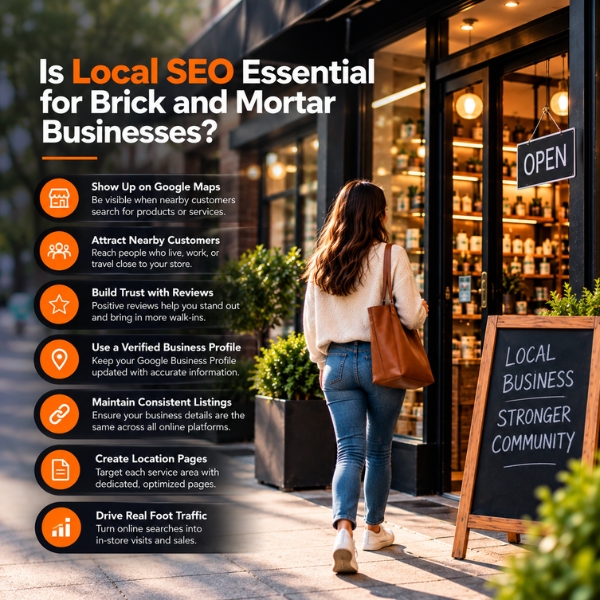
Local SEO is the practice of improving a business's visibility for searches tied to a specific place. For a storefront, that place is the street address customers drive or walk to.
It covers the Google Business Profile, the website, third-party directories, reviews, and local mentions across the web. Each piece helps Google confirm where the store is, what it sells, and why it deserves a visit.
How Local Results Differ From Standard Organic Results
A standard search returns a list of web pages. A local search often returns a map with a short set of businesses beneath it, followed by organic results that favor nearby pages.
That map section, usually called the local pack, pulls from Business Profiles rather than websites alone. A store can hold a strong organic page and still miss the local pack if its profile is incomplete.
Where Local Results Appear Today
Local results now surface in Google Search, the Google Maps app, voice assistants, and AI-generated answers. Each surface draws on similar data about the business, so accurate information carries across all of them.
This spread matters because shoppers rarely use a single channel. A person may ask an AI assistant for a recommendation, check reviews on Maps, and then tap for directions within the same few minutes.
Why Is Local SEO Essential for Physical Stores?
Local SEO matters because the path from search to store visit has become short and direct. The business that shows up with accurate details and strong reviews tends to win the visit.
Local Searchers Arrive With Purchase Intent
Someone searching for "hardware store open now" or "bakery near me" usually needs something today. Searches like these carry far more buying intent than broad informational queries.
A storefront that appears for these searches meets customers at the end of their decision. That is why local visibility often converts into calls, direction requests, and same-day sales faster than general website traffic.
Reviews Shape the Decision Before the Visit
Reviews now act as a first impression. The BrightLocal Local Consumer Review Survey 2026 found that 97% of consumers read reviews for local businesses and that the average consumer checks six different review sites before choosing one.
The same survey, based on 1,002 US adults, showed that 41% now always read reviews, up from 29% in 2025. It also found that 31% will only use a business rated 4.5 stars or higher, up from 17% a year earlier.
Ratings also feed visibility itself, and that link deserves its own explanation. Kaizen Global covers it in detail for readers who want to see how Google reviews affect rankings.
AI Assistants Now Recommend Local Businesses
BrightLocal's 2026 data also placed AI search engines third among the tools consumers use for local recommendations, behind Google and Facebook. That shift rewards stores whose details are clear and consistent everywhere.
AI systems summarize what they can verify. Businesses with complete profiles, steady reviews, and well-structured websites give these systems more to work with, and owners can get featured in AI Overviews by applying the same fundamentals.
Competitors Fill Every Gap Left Open
Local search has limited space. When one store leaves its hours outdated or its category vague, another store with a cleaner profile takes that spot.
This makes local SEO a defensive need as well as a growth tool. Even a well-known neighborhood shop can lose ground to a newer business that keeps its listing current.
How Does Google Decide Which Local Businesses Appear First?
According to Google Business Profile Help, local results are mainly based on three factors. Those factors are relevance, distance, and prominence.
Google also states plainly that there is no way to pay for a better local ranking. Paid ads can appear near local results, but they do not change the organic order.
Relevance
Relevance measures how well a Business Profile matches what someone searched for. Accurate categories, detailed services, product listings, and a clear business description all strengthen it.
A pet supply store that lists only "Pet store" as its category may miss searches for grooming or aquarium supplies. Adding the right secondary categories and services closes that gap.
Distance
Distance is how far the business sits from the person searching, or from the location named in the query. Owners cannot change this factor without moving.
Distance explains why a store can appear first for one customer and lower for another a few miles away. Strong relevance and prominence help a business compete beyond its immediate block.
Prominence
Prominence reflects how well-known a business is. Google notes that it draws on information such as how many websites link to the business and how many reviews it has, with more reviews and positive ratings able to help local ranking.
Offline reputation counts too. Local press coverage, community sponsorships, and steady branded searches all signal that real people know and trust the store, and owners can strengthen brand signals for SEO through the same efforts.
Which Brick and Mortar Businesses Depend on Local SEO Most?
Nearly every storefront benefits from local SEO, but the level of dependence varies. Honest planning starts with knowing where a business falls.
High Dependence
Restaurants, cafes, salons, dental and medical clinics, gyms, auto repair shops, pharmacies, and convenience retail rely heavily on nearby searches. Customers choose quickly, often on a phone, and rarely travel far.
Moderate Dependence
Furniture showrooms, specialty retailers, bridal shops, and car dealerships draw customers from a wider radius. Local SEO still matters, but supporting content and brand reputation carry more weight because buyers research longer.
Lower Dependence
Wholesale-only locations, warehouses that do not serve walk-in buyers, and referral-only practices gain less from the local pack. These businesses still need an accurate profile so the address, hours, and phone number stay correct.
What Does a Complete Local SEO Strategy Include?
A complete strategy treats the store's digital presence as one connected system. Weakness in one area can limit results from the others.
Google Business Profile Optimization
The Business Profile is the core asset for any storefront. Google advises verifying the business and keeping the full address, hours, special hours, category, and attributes such as parking or Wi-Fi accurate.
- Choose the most specific primary category available
- Add secondary categories only where they truly apply
- Upload real photos of the storefront, interior, products, and team
- Set holiday and special hours before each holiday arrives
- Add in-store products if the business is an eligible retailer
- Use the Q&A and posts features to answer common customer questions
Location Pages and On-Page Signals
The website should confirm everything the profile says. A dedicated location page with the address, hours, embedded map, parking notes, and directions from nearby landmarks gives Google and shoppers a strong reference point.
Title tags, headings, and body copy should name the city or neighborhood naturally. Business owners can apply proven small business SEO tips to tighten these on-page elements.
NAP Consistency and Citations
NAP stands for name, address, and phone number. These details should match exactly across the website, Business Profile, Apple Maps, Bing Places, Yelp, Facebook, and industry directories.
Small mismatches create doubt. "Suite 4B" on one site and "#4B" on another may seem harmless, but outdated phone numbers and old addresses send customers to the wrong place.
Review Generation and Response
Steady, recent reviews matter more than a burst of old ones. A simple process, such as a QR code at checkout or a follow-up text after a service, keeps new reviews arriving.
Responses matter as much as ratings. Google notes that replying to reviews shows customers their feedback is valued, and a calm, specific reply to a negative review often reassures future shoppers more than a perfect score.
LocalBusiness Schema Markup
Structured data helps search engines read the business details on the website. Google Search Central documentation lists name and address as required properties, with hours, telephone, geo coordinates, and URL among the recommended ones.
Google also advises using the most specific subtype, such as Restaurant or HealthClub, rather than the generic LocalBusiness type. One detail many stores miss is that Google recommends review and aggregateRating markup only for sites that collect reviews about other businesses, so a store should not mark up its own testimonials this way.
Local Links and Community Mentions
Links from local sources carry strong relevance. Chamber of commerce listings, local news features, event sponsorships, school partnerships, and neighborhood blogs all tie the store to its community.
These links also build prominence. A single feature in a respected local outlet can do more than dozens of generic directory submissions.
Mobile Speed and Store Visit Actions
Local searches happen largely on phones, often on the move. A slow or cluttered mobile page loses visitors before they find the address or call button.
Tap-to-call buttons, a visible "Get Directions" link, and fast-loading pages turn searches into visits. Store owners can run a full mobile SEO check to find these friction points.s
What Does a Before and After Business Profile Look Like?
The following is an illustrative example of a hypothetical neighborhood bakery. It shows the type of changes a profile review usually uncovers, not a measured result.
Before the Review
- Primary category set to "Store" instead of "Bakery"
- Holiday hours never updated, so the listing showed open on a closed day
- Four photos, all taken years ago, with no interior or product images
- Phone number on Yelp still pointed to a previous owner
- Thirty reviews, with the latest one over a year old and no owner replies
- Website homepage listed no address or hours above the fold
After the Review
- Primary category changed to "Bakery," with "Cake shop" and "Coffee shop" added
- Special hours scheduled for every upcoming holiday
- Fresh photos of the counter, seasonal products, and storefront at street level
- Phone number corrected on every directory listing
- QR code card added at checkout, with owner replies to every new review
- New location page with address, hours, parking, and LocalBusiness schema
None of these changes required a large budget. Each one removed a reason for Google or a shopper to doubt the listing.
What Are the Most Common Local SEO Mistakes Storefronts Make?
Most local SEO problems come from neglect rather than bad strategy. These are the issues that appear again and again during audits.
- Adding keywords or city names to the business name on the profile, which conflicts with Google's guidelines and can lead to suspension
- Leaving duplicate listings active after a move or ownership change
- Letting hours drift out of date, especially around holidays
- Using one generic homepage for several locations instead of individual location pages
- Ignoring negative reviews or answering them defensively
- Buying reviews or offering incentives for them, which breaks platform policies
- Marking up first-party testimonials as review schema
Brands with more than one storefront face extra complexity here. Teams in that position should plan SEO for multiple locations so each branch builds its own signals.
How Can Store Owners Measure Local SEO Results?
Local SEO should be judged by store activity, not only by ranking positions. The right metrics connect search visibility to real visits and sales.
Business Profile Performance
The Performance section of the Business Profile shows calls, direction requests, website clicks, and how people found the listing. Tracking these monthly reveals whether visibility is turning into action.
Website and Search Console Data
Adding a UTM tag to the website link on the profile separates profile traffic from other organic visits in analytics. Google Search Console then shows which local queries bring impressions and clicks to location pages.
In-Store Attribution
A simple "How did you hear about us?" question at checkout adds context that software cannot capture. Pairing that feedback with profile data gives a fuller picture of local impact.
Results build gradually, and timelines depend on competition and starting conditions. Owners who want realistic expectations can learn how long local SEO takes before setting targets.
How Ready Is Your Storefront for Local Search?
The Kaizen Storefront Visibility Check is a quick self-assessment. Each "no" points to a specific fix.
- Is the Business Profile verified and owned by the business itself?
- Does the primary category match the core product or service exactly?
- Are regular and holiday hours correct for the next three months?
- Do the name, address, and phone number match on the top ten directories?
- Has the store received a new review in the last 30 days?
- Does every review from the past six months have an owner reply?
- Does the website have a dedicated page for each physical location?
- Is LocalBusiness schema present and valid in the Rich Results Test?
- Does the mobile page show the address and call button without scrolling?
- Has the store earned at least one link or mention from a local source this year?
A store answering "yes" to eight or more is in solid shape. Fewer than five usually signals that competitors are capturing customers who should be walking through the door. A deeper review is available for owners who want to work through the full local SEO checklist.
Ready to Bring More Nearby Shoppers Through the Door?
Kaizen Global helps brick and mortar businesses turn local searches into store visits. Our team audits Business Profiles, fixes citation errors, builds location pages, adds schema, and sets up review systems that keep working after launch.
Business owners can explore our SEO services to see the full scope, or book a local SEO audit with our specialists today.
Frequently Asked Questions
Can a store rank in nearby towns without a second location?
A storefront can appear in nearby towns, but distance makes the local pack harder to win outside its immediate area. Organic pages that serve customers from those towns, such as delivery information or regional product guides, offer a better route than creating listings at addresses the business does not occupy.
Does local SEO replace Google Ads for physical stores?
No, the two serve different roles. Ads buy immediate placement for as long as the budget runs, while local SEO builds organic visibility that continues without per-click costs. Many stores use ads during slow seasons or launches and rely on local SEO for steady demand.
Is a website still necessary if the Business Profile is complete?
Yes. The website confirms the profile's details, hosts schema markup, and gives Google more content to judge relevance. It also gives shoppers menus, product ranges, and policies that a profile cannot fully hold, and teams can build a fast local website designed for those needs.
Can a business use a virtual office or P.O. box for its listing?
Google's guidelines do not allow P.O. boxes or mailboxes as business addresses. Virtual offices are generally ineligible unless staffed during business hours, so a storefront should list only the physical address where it serves customers.
What happens to local rankings when a store moves?
A move usually causes a temporary dip while Google processes the new address and distance changes. Updating the existing profile rather than creating a new one preserves its reviews and history, and correcting every directory listing at the same time shortens the recovery period.
Should a store reply to old reviews that never got a response?
Replying to older reviews is still worthwhile, especially negative ones that remain visible. A short, genuine reply shows current shoppers that the business is attentive today, even if the original issue was resolved long ago.
Take control of your smart contract security - Request a professional Smart Contract Audit today and ensure the solidity of your blockchain projects
Insights
Mobile Seo Checklist - A Complete Guide
Mobile SEO refers to optimizing your website to ensure it performs well on mobile devices, offering a seamless user experience ...
25-Step SEO Migration Checklist
Migrating your website can feel like a daring task filled with potential challenges. No matter if you're redesigning your site ...
Local SEO Checklist: Maximize Your Local Reach
Local search engine optimization (SEO) has become essential for businesses aiming to connect with their community and attract nearby ...