How SEO for Plumbing Services Boosts Online Visibility and Trust
By Hassan Khan, SEO Expert at Kaizen Global | Updated October 7, 2026
SEO for plumbing services places a plumbing company in Google Maps, organic results, and AI-generated answers. It builds trust by surrounding that placement with reviews, verified credentials, and consistent business details. Placement earns the look, and trust signals decide whether that look becomes a phone call.
Picture two searches. A homeowner standing in an inch of water at 11 p.m. has seconds to choose a plumber. A family planning a tankless water heater upgrade has days to compare options.
SEO decides whether a plumbing company appears in both moments. It also decides whether the company looks credible enough to earn the call.
What Does SEO for Plumbing Services Actually Do for a Plumbing Business?
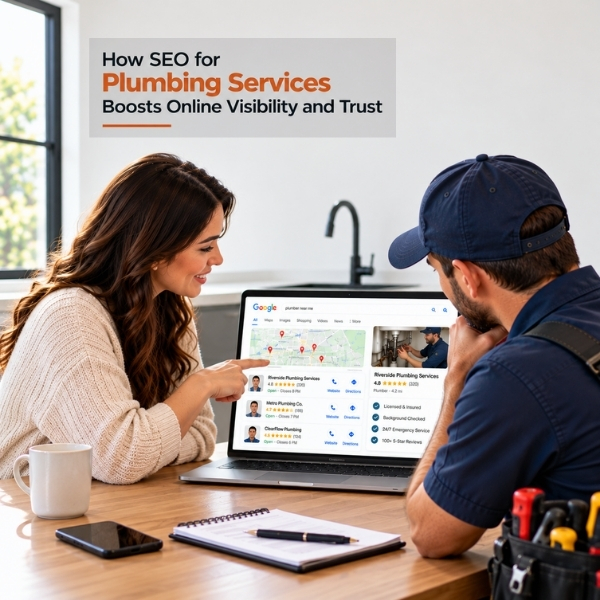
SEO controls two outcomes at once. It puts the business in front of people searching for plumbing help. It also shapes what those people see before they decide to call.
Search Result Placements
A plumbing search in 2026 often returns several layers of results:
- Sponsored Local Services Ads at the top
- The Local Pack, a map that typically shows three business listings
- Standard organic website results
- AI Overviews and answers from AI assistants
Local Services Ads are paid placements. SEO influences the rest: the Local Pack, organic listings, and the sources AI tools draw on when they recommend a plumber.
Pre-Click Trust Signals
Much of the hiring decision happens on the results page itself. Star ratings, review counts, recent review dates, photos, business hours, and service areas all appear before anyone opens a website.
Local trust signals such as reviews and schema markup can drive conversions before a searcher ever clicks through to the site. A plumber with a complete, active profile can win the call over a competitor with a better website and a neglected listing.
The Visibility and Trust Cycle
Visibility and trust feed one continuous cycle:
- Strong placement brings more profile views and calls.
- More calls lead to more completed jobs.
- More completed jobs create more opportunities for reviews.
- Fresh reviews strengthen prominence, which supports stronger placement.
A break anywhere in this cycle stalls growth. Plumbers with great service but no review process tend to lose visibility over time. Plumbers with high visibility but weak trust signals risk losing the click to a competitor one spot lower.
Why Does SEO Matter So Much for Plumbing Searches?
Plumbing demand is urgent, local, and high stakes. Each of those traits raises the value of search placement.
Emergency Search Behavior
Burst pipes, sewer backups, and failed water heaters create searches where the homeowner wants help within the hour. These searches often happen on a phone, right next to the problem, and the choice usually comes down to the first few listings.
A plumber missing from the Local Pack during an emergency search is hard for that homeowner to find. Click-to-call access and accurate hours matter as much as placement.
Planned Project Research
Repiping, water heater installation, and sewer line replacement are high-ticket jobs. Homeowners typically take time to read reviews, check credentials, and look for pricing before requesting a quote.
Trust signals carry more weight here than placement alone. A company in third position with recent, detailed reviews and visible licensing can outperform the first listing.
Service Area Limits
Google weighs relevance, distance, and prominence when choosing which local businesses to show. Distance means a plumber's real service footprint shapes where Local Pack placement is realistic.
Plumbing companies with more than one shop face this limit at every branch, and this guide to local SEO for multiple locations explains how to give each location its own visibility.
Organic pages can extend reach into nearby towns, but only with genuine local content. The table below shows how search intent changes what a plumbing business needs to show.
| Intent Type | Example Query | What the Searcher Needs to See | Best Page Type |
|---|---|---|---|
| Emergency | emergency plumber near me | Open now, phone number, response time | Google Business Profile, emergency service page |
| Urgent repair | water heater not working | Same-day availability, reviews | Service page |
| Planned installation | tankless water heater installation cost | Pricing guidance, credentials, project photos | Service page with pricing section |
| Research | Why is my water bill so high | A clear, expert answer | Blog post linked to a service page |
How Does SEO for Plumbing Services Increase Online Visibility?
Each part of plumbing SEO adds a different kind of visibility. The sections below explain what each one does and where it shows up.
Keyword Research and Intent Grouping
Keyword research identifies the exact phrases homeowners use for each service and location. Strong research groups terms into the four intent types above, then maps every group to one page so pages do not compete with each other.
Useful sources include Google autocomplete, Search Console queries, and the search terms listed in Google Business Profile performance reports. Office staff notes from incoming calls are an overlooked source, since they capture how customers describe problems in their own words, such as "water coming up through the basement drain."
Google Business Profile Completeness
The Google Business Profile is widely considered the most influential asset for Local Pack placement. Completeness covers the correct primary category, accurate secondary categories, a full services list, defined service areas, current hours, and real job photos.
Regular posts show Google that the business is active. Google has discontinued the old Q&A section and replaced it with an AI-powered feature called Ask Maps, which answers customer questions using the details a business has published. Complete, accurate profile information gives that feature better material to work with.
Service and Location Page Coverage
One page per high-value service gives Google a clear match for each search. Drain cleaning, water heater repair, repiping, leak detection, and emergency plumbing each deserve their own page.
Location pages work only with real local substance, such as common housing types, local water conditions, or permit requirements. Dedicated pages let one website compete for dozens of specific queries instead of one generic term.
The same one-page-per-service structure works across local service industries, and this guide on why photographers need SEO applies it to a very different trade.
Citation Consistency
Citations are listings of the business name, address, and phone number on other websites. Consistent details across directories help Google confirm that the business is real and correctly described.
Directories that matter for home services include Yelp, Angi, Nextdoor, and the state licensing board site where it offers a public lookup. Clean citations support Local Pack placement and keep outdated phone numbers away from customers.
Technical Site Health
Technical health decides whether Google can find and load every page. Plumbing sites need fast load times, HTTPS security, clean, crawlable structure, and an XML sitemap submitted in Google Search Console.
Click-to-call buttons belong near the top of every service page. A technically sound site can be fully indexed and gives mobile visitors fewer reasons to return to the results page.
Topical Content Coverage
Content built around clusters gives Google a complete picture of a plumber's expertise. A water heater cluster might include repair signs, tank versus tankless comparisons, maintenance schedules, and replacement cost factors, all linking to the water heater service page.
Each article should answer a real customer question in plain language. Coverage like this can earn placement for research queries and passes authority to the pages that book jobs.
Local Link Authority
Links from respected local and industry sources strengthen the prominence factor in local search. For plumbers, the most natural opportunities come from work they already do:
- Sponsorships of youth sports teams, school events, and community fundraisers
- Dealer or installer locator pages from water heater and fixture manufacturers
- Trade associations such as the Plumbing-Heating-Cooling Contractors Association
- Local chamber of commerce membership directories
- Local news coverage of community service work
Each of these links also shows homeowners the business has real roots in the area.
AI Search Presence
AI tools now play a real role in local discovery. Use of ChatGPT and other generative AI tools for local recommendations rose from 6% to 45% in a year, which makes AI the third most popular source of business recommendations.
Consistent details across the web, clear answers on the business website, and mentions on trusted third-party sources all shape what AI tools can say about a business. The same citation and content work that supports Google visibility also feeds how assistants describe a plumbing company.
Clear, answer-first service pages also improve the odds of being cited in Google's own AI summaries, and this guide on how AI Overviews are reshaping SEO covers how those answers select their sources.
How Does SEO Build Trust With Homeowners?
Trust signals turn a visible listing into a credible choice. The elements below work on the results page and on the website itself.
Review Volume, Ratings, and Recency
Reviews are the strongest trust signal in local search, and expectations keep rising. BrightLocal's 2026 survey found that 41% of consumers always read reviews when browsing for businesses, up from 29% the year before, and that 31% will only use a business with 4.5 stars or more, up from 17%. BrightLocal CEO Myles Anderson described reviews as "stable, sticky, and more important than ever."
Recency matters as much as volume. The same survey found that 74% of consumers look for reviews written in the last three months. A reliable system asks every customer for a review right after the job and sends a direct link by text.
Responses count too. Generic or templated replies make 50% of consumers unlikely to choose a business, so each reply should reference the actual job.
Reviews feed the prominence signal Google uses to rank local results, and this breakdown of how Google reviews affect SEO explains where they move visibility and where they do not.
Licensing, Insurance, and Certification Proof
Homeowners letting a stranger into their home want proof of competence. License numbers, proof of insurance, and manufacturer certifications belong on the website, in directory listings, and in the Google Business Profile wherever the guidelines allow.
Plumbing work involves gas lines, water heaters, and sewer systems, where mistakes carry safety risks. Clear credential information reassures searchers and supports the trustworthiness signals Google looks for in content.
Pricing and Estimate Transparency
Pricing has become a visibility issue as well as a trust issue. Google has added an "Online estimates" filter to local home service searches, including plumbing. When a homeowner applies it, contractors without online estimates disappear from view.
The matching Online estimates attribute can be switched on in the Google Business Profile. Google's own documentation on exact eligibility rules is limited. Marketing firms working with contractors report that online calculators, starting prices, and clear mentions of free estimates all support eligibility. Price ranges and diagnostic fees on service pages also give comparison shoppers a reason to call.
On-Site Reliability Signals
Reviews on Google do not carry over to the website automatically. Service pages build confidence when they show testimonials tied to a named service and town (shared with customer permission), written warranty terms, BBB accreditation, and trade association memberships.
Commitments such as response windows or satisfaction terms belong on the site only when the business consistently delivers them. A promise that fails in practice can quickly turn into negative reviews.
First-Hand Experience Signals
Generic service pages read as if any company could have written them. Pages that show real experience build far more confidence.
Consider a water heater page before and after improvement. The weak version is titled "Water Heater Services" and offers three paragraphs about quality, reliability, and customer satisfaction.
The strong version names the brands the team installs and explains the signs that point to repair versus replacement. It shows photos from actual local installations and introduces the technicians with their licensing and years in the trade. That page answers questions, proves expertise, and gives homeowners a reason to trust the company before calling.
Other home service trades rely on the same proof, and this guide to SEO for home builders shows how project photos and video build credibility before the first call.
Structured Business Data
Schema markup tells search engines exactly what the business is, where it operates, and what it offers. Plumbing companies can use LocalBusiness structured data with the Plumber type, along with service and area details.
The markup must match the Google Business Profile and citations exactly. Agreement across all three sources supports Google's confidence in the details it displays.
Which SEO Mistakes Damage Plumber Visibility and Trust?
Some shortcuts produce quick gains and lasting damage. These mistakes can hurt placement and credibility at the same time.
Duplicate or Unverified Listings
Duplicate Google Business Profiles split reviews between listings and confuse Google about which one is accurate. Unverified listings let outdated information circulate unchecked.
Copy-Swapped City Pages
Pages that swap one city name for another across identical text offer readers nothing new. Large sets of near-duplicate location pages can fall under the doorway abuse described in Google's spam policies.
Review Gating and Incentives
Asking only happy customers for reviews, or offering discounts in exchange for them, conflicts with Google's review content policies. Violations can lead to removed reviews and a profile that looks suspiciously perfect to customers.
Bought Links and Keyword Stuffing
Purchased backlinks and pages packed with repeated phrases such as "plumber in [city]" also fall under Google's spam policies. Recovery from spam penalties is often slow, while earned local links carry authority without that risk.
Avoiding these shortcuts is only half the job, and these SEO tips for small businesses cover the steady, policy-safe habits that build lasting visibility instead.
How Can Plumbers Measure Gains in Visibility and Trust?
Rankings alone do not show whether SEO is working. A useful measurement plan tracks visibility and trust as separate outcomes and connects both to booked jobs.
Visibility Metrics
These numbers show whether more people are finding the business:
- Impressions and clicks in Google Search Console for service and location queries
- Local Pack position across a grid of points within the service area
- Google Business Profile views, calls, direction requests, and website clicks
- Indexed page count and coverage errors
Trust Metrics
These numbers show whether people who find the business choose it:
- Review velocity, meaning new reviews per month
- Average rating trend over the past 90 days
- Review response rate and response time
- Growth in branded searches for the company name
- Call answer rate and the share of calls that become booked jobs
Call tracking numbers and GA4 conversion events connect these metrics to revenue. Separate tracking numbers for the website, the Google Business Profile, and each ad channel show which source produces booked work, not just calls.
On the Google Business Profile, enter the tracking number in the primary phone field and list the main business number as an additional phone, so citations stay consistent.
Branded search growth deserves close attention, since it shows homeowners now look for the company by name, and this guide on why brand signals matter for SEO explains how that demand strengthens visibility.
Scorecard Checks
The scorecard below keeps plumbing SEO focused on outcomes. Each item gets a yes or no answer every month.
Visibility checks:
- Google Business Profile details match the website and top citations
- Every core service has its own optimized page
- No new crawl or indexing errors appear in Search Console
- At least one new helpful article or service page update went live
- Local Pack position held or improved for the top five service terms
Trust checks:
- New reviews arrived in each of the last four weeks
- Every review received a personalized response
- License and insurance details are current across all listings
- Pricing or estimate information is visible on key service pages
- Booked jobs from organic and Google Business Profile calls held or grew
A Real Client Example
Kaizen Global helped a residential plumbing company improve its local SEO visibility, Google Business Profile performance, and lead generation across one mid-sized city and three nearby suburbs.
The campaign began with several clear gaps: inconsistent directory information, an incomplete Google Business Profile, no dedicated service pages, limited recent reviews, and no pricing or estimate information on the website.
Kaizen Global addressed these issues by:
- Correcting directory listings and optimizing the Google Business Profile.
- Adding dedicated pages for drain cleaning, water heater repair, and emergency plumbing.
- Implementing a review-generation process after completed jobs.
- Building a water heater content cluster and earning a relevant local backlink.
Results After Six Months
| Metric | Month 0 | Month 6 |
|---|---|---|
| New Google reviews/month | 0 | 9 |
| Average rating | 4.3 | 4.6 |
| GBP calls/month | 38 | 71 |
| "Water heater repair" Local Pack | Not top 3 | #2 |
| Booked jobs/month | 22 | 43 |
The campaign increased local visibility, Google Business Profile calls, reviews, and booked jobs through a focused local SEO and content strategy.
What Does a Realistic Plumbing SEO Timeline Look Like?
Plumbing SEO compounds over time, and timelines vary with local competition and the starting strength of the business profile. Published estimates range from three to six months to a 12-month-plus effort, and these phases explain the gap.
First 30 Days
The first month covers Google Business Profile cleanup, a citation audit, technical repairs, and the launch of a review request process. Businesses with obvious profile gaps may see call volume improve from these fixes alone.
Months Two to Four
Dedicated service pages go live, and on-page optimization tightens. Local Pack movement often begins in the area closest to the business location.
Months Five to Twelve
Content clusters, earned links, and steady reviews widen the area where the business competes. Crowded metro markets typically sit at the longer end of this range, while less competitive towns may move faster.
Ready to Turn Search Visibility Into Booked Plumbing Jobs?
Kaizen Global's SEO services help plumbing businesses get found and trusted. The work covers profile optimization, service pages, citations, and review systems, and every plan is measured by calls and booked jobs.
Book a consultation with Kaizen Global to see where your fastest gains are.
Frequently Asked Questions
How do Local Services Ads and the Google Verified badge fit with plumbing SEO?
Local Services Ads are pay-per-lead placements above organic results, which makes them useful while SEO builds momentum. Google replaced the Google Guaranteed badge with a single Google Verified badge for advertisers who pass its screening, and it discontinued the associated Money Back Guarantee. The badge belongs to the ad program, and Google has not described it as an organic or Local Pack ranking factor.
Can a plumbing business appear in the Local Pack without a storefront address?
Yes. Plumbers who serve customers at their homes can set up a service area business profile, hide the street address, and define the cities or zip codes they cover. Mailbox services, P.O. boxes, and unstaffed virtual offices violate Google's Business Profile guidelines and risk suspension.
Can a plumber show up in nearby cities without an office there?
Local Pack placement depends heavily on distance, which makes the map difficult to win far from the business location. Organic results offer more room. A page for a nearby city with genuine local detail and real project examples from that area can earn organic placement there.
Do reviews outside Google matter for plumbers?
They matter more each year. The average consumer now checks six different review sites, and Google's share as a review source fell from 83% to 71% in a year while Apple Maps nearly doubled. Spreading review requests across Google, Facebook, Yelp, and Nextdoor keeps every profile current.
How many reviews does a plumber need to compete locally?
The bar is set by local competitors, but consumer expectations set a floor. BrightLocal found that 47% of consumers will not use a business with fewer than 20 reviews. Beyond that floor, a useful benchmark is the review count of the three businesses in the Local Pack for the company's main service terms.
How should a plumbing company respond to a fake negative review?
The first step is flagging the review through the Google Business Profile as a policy violation. While Google evaluates the flag, a short, calm public reply can state that no record of the job exists and invite the reviewer to call the office. Future customers judge the reply as much as the review, so customer details and arguments stay out of it.
Does publishing prices on a plumbing website help or hurt conversions?
Price ranges usually help when they include context. Plumbing costs depend on access, parts, and pipe condition, so "starting at" figures and diagnostic fees work better than fixed quotes. Reviewing those figures every few months keeps them accurate as material costs change.
Take control of your smart contract security - Request a professional Smart Contract Audit today and ensure the solidity of your blockchain projects
Insights

Mobile Seo Checklist - A Complete Guide
Mobile SEO refers to optimizing your website to ensure it performs well on mobile devices, offering a seamless user experience ...

25-Step SEO Migration Checklist
Migrating your website can feel like a daring task filled with potential challenges. No matter if you're redesigning your site ...

Local SEO Checklist: Maximize Your Local Reach
Local search engine optimization (SEO) has become essential for businesses aiming to connect with their community and attract nearby ...