How to Get to the Top of Google Search Through SERP and Competitor Analysis
Updated : September 4, 2026
Getting to the top of Google search results requires a systematic study of the search engine results page and the pages already ranking there for a target keyword, followed by building a page through Search Engine Optimization (SEO), which involves relevance, authority, and quality, that outperforms whatever currently ranks there. Most guidance on ranking higher treats keyword research, content creation, and backlinks as separate checklists. In practice, every one of those checklists should be informed by what Google is already rewarding for that specific query. The SERP itself is the clearest evidence available of what Google's ranking systems consider a strong answer. The sections below walk through each stage in order. Working through them in sequence turns the framework into a page ready to compete for the top spot.
Choose and Prioritize the Right Keyword Before Analyzing Any SERP
A SERP audit is only worth running on a keyword that can drive a meaningful result. Before opening a single search result, narrow a broad topic down to a shortlist worth the analysis time.
Weigh Demand Against Difficulty
Three figures matter most when shortlisting a keyword:
- Search volume, which indicates how many people are searching the term at all
- Keyword difficulty, which indicates how hard the current top ten will be to displace
- Business relevance, which indicates whether ranking for the term would actually drive a qualified visitor
A high-volume, low-relevance keyword wastes production effort on traffic that never converts. A highly relevant, low-volume keyword can still be worth pursuing if it represents a searcher close to a decision.
Start With Long-Tail Variations
Long-tail keywords, the longer and more specific phrases branching off a core topic, typically carry lower difficulty and clearer intent than the broad seed term they come from. Building early wins on long-tail variations, then using those pages to support a later push at the more competitive seed keyword, is a more realistic path for most sites than attempting the hardest keyword first. Once you set and prioritize a shortlist, each keyword becomes a candidate for the SERP analysis described below.
Why the SERP Is the Real Brief for Any Piece of Content
Before writing a single sentence, the search results page for a target keyword tells a content team almost everything it needs to know about what Google expects. The ranking pages reveal:
- The intent Google has decided the query represents
- The format it favors
- The depth it rewards
- The SERP features it triggers
Skipping this step and writing from assumptions is one of the most common reasons that otherwise well-written content fails to rank. A page built around the wrong intent, the wrong format, or a shallower treatment than the current top ten will struggle regardless of how polished the writing is.
Identify the Search Intent Behind the Keyword
Search intent falls into four broad categories: informational, navigational, commercial, and transactional. Google sorts each keyword into the intent it believes searchers hold, and the ranking pages reflect that decision far more reliably than any keyword tool label. A search for "best running shoes for flat feet" returns product roundups and buying guides rather than a single product page. This signals commercial investigation intent. A search for a specific shoe model by name is more likely to surface the retailer's product page directly, reflecting transactional or navigational intent. Reading the top ten results for a target keyword and noting the dominant page type is the fastest way to confirm intent before drafting begins.
Study the SERP Features Present
Modern search results rarely consist of ten blue links. Several features now compete for the same visual space, and each one changes what a page needs to do to earn visibility:
- Featured snippets
- People Also Ask boxes
- Image packs
- Video carousels
- Local packs
- AI Overviews
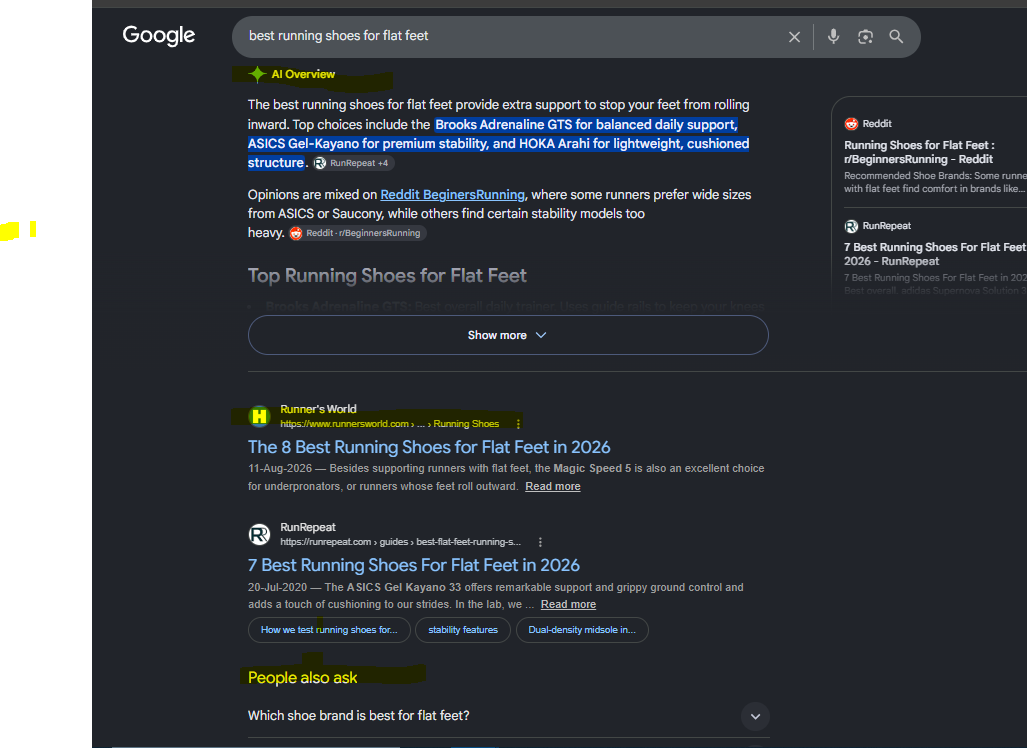
Annotated Google search results page for best running shoes for flat feet, showing AI Overview, People Also Ask, and organic listings. A keyword that triggers an AI Overview rewards content structured with clear, direct answers near the top of a section. Google's generative systems tend to pull from pages that state a conclusion plainly before elaborating. A keyword that triggers a People Also Ask box reveals related questions worth answering directly inside the content, since those questions represent genuine subtopics searchers care about. Recording which features appear, and which competing pages are winning them, shapes the content brief before a single paragraph gets written. The broader shift toward AI-driven search results is worth understanding beyond snippet formatting alone, covered in more depth in Google AI Overviews and SEO.
Note the Content Format Google Rewards
Beyond intent and features, the SERP shows the format Google's ranking systems currently favor for that query. This might be:
- Long-form guides
- Short direct-answer pages
- Listicles
- Comparison tables
- Video content
Matching that format is not about copying competitors. It is about recognizing that Google has already tested many formats against real user behavior for that query and settled on what satisfies searchers. A query returning mostly comparison tables and short buying guides is a poor candidate for a 4,000-word narrative essay, no matter how well researched. A query returning in-depth explainer content rewards genuine depth and would be poorly served by a thin, surface-level summary.
How to Conduct a Thorough Competitor Analysis
Once the SERP has been read for intent, features, and format, the next step is a structured audit of the individual pages occupying the top positions. This is where content gap analysis and information gain opportunities become visible.
Identify the Real Organic Competitors
The businesses a company considers competitors and the pages actually ranking for a target keyword are frequently different lists. A regional service business might view a handful of local firms as competition, while the SERP is actually dominated by national directories, review aggregators, or industry publications with no direct business relationship to the query at all. Pulling the top ten to twenty organic results for each priority keyword, rather than relying on an assumed competitor list, produces a far more accurate picture of who actually needs to be outperformed. Very large, high-authority sites are useful to study but difficult to outrank directly. Similarly sized or newer competitors often represent the more realistic and immediate opportunity.
Audit Competitor Content Depth and Structure
For each ranking page, a useful audit records:
- The heading structure
- The subtopics covered under each heading
- The approximate word count
- The presence of original data or examples
- Any multimedia used
Word count and term frequency scripts are more reliable for this than manual estimation. Manually skimming a page tends to underestimate how much ground it actually covers. The audit should also note what each page does poorly. Look for sections that feel thin, claims made without support, outdated statistics, or subtopics mentioned but never fully explained. These weak points are exactly where a new or revised page can add value that neither Google nor the searcher had access to before.
Find the Content Gaps Competitors Left Behind
Content gap analysis compares the subtopics covered across every ranking page against the full range of questions a searcher with that query might reasonably have. Subtopics that appear in only a few of the ranking pages, or that appear but are treated superficially everywhere, represent genuine opportunities to build a more complete resource. This differs from simply writing a longer page. A page that answers every subtopic competitors already cover, plus the two or three genuinely useful angles none of them addressed well, tends to outperform a page that is merely longer without being more complete. The goal is topical completeness measured against what a searcher needs, not against an arbitrary word count target.
Analyze Competitor Backlink Profiles
Backlinks remain one of the clearest trust signals search engines use. Reviewing where the ranking pages earn their links reveals both the domains worth pursuing for outreach and the type of content that tends to attract links in that space. Original data, comprehensive guides, free tools, and well-designed visual assets are typically what earns links naturally. Noting which competitor pages have attracted the most referring domains often points directly at what kind of asset is worth building. Reviewing referring domain quality matters more than counting total links. A page with fewer backlinks from topically relevant, reputable sources frequently outranks a page with a larger number of weak or unrelated links, since Google weighs relevance and trust alongside raw volume.
Turning SERP and Competitor Insights Into Content That Outranks
With SERP intelligence and a competitor audit in hand, the actual content build becomes far more targeted. Every decision, from the outline to the individual sentences, can be traced back to a specific gap or opportunity uncovered in the research phase.
Build a Topical Hierarchy That Surpasses the Competition
A strong topical hierarchy organizes a page so that the primary heading answers the core query directly, with subheadings covering every subtopic a thorough competitor analysis surfaced. Google's language systems are sophisticated enough to understand how a page relates to many related queries even without exact keyword matches. The priority is comprehensive, logically ordered coverage rather than keyword density. A clear content hierarchy typically follows this pattern:
- H1: The core topic, stated directly
- H2: Major sections covering each primary subtopic
- H3: Supporting detail within each section
- H4: Individual items, tools, or examples where separate treatment helps
This structure also happens to be what performs well for featured snippets and AI Overviews, since both tend to pull from clearly labeled, self-contained sections.
Close Information Gaps With Original Insight
Information gain, the concept of adding something genuinely new relative to existing top-ranking content, is one of the strongest differentiators available once basic topical coverage is matched. A few sources of genuine information gain:
- Original examples drawn from real work
- First-hand experience with the topic
- Proprietary data or original research
- A genuinely different framing of a familiar problem
Rewriting existing content in different words does not create information gain, no matter how polished the result reads. This is also where experience and expertise signals, the E and E in E-E-A-T, become part of the writing itself rather than an afterthought. A page written by someone who has actually done the work being described reads differently than one assembled purely from research. Google's Search Quality Rater Guidelines explicitly value that distinction, and Google's guidance on creating helpful, reliable, people-first content reinforces it directly, though it is worth noting that E-E-A-T functions as a quality framework Google's raters use to evaluate content rather than a direct, measurable ranking factor in the algorithm.
Structure Content for Featured Snippets and AI Overviews
Pages that answer a specific question in a short, self-contained paragraph immediately after the heading that poses it stand a much better chance of being selected for a featured snippet or cited in an AI Overview. The right format depends on the question:
- Numbered steps work well for process-based questions
- Short definitional paragraphs work well for "what is" queries
- Comparison tables work well when a searcher is weighing options
None of this requires sacrificing depth elsewhere on the page. A concise, direct answer near the top of a section followed by fuller context and nuance below it serves both the searcher who wants a fast answer and the searcher who wants to understand the topic thoroughly.
Prioritize Which Gaps to Close First
A thorough competitor audit routinely surfaces more gaps than a single page can address well. Ranking them before drafting begins prevents a page from trying to do everything at once and doing none of it thoroughly. A simple way to rank each gap:
- Demand: does this subtopic show up in People Also Ask, related searches, or multiple competitor pages, or does only one weak page mention it
- Competitive weakness: is every ranking page thin here, or does one page already cover it well
- Alignment: does the business have genuine expertise or first-hand experience to draw on for this specific gap
A gap that scores high on all three belongs in the outline. A gap that scores low on alignment is often better addressed with a quote or contribution from someone who does have that experience, rather than forced into the draft without it.
A Worked Example: From SERP Read to Published Page
Applying the framework to a single keyword shows how the pieces connect in practice. Take the keyword "best CRM for small teams."
Step One: Read the SERP
The top ten is dominated by comparison listicles and one interactive tool, confirming commercial investigation intent. A People Also Ask box surfaces the question "is a free CRM good enough for a small team," which none of the top five results answers directly.
Step Two: Audit the Competitors
Three of the top five pages list ten or more tools with a paragraph each but never address pricing tiers beyond the free plan. Two pages have review dates over a year old, and one lists a product that was acquired and rebranded eight months earlier.
Step Three: Identify and Prioritize the Gaps
The unanswered free-versus-paid question scores high on demand, since it appears in People Also Ask and is absent from the strongest competitors. The outdated pricing and acquisition information scores high on competitive weakness, since it is a factual error competitors have not corrected.
Step Four: Build the Page
The resulting outline leads with a direct answer to the free-versus-paid question, corrects the outdated pricing and naming, and organizes the remaining tools by team size rather than as an undifferentiated list, since none of the audited competitors segmented by that variable.
On-Page SEO Elements That Reinforce the Competitive Edge
Strong content still needs the supporting on-page elements that help search engines interpret and display it correctly. None of these elements will compensate for thin or poorly researched content, but skipping them undermines even the strongest research and writing. Running through a complete On-Page SEO Checklist alongside this section catches anything the outline below misses.
Title Tags, Meta Descriptions, and Headings
A strong title tag should:
- Be unique to the page
- Include the primary keyword naturally
- Stay concise enough to display fully in search results, generally under about sixty characters
A reliable template pulled straight from the SERP audit: primary keyword, a specific qualifier the competitor audit revealed was missing, and the brand name. For the CRM example above, that produces something like "Best CRM for Small Teams: Free vs. Paid Compared (2026)" rather than a generic "Best CRM Software" title matching what the weaker competitors already used. The meta description does not directly influence rankings. A clear, compelling summary under roughly one hundred fifty characters still improves click-through rate from the results page, which is the actual goal of that element. Heading tags should follow a logical hierarchy, with a single H1 that states the page's core topic and H2s that break the page into its major sections. Google's SEO Starter Guide states plainly that heading order and count are not themselves ranking factors, but a clear hierarchy still helps both readers and crawlers understand how a page is organized.
URL Structure and Internal Linking
Short, descriptive URLs that include relevant words rather than random identifiers help both users and search engines understand what a page covers before they click. Internal links from related, already-published content point search engines toward new or updated pages and help distribute topical authority across a site's content cluster. Effective internal linking connects a pillar page covering a topic broadly to individual posts covering specific subtopics in depth, with anchor text that describes the destination page accurately rather than generic phrases like "click here." This structure mirrors the pyramid model search engines navigate most efficiently:
- A homepage links to category-level pages
- Category-level pages link to pillar content
- Pillar content links to detailed supporting posts
Images, Alt Text, and Structured Data
Every image should include descriptive alt text that explains what the image shows. This matters both for accessibility and for search engines that cannot interpret pixels the way they interpret text. Compressing images and choosing descriptive file names supports both search visibility and page speed. Structured data does not directly move rankings on its own. It does make a page eligible for enhanced search result formats such as review stars, FAQ accordions, and other rich results that can meaningfully improve click-through rate. A page that includes a genuine FAQ section, like the one closing this guide, is a natural candidate for FAQPage schema, provided the markup matches the visible questions and answers exactly. Schema markup should always be verified against a page's actual content rather than assumed from what similar sites use, since inaccurate structured data creates more risk than benefit.
Technical SEO Foundations Competitor Analysis Cannot Fix
Even the most complete content built from a thorough SERP and competitor analysis will underperform if the underlying site has technical barriers preventing Google from crawling, indexing, or fairly evaluating it. Working through a full Technical SEO Checklist is the fastest way to confirm none of those barriers is already present.
Core Web Vitals and Page Experience
Google treats page experience as a factor in how pages are evaluated for ranking, measured largely through Core Web Vitals:
- Largest Contentful Paint, which tracks how quickly the main content loads
- Cumulative Layout Shift, which tracks unexpected movement as the page renders
- Interaction to Next Paint, which tracks how quickly the page responds to clicks and taps
A page that loads slowly or shifts unexpectedly creates friction for visitors regardless of how well the content itself is written. The relationship between Core Web Vitals and user experience goes deeper than passing a technical threshold, since a page can score well on paper and still feel slow or clunky to real users. Google also evaluates the mobile version of a page first when deciding how to index and rank it, a practice known as mobile-first indexing. A page that hides content, collapses navigation awkwardly, or performs noticeably worse on a phone than a desktop is being judged primarily on that weaker mobile experience, not the stronger desktop one. Working through a full Mobile SEO Checklist catches these issues before they affect how Google evaluates the page. Testing pages through tools like Google's PageSpeed Insights surfaces the specific bottlenecks to fix, whether that means compressing images, reducing unnecessary scripts, or improving server response time. This closes a gap that pure content quality cannot close on its own.
Crawlability and Indexing
A page that Google cannot crawl or has not indexed will never appear in search results regardless of its quality. A few foundational checks to confirm before investing further in content:
- Whether a site's important pages are actually indexed
- Whether robots.txt is accidentally blocking key pages
- Whether broken internal links need fixing
- Whether duplicate content needs resolving through canonical tags
Google's own Search Essentials guidance is clear that sites following basic technical requirements are simply more likely to be crawled, indexed, and evaluated fairly. This makes the groundwork above a prerequisite rather than an optional enhancement.
Building Authority Through Backlinks and Trust Signals
Backlinks from relevant, reputable sources remain one of the strongest signals a search engine uses to judge whether a page deserves prominent placement. The competitor backlink audit described earlier should feed directly into a targeted outreach strategy rather than a generic, high-volume link building campaign.
What Tends to Earn Links Naturally
- Guest contributions to genuinely relevant industry publications
- Original research or data that other sites want to cite
- Digital PR around a well-built resource
These approaches tend to earn links more sustainably than directory submissions or paid link schemes, which carry real risk of penalty.
Turning the Backlink Audit Into an Outreach List
The competitor backlink audit already identified which domains link to the ranking pages. Three tactics turn that list into actual outreach:
- Broken link building: find pages on those domains linking to content that no longer exists, and offer the newly built page as a working replacement
- Unlinked mention reclamation: search for existing mentions of the brand or its content that were never linked, and request that a link be added
- Direct relevance pitching: for domains linking to a competitor's weakest page, a direct pitch pointing out that the new page closes the specific gaps identified in the audit tends to convert better than a generic outreach template
Reinforcing Trustworthiness
Trustworthiness, the final letter in E-E-A-T, is reinforced not only by backlinks but by:
- Accurate information
- Transparent sourcing
- A byline that reflects real expertise on the subject matter
These signals compound over time as a site consistently publishes reliable content.
Extending the SERP and Competitor Audit Framework to Local SEO and Google Business Profile
For businesses competing on geographically specific queries, ranking at the top of organic search results is only part of the picture. Google frequently displays a local pack alongside or above the organic listings, and that pack deserves the same audit treatment already applied to the organic SERP.
Audit the Local Pack the Same Way
Searching the target keyword with a "near me" or city-level qualifier surfaces the local pack competitors, which are frequently a different set of businesses than the organic competitors identified earlier. Recording each local competitor's review count, review recency, listed categories, and posted photos reveals the same kind of gap the organic audit surfaced: businesses with outdated profiles, thin descriptions, or categories that only loosely match the search.
Google Business Profile Fundamentals
A complete, accurate Google Business Profile plays a significant role in whether a business appears in that local pack. This includes:
- Business name, address, and phone number
- Accurate category
- Current hours
- A description that reflects the services actually offered
These fundamentals cover the starting point, but a full Local SEO Checklist works through every field and signal worth auditing in one pass.
Ongoing Local Signals
Beyond the profile itself, a few habits reinforce local relevance over time:
- Encouraging genuine customer reviews and responding to them consistently
- Keeping listing information identical across every directory a business appears in
- Building location-specific content on the website itself, informed by the same subtopic gaps the organic competitor audit already found
Tracking, Iterating, and Staying Ahead as Competitors Change
SERP and competitor analysis is not a one-time exercise performed before a page is published. Rankings shift as competitors update their own content, as Google rolls out algorithm updates, and as a topic's available information changes over time.
What to Monitor
Monitoring keyword positions, organic traffic, and click-through rate through Google Search Console for published pages reveals which pages are losing ground and need revision versus which are stable and simply need routine maintenance.
Specific Triggers That Warrant a Fresh SERP Read
Rather than reviewing every page on a fixed calendar regardless of performance, a few concrete signals indicate a page needs a fresh SERP and competitor audit sooner:
- A ranking drop of three or more positions that holds for two consecutive weeks
- A new SERP feature appearing for the keyword, such as an AI Overview or a featured snippet the page does not currently hold
- A competitor page visibly expanding, adding sections, or being republished with a new date
- The page itself passing twelve months without a content review, regardless of ranking stability
Once a trigger is identified, the practical mechanics of making those changes are covered separately in How to Update Content for SEO.
Repeat the Competitor Audit, Not Just the Ranking Check
Page-level gap analysis, essentially repeating the competitor audit process against a page's current competition rather than only its original competition, is often the most effective way to identify why a previously strong page has started slipping and what specific additions would restore its position. A ranking check alone shows that a page has slipped; a repeated competitor audit shows why. Running that repeated audit against the full SEO Checklist for Optimizing Your Website keeps the review consistent every time it happens.
Frequently Asked Questions
How long does SERP and competitor analysis take before writing a piece of content?
A focused SERP and competitor audit for a single target keyword typically takes between one and three hours, depending on how many competing pages need review and how competitive the keyword is. Investing that time upfront consistently saves far more time later, since it prevents building content around the wrong intent, format, or depth and having to substantially rewrite it after publication.
What tools are needed to analyze a SERP and its competitors effectively?
A combination of manual review, a keyword research platform for volume and difficulty data, a backlink analysis tool for competitor link profiles, and a site crawler for technical audits covers most of what a thorough analysis requires. Manual review of the actual search results page remains essential regardless of which paid tools are available, since no tool fully replaces reading what Google is actually showing for a query.
How can a brand new website start ranking on Google with no existing traffic?
A new domain benefits most from targeting mid-competition, long-tail keywords where the current top ten is weaker and easier to challenge, rather than aiming straight at terms dominated by pages with years of accumulated authority. Prioritizing those easier terms first builds early rankings that support a later push at more competitive keywords.
Is it okay to copy the structure of a top-ranking competitor's page?
No. Copying a competitor's structure reproduces its blind spots along with its strengths. A competitor audit exists to find where the current top results fall short so a new page can improve on them, and pages that read as close rewrites of an existing result rarely outperform the original they were modeled on.
Do Google Ads affect organic SEO rankings?
Paid ad placements do not directly influence organic rankings, but reviewing which advertisers consistently bid on a keyword still adds a useful signal. A keyword attracting steady paid competition usually reflects genuine commercial demand, which is worth weighing alongside organic difficulty when deciding which keyword to prioritize.
How many competitors should I analyze for SEO?
The top ten organic results form the baseline, since Google's ranking systems have already validated those pages for the query. Extending the review to positions eleven through twenty is worth the extra time mainly on highly competitive keywords, where the content gap between position ten and position fifteen is often small enough to still be useful.
Is SEO different for product pages than for blog posts?
The core process applies to both, but the signals reviewed during the audit shift. Product pages should weigh structured data, pricing visibility, and review markup more heavily, while blog content should weigh subtopic coverage and format more heavily, since the SERP features and searcher expectations differ between the two page types.
Put SERP and Competitor Intelligence to Work with Kaizen Global
A page rarely reaches the top of Google through guesswork. Getting there takes a disciplined process: choosing the right keyword, reading its SERP accurately, auditing what the current top-ranking pages do well and where they fall short, and building content, structure, and authority signals deliberately around those findings. Kaizen Global's SEO services, alongside dedicated content writing services, apply this exact process to every client engagement, from the initial keyword shortlist through the published page and its first performance review. Businesses ready to see this framework applied to their own site can schedule a call through Calendly or reach out directly through the contact us form.
Put SERP and Competitor Intelligence to Work with Kaizen Global
Insights

Mobile Seo Checklist - A Complete Guide
Mobile SEO refers to optimizing your website to ensure it performs well on mobile devices, offering a seamless user experience ...
25-Step SEO Migration Checklist
Migrating your website can feel like a daring task filled with potential challenges. No matter if you're redesigning your site ...

Local SEO Checklist: Maximize Your Local Reach
Local search engine optimization (SEO) has become essential for businesses aiming to connect with their community and attract nearby ...