How to Optimize a Cat Rescue Website for SEO
By Hassan Khan, SEO Expert at Kaizen Global | Updated October 2026
Optimizing a cat rescue website for SEO comes down to four steps: use the words people actually search, give every adoptable cat its own indexable page, set up a Google Business Profile, and fix the technical basics that slow photo-heavy pages. Together, these put the rescue in front of adopters, fosters, and people who just found a stray kitten nearby.
Done well, cat rescue SEO turns the website into a steady source of adoption applications, foster signups, and donations. Every step below works with free tools and a few volunteer hours each month.
What Does SEO Mean for a Cat Rescue Website?
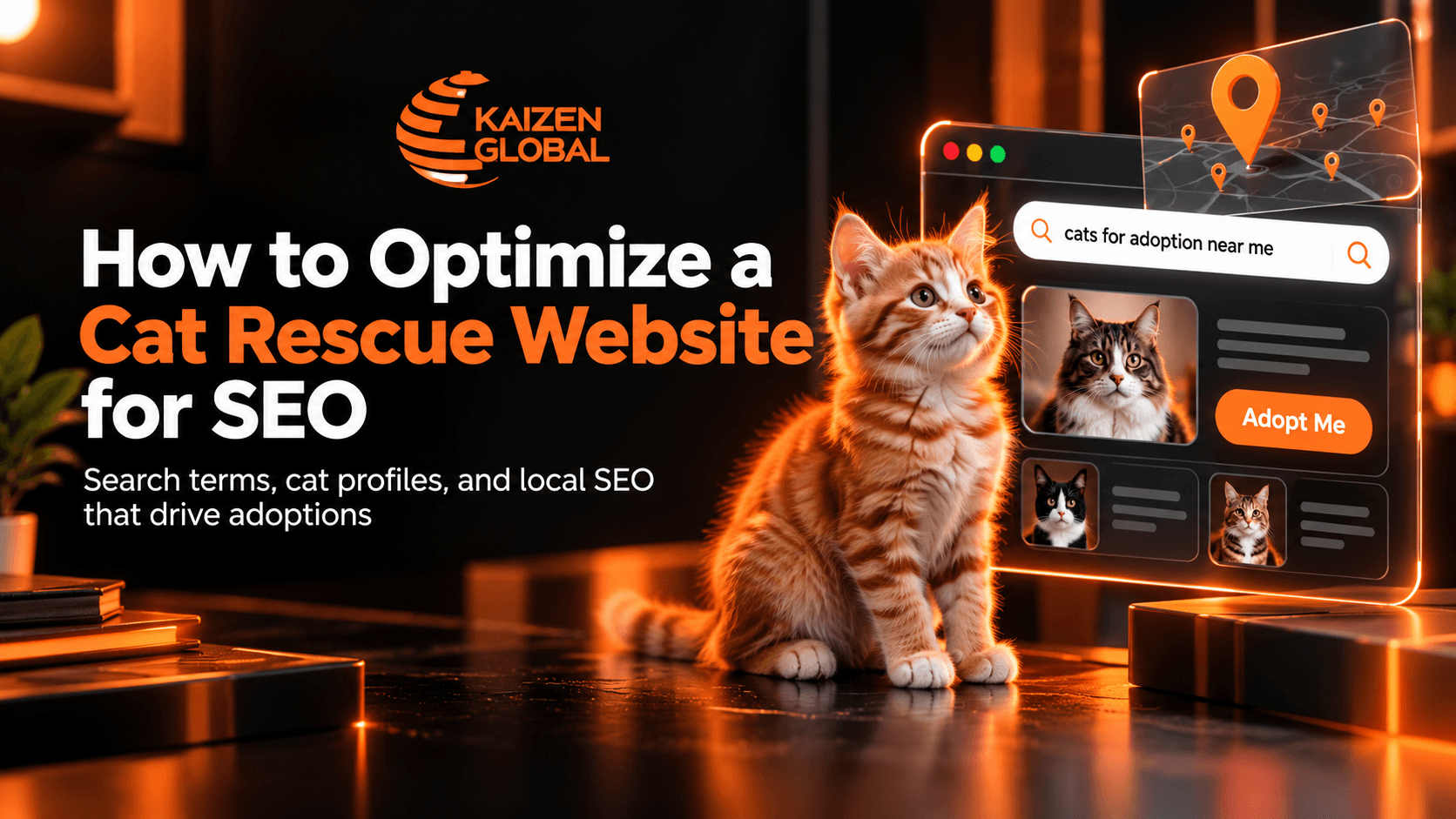
For a rescue, SEO is about reaching the right person at the right moment, not chasing traffic totals. A family ready to adopt and a neighbor who just found kittens under a porch both need the rescue, but they search in very different ways.
Who Searches for Cat Rescues
Each audience should land on one page built around one action.
| Audience | Typical search | Best landing page |
|---|---|---|
| Adopters | kittens for adoption near me | Adoptable cats page |
| Owners rehoming a cat | rehome my cat | Surrender page |
| People who found strays | found a kitten what do I do | Found-kitten guide |
| Fosters and volunteers | foster kittens in [city] | Foster or volunteer page |
| Donors and businesses | donate to cat rescue near me | Donation page |
| Reporters and community groups | [city] cat rescue | About or press page |
Where Rescue Websites Lose Visibility
- Adoptable cats load only inside a third-party widget, which Google may not index as part of the rescue's own page.
- The site never states the city, county, or region it serves.
- Pages are thin, often a single photo and two lines of text.
- Updates and urgent appeals live only on social media.
How Do People Search for Cats to Adopt, Foster, or Surrender?
The public does not use shelter vocabulary. Pages written in rescue shorthand miss many of the searches that matter most.
The table below matches rescue terms to the phrases people actually search.
| Rescue term | What people type |
|---|---|
| Owner surrender | rehome my cat, give up my cat |
| Intake | where can I take a stray cat |
| TNR | what to do about feral cats |
| Foster program | foster kittens near me |
| DSH | tabby cat for adoption |
| Neonatal kittens | found baby kittens with no mother |
| Barn cat program | barn cats for adoption, working cats |
Three free tools reveal how local people word their searches.
- Google autocomplete shows common phrasing as a query is typed.
- Google Trends compares terms by region and season.
- The Search Console Performance report lists queries already bringing visitors.
Rescues serving bilingual communities should check these tools in each language. Surrender and found-kitten searches often happen in Spanish as well as English, and a translated surrender page can reach people no English page will.
Adoption Searches
Adoption searches tend to be local and specific, which signals strong intent.
- kittens for adoption near me
- adopt a bonded pair of cats
- senior cats for adoption in [city]
- FIV positive cat adoption
Surrender and Rehoming Searches
Owners in a difficult situation type "rehome my cat," "where can I take my cat," or even "get rid of my cat." Using that last phrase once, in a compassionate paragraph, helps the surrender page reach the people who need guidance most.
Stray and Kitten Emergency Searches
Searches such as "found a kitten what do I do," "feral cat in my yard," and "TNR program near me" surge in spring and summer. A helpful answer often turns these visitors into future fosters, donors, or adopters.
Volunteer, Foster, and Donation Searches
Supporter searches such as "volunteer at a cat shelter" have lower volume. Each visitor, however, is a potential long-term supporter.
Which Pages Should Every Cat Rescue Website Have?
Clear structure helps Google understand what the rescue covers and helps stressed visitors find the right page in seconds.
Mission, Location, and Service Area Pages
The About page should state who runs the rescue, its nonprofit status, years in operation, and the areas it serves. Separate area pages make sense only with unique content, such as local partner vets or event locations. Cloning one page with different town names creates doorway pages, which Google's spam policies prohibit.
Adoptable Cats Page With Filters
This page lists every available cat and links to each profile. Useful filters include kittens, adults, seniors, bonded pairs, special needs, and cats good with dogs. Giving key filters their own URLs, such as /adopt/cats/bonded-pairs/, lets them appear for searches like "bonded cats for adoption in [city]."
Program Pages for Fostering, TNR, and Surrender
Each program page should cover four things.
- What the program is
- Who qualifies
- What happens after applying
- How to apply or get in touch
Surrender pages should also explain waitlists and alternatives such as rehoming assistance.
Help and Resource Pages for the Public
Guides on found kittens, feral colonies, and low-cost spay and neuter services answer the questions the rescue hears every week. These pages also attract links from other local sites.
Internal Links Between Rescue Pages
Internal links show Google which pages matter most and help visitors move from reading to acting.
- The home page links to Adopt, Foster, Surrender, Help, and Donate.
- The adoptable cats page links to every profile, and each profile links back along with the application.
- Help guides link to the matching program, so a found-kitten guide points to the foster page.
- Blog posts link to specific cats where relevant, such as a bonded-pair article linking to bonded pairs currently available.
- Descriptive anchor text such as "foster kittens in [city]" works better than "click here."
- Every profile should be reachable from at least one page, since orphaned profiles are slow to get indexed.
How Should Core Pages Be Optimized for Search and Trust?
Core pages carry the rescue's most important searches. Each one needs a distinct keyword focus, a clear title, and visible proof that the organization is legitimate.
Keyword Mapping for Core Pages
Assigning one primary search term to each page stops pages from competing with each other.
| Page | Primary search term | Example title tag |
|---|---|---|
| Home | cat rescue in [city] | [Rescue Name] Cat Rescue in [City] |
| Adoptable cats | cats for adoption in [city] | Cats and Kittens for Adoption in [City] |
| Foster | foster kittens in [city] | Foster Kittens and Cats in [City] |
| Surrender | rehome my cat in [city] | Rehome or Surrender a Cat in [City] |
| Donate | donate to cat rescue | Donate to Help Rescue Cats in [City] |
Meta descriptions should state the action and the area served in one or two plain sentences. Blog posts can then target longer questions without overlapping these core terms.
Trust Signals for Adopters and Donors
Visitors and search engines both look for evidence that a rescue is real and accountable. These signals belong on the About page and in the footer.
- 501(c)(3) status and EIN
- Annual report or a link to the Candid profile
- Board members and key volunteers with names and roles
- Partner veterinary clinics
- A physical mailing address or service area, phone number, and email
Conversion Basics for the Donation Page
The donation page should load quickly, explain what different gift amounts pay for in plain terms, and offer recurring giving. A secure, embedded form that keeps donors on the rescue's domain builds more trust than sending them to an unfamiliar third-party site.
How Should Adoptable Cat Profiles Be Optimized?
Profiles are the pages adopters care about most, and they are also the pages rescues neglect most often.
Unique Bios Instead of Copied Listing Text
When an identical bio appears on the rescue site, Petfinder, and Adopt-a-Pet, Google usually shows only one, often the larger platform. A longer, original bio on the rescue's own site gives that page a reason to appear, while listing platforms can carry a shorter version that links back.
Photo and Video Optimization
- Rename files before upload, such as milo-orange-tabby-kitten. webp instead of IMG_4471.jpg.
- Write descriptive alt text, such as "Orange tabby kitten Milo playing with a feather toy."
- Compress images and use WebP so profiles load quickly on phones.
- Upload short clips to YouTube and embed them for a second search surface.
A complete walkthrough explains how to optimize images for search, from choosing a format through compression and alt text.
Titles, URLs, and Headings for Each Cat
| Element | Example |
|---|---|
| URL | /adopt/cats/milo-orange-tabby-kitten/ |
| Title tag | Adopt Milo, a 4-Month-Old Orange Tabby Kitten in [City] |
| H1 | Meet Milo |
| Key details | Age, sex, coat, location, fee, vetting status |
Clean profile URLs follow the same principles used to write an SEO-friendly slug for any page.
A sample cat shows the difference a rewrite makes.
The weak version reads: "Milo. 2 yrs. DSH. M. UTD shots. Good w/ cats. Apply online."
The stronger version reads: "Milo is a two-year-old orange tabby who greets every visitor at his foster home in [City]. He lives happily with two other cats and settles into a lap within minutes. Milo is neutered, microchipped, and current on vaccines, and his adoption fee is [fee]."
The rewrite replaces shorthand with searchable words and answers questions adopters would otherwise email about.
What Happens to a Profile After Adoption
| Page situation | Best action |
|---|---|
| Has links or steady traffic | Convert it into an adoption story |
| Little value but a close match exists | 301 redirect to the nearest filter page |
| No traffic, no links | Remove it and return a 410 status |
Hundreds of dead profiles make a site look neglected. The Pages report in Search Console shows where these errors build up.
Do Petfinder and Adoption Software Embeds Help or Hurt Rescue SEO?
Listing platforms bring real adopters. What matters is how listings appear on the rescue's own site.
How Iframe and Widget Listings Get Indexed
Iframe listings are the least reliable option. Google's John Mueller has said Google does try to crawl iframed content and include it in the indexed page when allowed, but recommends placing anything that must be indexed directly on the page rather than relying on iframes, as reported by Search Engine Journal. Script-based widgets that write listings into the page often fare better, but results vary by provider.
The only reliable check is the URL Inspection tool in Search Console. If the rendered HTML for the adoption page does not include the cats' names and bios, Google is not treating those listings as part of the rescue's page.
When the Listing Platform Outranks the Rescue
National platforms often lead for broad searches like "cats for adoption near me." Rescues can still win searches for their own name, individual cat names, and specific needs such as barn cats or FIV-positive adoptions.
Feed Setups That Keep Content on the Rescue's Own Domain
Some shelter software and WordPress plugins load listings through an API as regular page content, with a permanent URL for each cat. Before choosing a tool, ask the provider two questions.
- Do listings appear in the page's HTML?
- Does each animal get its own indexable URL?
How Can a Cat Rescue Win Local Search Results?
For "near me" searches, local map results often appear above standard listings, even for rescues with small websites.
Google Business Profile for Shelters and Foster-Based Rescues
- Choose an accurate category, such as Animal shelter or Animal rescue service.
- Add real cat photos, event posts, and a link to the adoptable cats page.
- Rescues with a public facility list the address. Rescues without one can set up a service-area profile and hide the street address, which also protects volunteers' homes.
Eligibility needs checking first. Google's Business Profile policies state that to qualify, a business must make in-person contact with customers during its stated hours. A foster-based rescue that meets adopters at events, home visits, or scheduled meet-and-greets can usually show that contact, but a rescue that works only online may not qualify. The full rules appear in Google's Business Profile policies.
Rescues ready to go further can follow a local SEO checklist covering profiles, citations, and local content.
Consistent Name, Address, and Phone Details Across Directories
The rescue's name, phone, and website should match exactly across every listing.
- Bing Places
- Apple Business Connect
- Petfinder and Adopt-a-Pet
- Candid
- Local chamber of commerce
A shared spreadsheet of listings makes updates quick when details change.
Reviews From Adopters and Volunteers
- Ask adopters two to three weeks after adoption, once the cat has settled.
- Invite fosters and volunteers to share their experiences.
- Reply to every review, including critical ones.
- Ask every adopter, not only the happy ones, and never offer anything in return.
Google's Maps content policy treats incentivized reviews as rating manipulation and also bars businesses from selectively soliciting positive reviews or pressuring people to leave reviews while on the premises. Adoption events are therefore a place to hand out a review link card, not to ask for a review on the spot. The full rules appear in Google's Maps content policy.
Rating, volume, and recency each play a part, and it helps to see how Google reviews affect SEO before building a review routine.
Local Content and Community Signals
Adoption events at partner stores, community cat programs, and local news mentions all strengthen the rescue's local relevance. Mention neighborhoods naturally rather than stuffing city names into every paragraph.
What Content Should a Cat Rescue Blog Publish?
Every post should connect to a program, so readers have a clear next step.
Seasonal Content Around Kitten Season
Kitten season runs roughly from spring through fall in much of North America. Publishing seasonal posts several weeks before each peak gives Google time to index them before searches surge.
| Season | Content focus |
|---|---|
| Late winter | Foster recruitment and found-kitten guide refresh |
| Spring and summer | Bottle baby fostering, kitten adoption, Adopt a Shelter Cat Month in June |
| Fall | TNR content around Global Cat Day on October 16, adult cat adoption |
| Early winter | Adopt a Senior Pet Month in November, year-end giving |
Care and Community Cat Guides
Care guides earn searches from new and prospective adopters because they answer questions adopters actually type, such as how to introduce a new cat to a resident cat or what caring for an FIV-positive cat involves. Community cat guides earn searches from neighbors dealing with strays, covering what TNR involves, what an ear tip means, and where to find low-cost spay and neuter clinics. Local details such as county programs and partner clinics make both types stand out.
Adoption Stories With Real Outcomes
Use only real stories, shared with the adopter's permission. Linking each story to the cat's archived profile turns retired pages into lasting proof of impact.
Which Technical SEO Fixes Matter Most for Rescue Websites?
Most rescue sites need only a handful of technical fixes, and many of them live inside the website builder's settings.
Page Speed on Photo-Heavy Pages
- Compress every image.
- Load images below the first screen only as visitors scroll.
- Avoid large homepage sliders.
- Check mobile results in Google PageSpeed Insights first.
Indexing, XML Sitemaps, and Crawl Hygiene
- Use a sitemap that updates automatically as cats are added or adopted.
- Submit the sitemap once in Search Console.
- Set thin tag and archive pages to noindex.
- Serve every page over HTTPS.
Rescues with larger sites can run a technical SEO audit once a year to catch crawl errors and speed issues.
Schema Markup for Rescues
| Rescue type | Recommended schema |
|---|---|
| Rescue with a public facility | AnimalShelter |
| Foster-based rescue | NGO or Organization |
| All rescues | BreadcrumbList |
Schema.org has no Pet type that produces special search results. Since 2023, Google has also limited FAQ rich results mainly to authoritative government and health websites.
A basic example, with placeholders to replace:
{
                 "@context": "https://schema.org",
                 "@type": "AnimalShelter",
                 "name": "[Rescue Name]",
                 "url": "https://www.example.org/",
                 "logo": "https://www.example.org/logo.png",
                 "telephone": "[Phone Number]",
                 "areaServed": ["[County One]", "[County Two]"],
                 "nonprofitStatus": "Nonprofit501c3",
                 "sameAs": ["[Facebook URL]", "[Instagram URL]", "[Petfinder URL]"]
                 }
Google's Rich Results Test confirms whether the markup is valid.
Accessible Forms for Adoption and Foster Applications
- Make forms work smoothly on phones.
- Use clear field labels.
- Ask only for information needed at the first step.
- Send applicants to a dedicated thank-you page, which makes conversions easy to track.
How Can a Cat Rescue Earn Quality Backlinks on a Small Budget?
Rescues have more natural link opportunities than most small organizations.
| Link source | Outreach angle |
|---|---|
| Local news outlets | Pitch adoption events, kitten season appeals, and unusual rescue stories with photos |
| Vets, groomers, and pet stores | Ask to be listed on their client resources page |
| City and county animal services | Request a spot on their referral or resources page |
| Foundations and nonprofit directories | Complete grantee, Candid, and community foundation profiles |
Avoid paid link packages and link exchanges, which carry risk without lasting benefit.
How Does a Cat Rescue Stay Visible in AI Overviews and AI Search?
People now ask AI tools questions like "which cat rescues near me take bonded pairs." Three habits improve the odds of being cited.
Answer-First Writing on Help Pages
Open each help page with a direct answer in the first sentence or two, then add steps and local details. AI systems tend to pull short, clear answers.
The same structure explains how pages get featured in AI Overviews across every topic.
Consistent Organization Details Across the Web
The same directory consistency that supports local search also helps AI tools recognize and recommend the rescue. Descriptions and service areas should match across the website, directories, and social profiles.
Citable Facts From the Rescue's Own Records
Publish real, dated figures from the rescue's records, such as cats adopted last year or kittens fostered each season. Update them annually so they stay accurate.
How Should a Rescue Measure SEO Results?
Traffic alone says little. Measurement should track the actions that keep the rescue running.
Conversions That Matter
Set up GA4 key events for each of these actions.
- Adoption application submissions
- Foster and volunteer signups
- Donation clicks
Comparing these numbers with adoption records shows which pages actually produce results.
Search Console Reports to Check Monthly
Setup takes one session. Verify the domain through a DNS record, submit the XML sitemap, and add volunteers as users instead of sharing a password. After that, three reports cover most needs.
- The Performance report shows which searches bring visitors.
- The Pages report flags indexing problems and broken profiles.
- URL Inspection shows how Google sees an individual page.
A thirty-minute monthly review, logged in a shared document, is enough for most rescues.
What Does a 30-Day Cat Rescue SEO Plan Look Like?
This plan assumes a few volunteer hours per week.
| Week | Focus | Tasks |
|---|---|---|
| One | Tracking and local profiles | Verify Search Console and submit the sitemap, set up GA4 key events, check eligibility and update the Google Business Profile |
| Two | Core pages | Map keywords to pages, rewrite titles and copy for the home, adoption, foster, surrender, and donate pages, add trust signals to the About page |
| Three | Cat profiles | Create a profile template, rewrite current bios, fix broken adopted profiles |
| Four | Content and outreach | Publish one seasonal guide, send three outreach emails, request adopter reviews |
How Can Kaizen Global Help a Cat Rescue Grow Online?
A rescue team’s time belongs with the cats. Kaizen Global’s SEO services handle the search side, including keyword mapping, cat profile templates, local SEO, and visibility in AI search.
Kaizen Global also builds fast, mobile-friendly websites that display adoptable cats as indexable pages instead of hidden widgets. For a website review, call +92 312 4422229 or email info@thekaizenglobal.com.
Frequently Asked Questions
How long does it take a cat rescue website to see SEO results?
Searches for the rescue's name and Google Business Profile updates often respond within a few weeks. Broader terms like "cats for adoption in [city]" usually take several months, depending on local competition. A closer look at how long local SEO takes explains what speeds results up or slows them down.
Is SEO worth the effort for a rescue with only a few cats at a time?
Yes. Surrender, stray, foster, and donation searches continue no matter how many cats are listed, so a small rescue can earn steady visibility through helpful guides.
Which website platform works best for rescue SEO?
WordPress offers the most control over URLs, schema, and listing feed plugins. Wix and Squarespace can perform well for small sites if titles, URLs, and image settings are editable.
Can volunteers handle SEO for a cat rescue?
Many rescues succeed with one volunteer following a written checklist. Pairing that volunteer with a backup keeps the work going when schedules change.
Does a .org domain help a rescue's search visibility?
Google gives .org domains no ranking advantage over .com. The ending can still reassure visitors that the organization is a nonprofit.
Should a rescue's social media posts link back to its website?
Yes. Social links do not directly boost search visibility, but they send visitors to profiles and application forms. Publishing each new cat on the website first and then sharing that link keeps the site as the main hub.
Can Google Ad Grants help a rescue while SEO builds?
Yes, as a separate paid channel. Google offers eligible 501(c)(3) organizations up to $10,000 each month in free search advertising, and grantees must maintain a 5% click-through rate and track meaningful conversions. Qualifying requires joining Google for Nonprofits with valid charity status and having a website that meets the Ad Grants website policy, as outlined in Google's Ad Grants eligibility requirements. The ads do not affect organic visibility.
How often should a rescue update its website?
Adoptable cat listings should change the same day a cat arrives or is adopted. Program pages and guides need a review at least once a year, and seasonal guides should be refreshed before each kitten season.
Help More Cats Find Homes — Request a Cat Rescue SEO Review
Insights
Mobile Seo Checklist - A Complete Guide
Mobile SEO refers to optimizing your website to ensure it performs well on mobile devices, offering a seamless user experience ...
25-Step SEO Migration Checklist
Migrating your website can feel like a daring task filled with potential challenges. No matter if you're redesigning your site ...
Local SEO Checklist: Maximize Your Local Reach
Local search engine optimization (SEO) has become essential for businesses aiming to connect with their community and attract nearby ...