Property Management SEO: Attract Owners, Not Just Tenants
Reviewed by Hassan Khan, SEO Expert at Kaizen Global | Updated October 31, 2026
Property management SEO attracts property owners when the website targets owner-intent searches, answers the questions owners ask before signing a management agreement, and proves local expertise with verifiable trust signals. Tenant traffic fills vacancies, but owner traffic grows the portfolio, and the two audiences search in very different ways.
Many property management websites are built around rental listings. They collect thousands of renter visits while owner leads stay flat. Fixing that imbalance starts with understanding how owners search, then building pages, proof, and local signals around those searches.
Why Do Property Management Websites Attract More Tenants Than Owners?
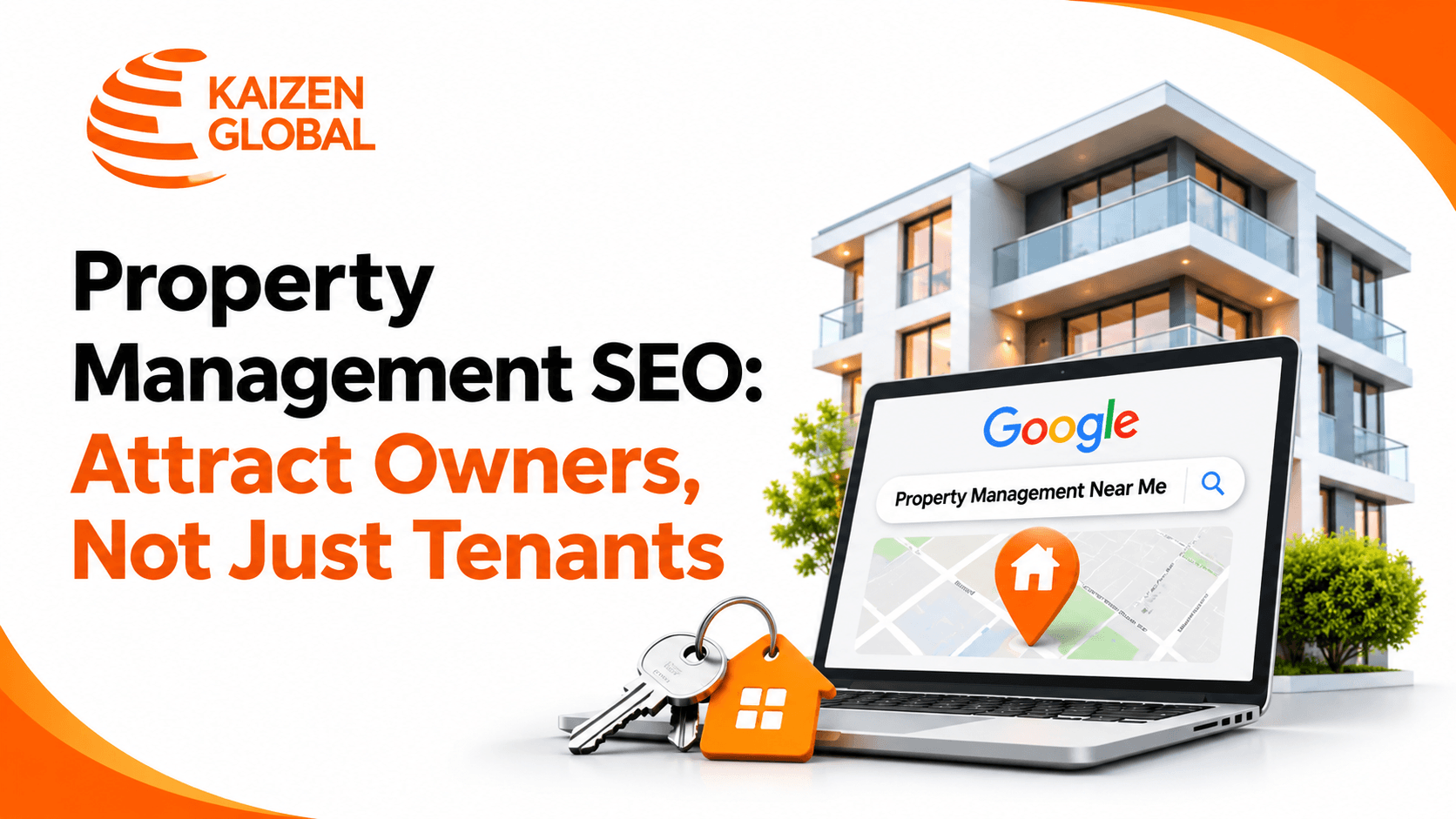
Renters search often, in large numbers, and with simple intent. Owners search rarely, usually when a problem tenant, a relocation, or an inherited house forces a decision.
A site with fifty listing pages and one generic services page tells Google exactly what it is for. Google then matches it to renters, because that is what the site appears to serve.
Tenant Searches Bring Volume
Queries like “2 bedroom apartments near downtown” or “pet friendly rentals” have high search volume and fast turnover. Each inquiry can fill one unit, which matters for occupancy and for keeping current owners happy.
Tenant traffic still has value. It simply does not grow the business on its own.
Owner Searches Bring Revenue
A single owner who signs a management agreement produces recurring fees for years. Owners also become a growth channel of their own. In the 2027 State of the Property Management Industry Report from Buildium and NARPM, 53% of growing companies said referrals from owner clients contributed most directly to their expansion.
The difference in intent shows up clearly when the searches sit side by side.
| Tenant search | Owner search | What the owner page must do |
|---|---|---|
| 2 bedroom apartments near downtown | property management companies near me | Show service area, services, and a clear next step |
| pet friendly rentals in Tampa | how much does property management cost in Tampa | Explain fees and what each one covers |
| apply for rental online | best property manager for single family homes | Prove experience with that property type |
| pay rent online portal | how to switch property management companies | Walk through the transfer process |
What Do Rental Property Owners Search For Before Hiring a Manager?
Owner searches follow a decision path with three stages. Each stage calls for a different type of page.
This matters more than it once did. Buildium’s 2027 report found that 47% of rental owners now identify as Accidental Landlords or Unintentional Investors, meaning they fell into ownership through circumstance. Many of them begin with basic questions long before they search for a company name.
Problem-Stage Searches
Owners at this stage are reacting to a situation. Typical queries include “tenant not paying rent what to do,” “how to rent out an inherited house,” and “landlord responsibilities in Florida.”
Blog posts and explainers capture these searches. A helpful answer here introduces the company before the owner even knows management is the solution.
Research-Stage Searches
Owners at this stage know they might hire help and want to understand the options. Queries include “what does a property manager do,” “property management fees explained,” and “property manager vs self-managing.”
Pricing pages, comparison guides, and process pages win these searches. They also do much of the selling, because owners arrive at the sales call already informed.
Hiring-Stage Searches
Owners at this stage are ready to compare companies. Queries include “property management company Tampa,” “single family property management South Tampa,” and “property management for out of state owners.”
That last query type deserves attention. Buildium’s 2026 Rental Owners’ Survey found that 55% of rental owners do not live near their properties, so remote owner searches are a real and underserved segment.
How Should Property Managers Research and Prioritize Owner Keywords?
Owner keyword research starts with the services the company actually offers, then expands through modifiers, real search data, and competitor gaps. The goal is a short, prioritized list mapped to specific pages, not a spreadsheet of thousands of terms.
Start With Seed Terms and Owner Modifiers
Seed terms describe the core service: property management, rental management, property manager, HOA management, and tenant placement. Each seed is then combined with the cities, neighborhoods, and property types the company serves.
Owner modifiers reveal intent. The most useful groups are:
- Cost terms such as fees, cost, pricing, and percentage
- Comparison terms such as best, reviews, vs, and top-rated
- Situation terms such as out of state, inherited, accidental landlord, and military relocation
- Property terms such as single family, condo, duplex, HOA, and small apartment building
- Switching terms such as change, fire, and switch property management company
Combining seeds and modifiers produces owner queries like “duplex property management fees in St. Petersburg” that tenants never search. Free and paid tools both handle this expansion well, and a quick look at the main types of SEO tools helps match the tool to the budget.
Mine Google Search Console for Hidden Owner Queries
Search Console shows the queries already bringing impressions, including many that keyword tools report as zero volume. Filtering the Queries report for words like owner, landlord, fee, manage, and management separates owner searches from renter noise.
Queries with impressions but few clicks are the fastest wins. They usually signal that a page is close to relevant but needs a clearer title, a dedicated section, or a page of its own.
Check Competitor Gaps
The local companies that appear for owner searches show which topics the market already rewards. Comparing their service, location, and pricing pages against the company’s own site reveals missing pages, such as an HOA page or a page for out-of-state owners.
Gaps work in both directions. Topics no local competitor covers well, such as a city’s rental registration process, are often the easiest owner keywords to win.
Map Keywords to Funnel Stages and Page Types
Every chosen keyword needs one home on the site. Assigning keywords by funnel stage prevents two pages from competing for the same search and shows which pages still need to be built.
| Funnel stage | Example owner keyword | Best page type | Primary goal |
|---|---|---|---|
| Problem | how to rent out an inherited house | Blog guide | Earn the first visit |
| Problem | tenant stopped paying rent in Florida | Blog guide | Earn the first visit |
| Research | property management fees explained | Pricing page | Build trust |
| Research | property manager vs self managing | Comparison guide | Build trust |
| Hiring | single family property management Tampa | Service page | Generate a lead |
| Hiring | property management for out of state owners | Service or landing page | Generate a lead |
| Hiring | switch property management company Tampa | Transfer process page | Generate a lead |
Hiring-stage keywords come first because they convert fastest. Research and problem-stage keywords follow, since they feed visitors into the hiring pages. Once mapped, each keyword can be placed in titles, headings, and body copy using a standard on-page SEO checklist.
How Should a Property Management Website Be Structured for Owners?
Site structure decides which audience Google believes the site serves. A clear owner path, supported by service and location pages, shifts that signal without abandoning tenants.
Separate the Owner Path From the Tenant Path
The main menu should split into two clear routes, such as “For Owners” and “For Residents.” The owner route leads to an owner hub page that links to every service, pricing, and location page built for owners.
The homepage headline should speak to owners first, since residents arrive with a specific listing or portal in mind. Here is a simple before and after.
Before: “Find Your Next Home in Tampa. Browse available rentals and apply online today.”
After: “Full-Service Property Management for Tampa Rental Owners. Tenant placement, maintenance coordination, and monthly owner statements, starting with a free rental analysis of your property.”
Residents still get a visible “Search Rentals” button. The difference is that the page now tells Google, and owners, who the business is built for.
Build Service Pages for Each Property Type
Owners of a single-family home ask different questions from owners of a twelve-unit building or an HOA board. One page cannot answer all of them well.
Separate pages for single-family, multifamily, HOA or association, and commercial management (only where those services are offered) each target their own keywords. A strong website design and development setup makes adding these pages simple without breaking the layout.
Create Location Pages That Prove Market Knowledge
Location pages fail when they swap a city name into identical copy. They succeed when they mention specific neighborhoods, local rental registration rules, typical property types, and the team members who work that area.
Clean URLs help here as well. A path such as /property-management/tampa/single-family is easy for owners and search engines to read, and it follows the same principles behind a well-written SEO slug. Companies serving several cities can plan local SEO across locations so each page earns visibility without competing against the others.
Link Owner Content in a Hub-and-Spoke Model
The owner hub page sits at the center, with service, location, and pricing pages as its spokes. Blog posts that answer problem-stage questions link up to research pages, and research pages link to the service and location pages where owners convert.
This structure moves an owner from a first question to a contact form in two or three clicks. It also signals which pages matter most, because the strongest owner pages receive the most internal links.
One simple rule keeps the model working. Each new owner blog post links to at least one research or service page, and each service page links back to two or three relevant guides.
What Content Earns the Trust of Rental Property Owners?
Owners are handing over an asset worth hundreds of thousands of dollars. Before they call, they want evidence of how their property, money, and tenants will be handled.
Buildium’s owner's research shows what that evidence should cover. Response speed was the top criterion owners use to judge a manager (43%), poor communication was the leading reason owners switch companies (57%), and 84% want to approve large repairs before work begins.
Fee and Pricing Explanation Pages
Pricing pages attract one of the highest-intent owner searches: “how much does property management cost.” Even when final pricing depends on the property, the page can explain the structure.
A useful pricing page lists every fee by name.
- Monthly management fee and what it includes
- Leasing or tenant placement fee
- Lease renewal fee
- Maintenance coordination or markup policy
- Vacancy, setup, or early termination fees, if any
Hidden fees are a known trust breaker. Publishing them openly filters out poor-fit leads and makes good-fit owners more confident.
Process and Reporting Walkthroughs
Owners want to picture the relationship before they sign. Pages that explain onboarding steps, repair approval thresholds, response time commitments, and monthly reporting answer those concerns directly.
A redacted sample owner statement is one of the most persuasive assets a property manager can publish. Few competitors show one, and it proves the reporting exists.
Local Market and Compliance Explainers
Rental rules change by state and city, and many owners worry about getting them wrong. Explainers on security deposit limits, eviction timelines, rental registration, and habitability rules in the service area attract problem-stage searches and position the company as the local authority.
These pages need named reviewers and clear update dates, since outdated legal information damages trust quickly. A process to refresh old content regularly keeps them accurate, and professional SEO content writing services can keep the publishing schedule consistent when the team is busy managing properties.
Owner Lead Magnets and Conversion-Focused Forms
Many owners are not ready to call after one visit. A useful free resource captures their details while they are still researching.
Strong lead magnets for property management include:
- A rental price analysis based on the owner’s address and property details
- A management cost calculator that estimates monthly fees for a given rent
- An owner onboarding checklist covering documents, keys, and timelines
- A local landlord compliance guide for the city or county
The rental price analysis usually performs best. It gives the owner something personal and gives the company a natural reason to follow up.
Forms matter as much as the offer. Owner forms should ask only for name, contact details, property address, and property type, along with a clear note on response time. Buildium’s owner research found response speed is the top way owners judge a manager, so a stated reply window on the form sets the right expectation from the first click, provided the team can meet it.
How Does Local SEO Help Property Managers Win Owner Leads?
Property management is local by nature. Owners want a company that knows their neighborhood, their rental market, and their local rules.
Google weighs relevance, distance, and prominence when deciding which businesses appear in local results. Each of the steps below strengthens at least one of those signals.
Set Up the Google Business Profile Correctly
The primary category should be “Property management company,” with services listed in owner language such as tenant screening, rent collection, and maintenance coordination. Posts and photos should feature real staff, real properties under management, and owner-focused updates.
Address settings matter. According to Google’s Business Profile guidelines, service-area businesses should hide their address, and a virtual office cannot be listed unless it is staffed during business hours. A company with a real office open to visitors can show its address, while a fully remote team should set up as a service-area business. A complete local SEO checklist covers the remaining profile and citation steps.
Collect Reviews From Owners, Not Only Residents
Most property management reviews come from tenants, and many of those are complaints. Owners read them, but they also look for reviews from people like themselves.
The best moments to ask owners for a review are natural milestones: the first lease signed, the first year-end statement, or a smoothly handled major repair. Reviews should never be incentivized, since Google prohibits paying or rewarding customers for them. The question of how Google reviews affect SEO goes beyond star ratings, because review content, recency, and responses all shape how prospects see the company.
Buildium’s 2027 report includes a telling example from Franklin Spees, owner/operator of Neighborhood PM. After acquiring another portfolio, his team found that the previous company’s investment in Google and Yelp reviews was producing new business calls almost every day.
Build Citations and Referral Partnerships
Consistent listings on directories such as the NARPM member directory, local real estate investor association sites, and chamber of commerce pages reinforce both location and legitimacy. Every listing should use the exact same business name, address, and phone number.
Local partnerships also produce links and leads. Real estate agents regularly meet sellers who decide to rent instead, and Buildium’s research found that 40% of growing companies credited referrals from industry professionals as a key contributor.
Compete With Directories and Best-Of Lists
Broad owner searches such as “property management companies in Tampa” often show directories, review platforms, and “best property managers” lists above individual company websites. Fighting for the top organic spot on those terms is slow, so the smarter move is to appear inside the results that already hold it.
That means complete, consistent profiles on property management directories, Yelp, the Better Business Bureau, and the NARPM member directory, with reviews collected on the platforms owners actually see. Local “best of” lists from news sites, business journals, and real estate blogs are also worth pursuing, usually by contacting the editor with verified credentials and owner reviews.
Company pages then win on longer, more specific searches. Queries like “HOA management for small associations in Brandon” or “property management for military owners near MacDill” rarely trigger directory results, which leaves room for a focused service or location page.
Earn Local Links Through Digital PR
Property managers hold data that local journalists want. Anonymized figures on average rents, days on market, or renewal rates across a portfolio can become a quarterly local rental report that news sites and business journals cite and link to.
Rental ordinances create another opening. When a city debates rent caps, registration fees, or new inspection rules, a property manager who offers clear, quotable commentary often becomes the local source reporters call first.
Other reliable link sources include sponsoring landlord education events, speaking at real estate investor association meetings, and writing guest articles for local business publications. Each one produces a relevant local link and puts the company directly in front of owners.
Which E-E-A-T Signals Matter Most for Property Management Websites?
Google’s quality guidelines put extra weight on experience, expertise, authoritativeness, and trust for topics that affect people’s finances. Property management fits squarely in that category.
Named People With Verifiable Credentials
An anonymous “our team” page is a missed opportunity. Each key team member should have a short bio with their role, years managing local properties, and any credentials such as a state real estate license or NARPM designations like RMP or MPM.
Linking these bios from the content each person reviews connects real expertise to the pages that need it most.
Proof Drawn From Real Operations
Owners respond to specific numbers: doors under management, average days on market, renewal rates, and average maintenance response time. These figures should only appear when they come from the company’s own records, with a date attached.
Case studies work the same way. A short write-up of a real property, shared with the owner’s permission, outperforms any generic promise of “maximized returns.”
Consistent Brand Signals Across the Web
Search engines increasingly treat a company as an entity, built from mentions, reviews, directory listings, and branded searches. Strong brand signals for SEO help a smaller local firm compete with national franchises that have more pages but less local reputation.
What Technical SEO Issues Hold Back Owner Conversions?
Technical problems on property management sites often come from the listing side of the business. Left unmanaged, they drown out the owner pages that drive revenue.
Listing Page Bloat
Every rental listing creates a URL, and most of those URLs expire within weeks. Hundreds of thin, expired listing pages waste crawl attention and weaken the overall quality signal of the site.
Expired listings should either return a proper “not found” status or be kept out of the index. Listing feeds syndicated across rental portals also create duplicate content, which is one more reason to keep owner pages as the strongest, best-linked part of the site.
Speed and Mobile Usability
Owners often check a management company on their phone between other tasks. A slow page or a broken contact form ends the visit before it starts.
Page speed, stable layouts, and mobile-friendly forms all affect both rankings and conversions. The balance between Core Web Vitals and user experience matters most on pricing and contact pages, where the decision to call is made.
Structured Data for Services and Locations
Local business markup helps search engines confirm the company’s name, address, phone, hours, and service areas. Google’s local business structured data documentation explains the supported properties.
Service and location pages can add Service markup that describes each management offering. A full technical SEO checklist covers redirects, canonical tags, and index management alongside schema.
How Can Property Managers Appear in AI Search Answers for Owner Questions?
Owners increasingly ask AI tools questions like “what should I look for in a property manager in Tampa” or “is property management worth it for one rental.” The companies mentioned in those answers gain an early advantage.
Buildium’s 2027 report notes that reputation now spreads through online reviews and, increasingly, through recommendations from AI models. That makes AI visibility part of owner acquisition, not a separate project.
Answer-First Content Blocks
AI systems favor content that answers a question clearly in the first sentence, then supports it with specifics. A fee page that opens with “Property management in Tampa typically costs a percentage of monthly rent plus a leasing fee” is far easier to cite than one that opens with a mission statement.
The differences between SEO, AEO, and GEO explain why the same page now needs to satisfy search engines, answer engines, and generative tools at once.
Consistent Entity Details
AI tools build their understanding of a business from many sources. When the company name, services, and service areas match across the website, Google Business Profile, directories, and review sites, the business becomes easier to identify and recommend.
Pages structured to get featured in AI Overviews tend to share the same traits: clear headings, direct answers, and verifiable facts.
How Should Owner-Focused SEO Results Be Measured?
Total traffic is a misleading number for property management companies. A spike in renter visits can hide a drop in owner leads.
Separate Owner Leads From Tenant Inquiries
Owner inquiries need their own form, their own thank-you page, and their own tracking event in analytics. A dedicated phone number on owner pages makes call tracking just as clear.
Once the two lead types are separated, the real performance of owner-focused SEO becomes visible.
Track Owner Keyword Visibility
Google Search Console can filter queries containing terms like “management,” “manager,” “fees,” and “owner.” Watching impressions and clicks for these queries shows whether owner pages are gaining ground, even before leads increase.
Tie Leads to Signed Management Agreements
The final measure is new doors under management. Connecting each owner leads to its outcome in a CRM that shows which pages and keywords actually produce contracts.
A simple value calculation keeps SEO spending in perspective. As an illustration only, a property renting for $2,000 per month with an 8% management fee produces $160 per month, or $1,920 per year, before leasing and renewal fees. Over a three-year relationship, that single owner is worth $5,760 in management fees alone, and multi-unit owners multiply that figure.
What Does an Owner-Intent SEO Audit Include?
The Kaizen Owner-Intent Checklist is a quick way to see whether a property management website is built for the audience that grows the business. Each item below should be true before investing heavily in new content.
- The homepage headline speaks to property owners first
- The main menu has a clear “For Owners” path
- Each owner keyword is mapped to one page by funnel stage
- Each managed property type has its own service page
- Each served city or area has a unique location page with local details
- A pricing page lists every fee by name
- A sample owner statement or reporting walkthrough is published
- An owner lead magnet appears on service and location pages
- Team bios show names, roles, and real credentials
- The Google Business Profile uses the correct category and address setting
- Owner reviews are requested at natural milestones
- Owner leads are tracked separately from tenant inquiries
Companies starting from scratch should begin with the first step of a structured SEO plan, which is a full audit of what already exists and what is missing.
Frequently Asked Questions
How long does property management SEO take to produce owner leads?
Google Business Profile improvements and review growth can influence local visibility within a few months, while new service and location pages usually take longer to gain traction. Timelines depend on market competition, the age of the domain, and how consistently content is published. A closer look at how long local SEO takes explains the factors in more detail.
Should owner portal and tenant portal login pages be indexed?
Login pages offer no value in search results and can confuse searchers looking for services. Most companies keep them out of the index and link to them from the menu instead.
Is it worth targeting self-managing landlords with content?
It often is, and few competitors do it well. Buildium’s research found that only 14% of growing companies cited contacting self-managing owners as a growth tactic, which leaves room for educational content that reaches these owners before they decide to hire help.
Do negative tenant reviews hurt owner acquisition?
They can, because owners read tenant reviews as a preview of how their own tenants will be treated. Calm, professional responses to every review show owners that problems are handled, which can turn a negative review into a trust signal.
Ready to Attract More Property Owners Through Search?
Kaizen Global builds owner-focused SEO strategies for property management companies, from keyword mapping and location pages to Google Business Profile optimization and AI search visibility. Every plan starts with an honest audit of where owner leads are being lost today.
Talk to our SEO team or book a free consultation to review your website. Prefer to explore first? See how our professional SEO services work, or reach us directly at +92 312 4422229 or info@thekaizenglobal.com.
Attract More Property Owners Through Search — Request a Property Management SEO Strategy Review
Insights

Mobile Seo Checklist - A Complete Guide
Mobile SEO refers to optimizing your website to ensure it performs well on mobile devices, offering a seamless user experience ...
25-Step SEO Migration Checklist
Migrating your website can feel like a daring task filled with potential challenges. No matter if you're redesigning your site ...
Local SEO Checklist: Maximize Your Local Reach
Local search engine optimization (SEO) has become essential for businesses aiming to connect with their community and attract nearby ...