Real Estate SEO: How Agents Can Attract Buyers and Sellers
Reviewed by Hassan Khan, SEO Expert at Kaizen Global | Updated October 28, 2026
Real estate SEO helps agents attract buyers and sellers by making their website, Google Business Profile, and local content appear when people search for homes, neighborhoods, home values, and agents in a specific market. Done well, it turns an agent’s site into a steady source of inbound leads instead of a digital business card.
The opportunity is large because the home search still begins on a screen. According to the National Association of REALTORS 2025 Profile of Home Buyers and Sellers, 46 percent of buyers started their home search online, while 20 percent began by contacting an agent. Search visibility decides which agent those early researchers meet first.
What Is Real Estate SEO and Why Does It Matter for Agents?
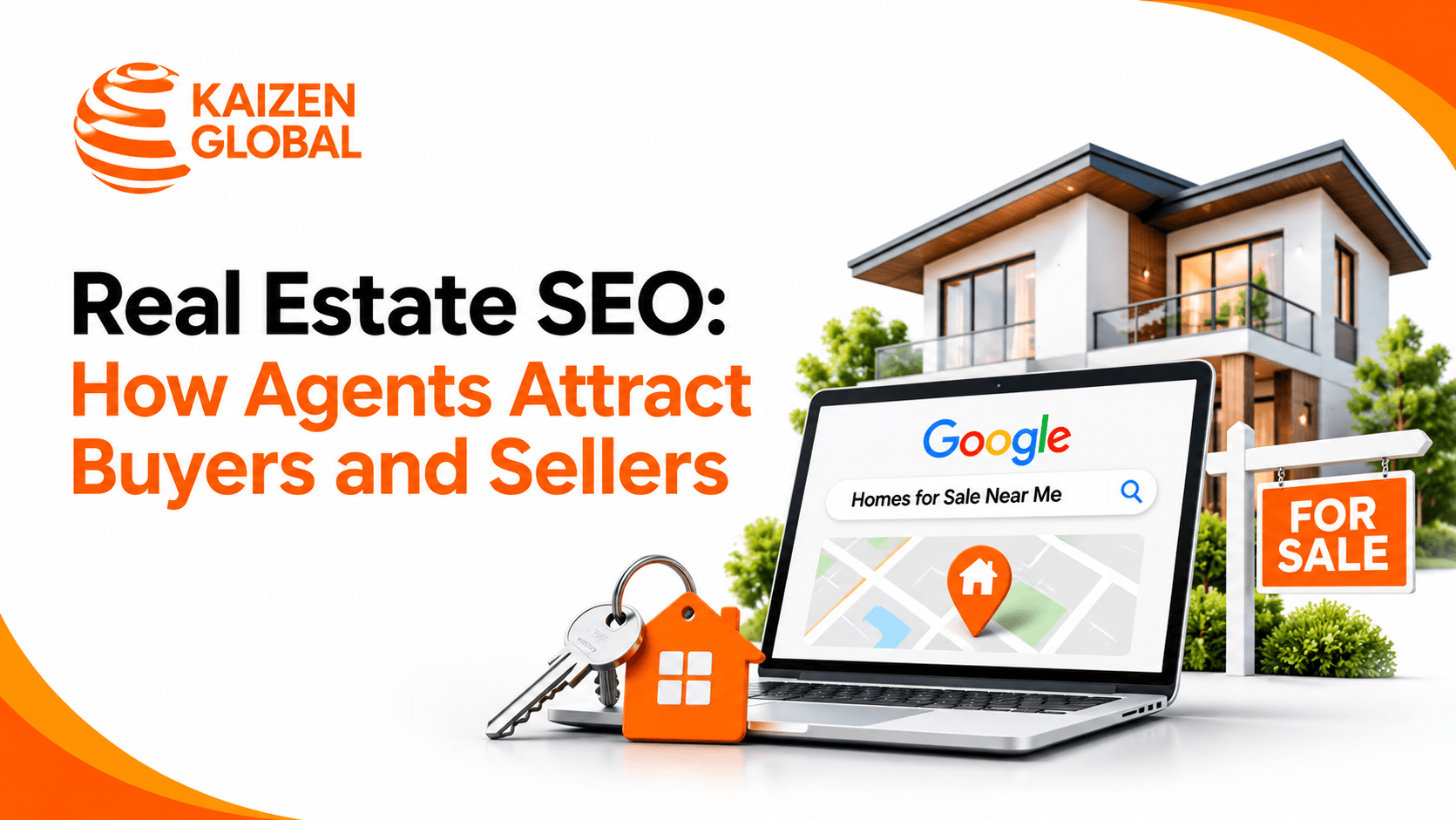
Real estate SEO is local search optimization built around property, place, and people. It targets three kinds of queries: searches for homes in an area, searches for information about buying or selling, and searches for an agent by name or reputation.
How Buyers Search Before They Contact an Agent
Buyers spend weeks researching before they speak with anyone. In 2025, 52 percent of buyers found the home they purchased on the internet, compared with 27 percent who found it through a real estate agent. Along the way, they search for neighborhoods, school zones, commute times, property taxes, and mortgage basics.
Every one of those searches is a chance to be the agent who answered the question first. A buyer who reads three helpful neighborhood pages on one site is far more likely to fill out that site’s contact form.
How Sellers Search Before They Choose an Agent
Sellers search differently. Their queries center on value, timing, and agent selection, such as “what is my home worth,” “best time to sell a house in Austin,” or “top listing agents near me.”
Sellers still lean heavily on professionals. A record 91 percent of sellers used a real estate agent, and only 5 percent of homes sold as For Sale By Owner, an all-time low. Nearly a quarter of sellers said they wanted their agent to help market the home to potential buyers, so an agent who appears for seller searches is already proving marketing skill before the listing appointment.
Why Portals Cannot Own Every Search
Large portals dominate broad searches like “homes for sale in Denver” and specific street addresses. Competing head-on for those terms rarely pays off for an individual agent.
Portals are weaker on hyperlocal and advice-driven searches. Queries like “living in Wash Park pros and cons,” “Highlands Ranch HOA fees explained,” or “how to sell a house with a tenant in Colorado” reward local expertise that a national listing database cannot fake.
How Do Buyer and Seller Search Intent Differ?
Buyers and sellers sit at opposite ends of the same transaction, so their searches reveal different concerns. Separating the two audiences during keyword research prevents pages that try to speak to everyone and convince no one.
Buyer Keywords and What They Reveal
Buyer searches usually combine a place with a lifestyle or financial detail. Common patterns include:
- [neighborhood] homes for sale under $500k
- best neighborhoods in [city] for commuters
- cost of living in [city] vs [city]
- first-time homebuyer programs in [state]
- new construction homes near [landmark]
These searches show that the buyer is comparing locations and budgets. Pages that answer with specifics, such as commute estimates, price ranges, and nearby amenities, earn both rankings and trust.
Seller Keywords and What They Reveal
Seller searches cluster around money, timing, and process. Common patterns include:
- how much is my house worth in [city]
- best time to list a home in [city]
- how to choose a listing agent
- cost to sell a house in [state]
- sell my house fast [city]
These queries carry high commercial intent. A seller researching listing agents is often only weeks away from signing an agreement.
Mapping Both Audiences to the Right Pages
Each intent deserves a dedicated destination. A simple intent-to-page map keeps the site organized:
- Neighborhood searches lead to individual neighborhood guide pages.
- Price and property type searches lead to filtered listing pages with unique introductory content.
- Home value searches lead to a valuation page with a request form and local pricing context.
- Process questions lead to buyer and seller guides.
- Agent name and reputation searches lead to an About page backed by reviews and credentials.
When two pages target the same query, they compete with each other. One clear page per intent avoids that problem and gives internal links an obvious target.
How Should Agents Set Up Google Business Profile for Local Visibility?
Google Business Profile often appears in the map pack above organic results, which makes it the first impression for many local searchers. For a lot of agents, it produces more calls than the website itself.
Choosing the Right Profile Type
Google treats real estate agents as individual practitioners. Its guidelines describe an individual practitioner as a public-facing professional with their own customer base and list real estate agents alongside doctors, dentists, lawyers, and financial planners. sterlingsky
The right structure depends on the office setup. When an agent is one of several public-facing practitioners at a location, the practitioner profile title should contain only the agent’s name and not the organization’s, while an agent who is the only public-facing practitioner for a branded organization should usually share a profile with that organization. Mistakes here frequently lead to suspensions, so it is worth reviewing the official Google Business Profile guidelines before creating anything. sterlingsky
Completing Categories, Service Areas, and Descriptions
“Real estate agent” is the right primary category for an individual practitioner, and secondary categories should be added only when they truly apply. Agents who meet clients at properties rather than an office can define service areas by city or zip code instead of displaying a street address.
The business description should name the markets served, the property types handled, and the client situations the agent focuses on, such as relocation or downsizing. Weekly photo uploads, posts about new listings, and answered questions keep the profile active and complete.
Building a Steady Review Flow
Reviews are the digital version of word of mouth, and word of mouth still drives this industry. Forty-three percent of buyers found their agent through a friend, neighbor, or relative, and reviews extend that trust to strangers.
A steady pace of recent reviews looks more credible than a burst of old ones followed by silence. Asking at closing, when satisfaction peaks, and texting a direct review link makes the request easy. For a closer look at the ranking impact, learn how Google reviews affect SEO.
Which On-Page Elements Matter Most on a Real Estate Website?
On-page SEO tells search engines exactly which location and audience each page serves. Small changes to titles, headings, and media often produce faster gains than publishing new content.
Title Tags and Meta Descriptions
Generic titles waste the most valuable space on a page. Here is an illustrative before and after for an agent in Charlotte:
- Before: Home | Smith Realty
- After: Charlotte Real Estate Agent for Buyers and Sellers | Smith Realty
- Before: Neighborhoods
- After: Dilworth Homes for Sale and Neighborhood Guide | Smith Realty
Meta descriptions do not directly affect rankings, but they shape clicks. A strong one names the area and offers a reason to visit, such as current market data or a free home valuation.
URL Structure and Headings
Clean URLs help both users and search engines understand page context. A structure like /neighborhoods/dilworth/ or /sell/home-value-charlotte/ beats long strings of parameters generated by a theme or plugin, and the guide to create clean, search-friendly slugs covers the formatting rules.
Each page needs one H1 that states the topic plainly, followed by H2 sections that match the questions searchers ask. A neighborhood page, for example, might use H2 sections for home prices, schools, commute, and things to do.
Images and Virtual Tour Media
Real estate sites are image heavy, which slows pages and frustrates mobile users. Compressing listing photos, serving modern formats like WebP, and adding descriptive alt text such as “renovated kitchen with quartz island in Dilworth bungalow” all help.
Descriptive file names and correctly sized images also help photos appear in Google Images. The full process is outlined in the guide to optimize images for SEO, and virtual tours should load on click rather than on page load to protect speed.
How Can Agents Fix the IDX Duplicate Content Problem?
IDX feeds let agents display MLS listings on their own sites, but they also create one of the biggest obstacles in real estate SEO. Because IDX property pages show content that is not unique, Google may treat them as duplicates and either ignore them or rank them below more original, authoritative pages.
Why Listing Pages Struggle to Rank
Listing pages also change constantly. Homes go pending, sell, and disappear, so the pages rarely build links or history, and some IDX plugins load listings inside iframes or heavy scripts that crawlers struggle to read.
Building Unique Pages Around the Feed
The fix is to surround IDX results with original content that only the agent can write. Neighborhood pages, condo building pages, and property type pages can each embed a filtered IDX search beneath several hundred words of local insight.
Featured listings deserve extra effort. An agent-written description, original photos, a short video, and neighborhood context turn a copy of MLS data into a page worth ranking.
Controlling Crawl and Index Bloat
IDX systems often generate thousands of near-identical URLs from filters like price, bedrooms, and sort order. These pages consume crawl attention without adding value for searchers.
Common controls include canonical tags that point filter variations to a main page, noindex tags on internal search results, and an XML sitemap that lists only pages worth indexing. Working through a technical SEO checklist after every plugin update confirms these settings still hold.
What Content Attracts Buyers and Sellers Over Time?
Content is where agents build an advantage that compounds. Each useful page keeps attracting searches months or even years after it is published.
Neighborhood and Community Guides
Neighborhood guides are the backbone of real estate SEO because they match how buyers search and are hard for portals to replicate. A strong guide reads like advice from a local, not a brochure.
The Kaizen Neighborhood Page Blueprint includes these elements:
- A short overview of the area’s character, housing, and lifestyle features
- Current price ranges by property type, with the date the data was pulled
- Housing styles, lot sizes, and typical construction eras
- Rush hour commute times to major employment centers
- School district boundaries with links to official district websites
- Parks, dining, shopping, and annual community events
- An embedded IDX search filtered to the neighborhood
- Original photos taken by the agent
- Separate calls to action for buyers and sellers
Market Reports and Pricing Content
Monthly or quarterly market updates attract both audiences at once. Buyers want to know if prices are softening, and sellers want to know what their home might bring.
Figures should come from the local MLS or association reports, with the source and date stated clearly. Original local data also earns links from news sites and community bloggers, which strengthens the entire domain.
Buyer and Seller Guides
Long-form guides answer the process questions that come before a first call. Strong examples include first-time buyer programs in a specific state, closing costs in a specific county, and how to prepare a home for listing photos.
These guides perform best when they reflect local rules and customs, such as transfer taxes or inspection norms. Generic national advice is everywhere, while state and county detail is scarce.
Video and Social Content
Neighborhood tours, market update videos, and listing walk-throughs can appear on YouTube and in Google’s video results. Embedding them on matching pages also keeps visitors on the site longer.
Social platforms extend the reach of every piece. Agents who want consistent distribution can explore social media marketing services that turn site content into short videos and posts.
How Do Technical SEO and Mobile Performance Affect Leads?
Technical problems quietly cap the results of every other effort. A slow, broken, or hard-to-crawl site loses rankings and leads at the same time.
Speed and Core Web Vitals
Large photo galleries, map embeds, and IDX scripts make real estate sites heavier than most. Lazy loading images, limiting third-party scripts, and choosing a fast host all reduce load times.
Speed metrics matter, but the overall experience matters more. The comparison of Core Web Vitals and user experience explains how the two interact in search performance.
Mobile Search Experience
Home searchers browse on phones between showings, during commutes, and late at night. Tap-to-call buttons, short forms, readable maps, and filters that work on small screens all affect conversions.
Running the site through a mobile SEO checklist catches tap target, viewport, and form issues before they cost leads. Testing the home valuation form on an actual phone is a quick win many sites skip.
Schema Markup for Agents and Listings
Structured data helps search engines understand who the agent is and what each page contains. Useful types include RealEstateAgent with address, service area, and contact details, along with BreadcrumbList for site structure and FAQPage for guide content.
Schema must reflect what is visible on the page. Marking up reviews or ratings that do not appear on the site, or inventing them, violates Google’s structured data policies and can trigger a manual action.
How Do Agents Build Authority and Backlinks Locally?
Links from relevant local websites show Google that an agent is a recognized part of the community. In real estate, a handful of local links usually outweighs dozens of generic directory links.
Local Partnerships and Sponsorships
Agents already work with lenders, inspectors, stagers, contractors, and attorneys. Featuring these partners on a resource page, with links in both directions where it makes sense, builds relevant local connections.
Sponsoring youth sports, school fundraisers, or neighborhood events often earns a link from the organizer’s website. Those links carry local relevance that is hard to buy.
Citations and Directory Consistency
Name, address, and phone number should match exactly across the website, Google Business Profile, brokerage site, portal agent profiles, the local chamber of commerce, and social accounts. Inconsistent details confuse search engines and weaken local signals.
Claimed portal profiles also give agents another place to collect reviews and link back to their own site. The local SEO checklist includes a complete citation audit process.
Digital PR With Local Data
Local reporters regularly need housing market commentary. Agents who publish clear market reports and respond quickly to journalist requests earn mentions and links from news sites, which are among the strongest local signals available.
How Is AI Search Changing Real Estate SEO?
Buyers and sellers increasingly ask AI assistants and Google AI Overviews questions like “Is Plano a good place to buy a home?” or “What are closing costs in Texas?” These systems pull answers from pages that respond clearly and show real expertise.
Answer-Ready Content
Pages that state a direct answer in the first sentence under each heading are easier for AI systems to cite. Short definitions, specific numbers with sources, and FAQ sections all help.
The guide on getting featured in AI Overviews explains how to format content for these results. The breakdown of SEO vs AEO vs GEO shows how traditional and AI-focused optimization connect.
Brand and Entity Signals
AI systems favor sources they can identify and verify. A consistent agent name, license details, brokerage affiliation, author bios on every article, and mentions across trusted local sites all strengthen that identity, and Kaizen’s analysis of why brand signals matter covers the topic in depth.
How Should Agents Measure Real Estate SEO Results?
Traffic alone does not pay commissions. Measurement should connect search activity to conversations, appointments, and closed deals.
Metrics That Connect to Leads
The most useful numbers include:
- Calls, direction requests, and website clicks from Google Business Profile
- Form submissions and home valuation requests tracked as GA4 conversions
- Positions for priority neighborhood and seller keywords
- Organic traffic to neighborhood guides and market reports
- Leads tagged by source in the CRM and followed through to closing
Google Search Console shows which queries bring impressions and clicks. That data reveals new content ideas and pages that need stronger titles.
Realistic Timelines
Real estate SEO is a long game. Google Business Profile improvements can show results within weeks, while competitive neighborhood and seller terms often take several months, as the article on how long local SEO takes explains.
Keeping Content Current
Outdated market data erodes trust quickly. Updating prices, dates, and school information on neighborhood pages at least twice a year keeps them accurate, and a simple process to refresh old content for SEO prevents strong pages from slowly sliding.
What Does a 90-Day Real Estate SEO Plan Look Like?
A phased plan keeps agents from spreading effort too thin. The order below puts the fastest visibility gains first.
Month One: Build the Foundation
- Audit the website for speed, mobile issues, broken links, and IDX indexing problems.
- Correct the Google Business Profile setup and complete every field.
- Fix name, address, and phone consistency across major citations.
- Set up GA4 conversions and Google Search Console.
Month Two: Strengthen Core Pages
- Rewrite title tags and headings on the homepage, About page, and service pages.
- Publish neighborhood guides for the three to five highest-demand areas.
- Launch a home valuation page targeting seller searches.
- Start a review request routine at every closing.
Month Three: Expand Reach
- Publish the first local market report and share it with local media.
- Add a buyer guide and a seller guide built around state and county details.
- Secure links from two or three local partners or sponsorships.
- Adjust titles on pages with high impressions but few clicks in Search Console.
Ready to Turn Search Traffic Into Buyer and Seller Leads?
Agents who appear for the right local searches spend less time chasing leads and more time serving clients who already trust their expertise. The work combines strategy, technical fixes, and steady local content, which is difficult to manage alongside showings and closings.
Kaizen Global builds real estate search strategies that cover Google Business Profile optimization, IDX cleanup, neighborhood content, and local link building. Explore our professional SEO services, let our team build a lead-generating website, or have our writers create neighborhood content that ranks.
Book a free strategy call and get a clear plan for attracting more buyers and sellers in your market. Reach us at info@thekaizenglobal.com or +92 312 4422229.
Frequently Asked Questions
Is SEO worth it for a new real estate agent?
Yes, especially for agents who have not yet built a large referral network. A new agent can win searches in a single neighborhood or niche, such as condos or relocation, long before competing for citywide terms. Those early wins create inbound leads that do not depend on paid ads.
Should agents build their own website or rely on a brokerage page?
An agent-owned domain is usually the stronger long-term asset. Content, links, and reviews built on a brokerage subpage stay with the brokerage if the agent moves. Many agents keep the brokerage profile for credibility while directing their marketing to their own site.
Can a local agent outrank large real estate portals?
Rarely for broad terms like “[city] homes for sale,” but often for hyperlocal and advice queries. Searches about specific subdivisions, condo buildings, school zones, or local selling costs reward first-hand knowledge that national portals do not offer.
Do Fair Housing rules apply to real estate SEO content?
Yes. Website content counts as advertising, so neighborhood pages and listing descriptions should describe properties, amenities, and features rather than the people who live there or the kind of buyer who would fit in. Wording that suggests a preference based on race, religion, familial status, disability, or another protected class creates legal risk, so content should be reviewed with a broker or compliance resource.
Does running Google Ads improve organic rankings?
No. Google has consistently stated that paid ads do not influence organic results. Ads are still useful for testing which neighborhood or seller keywords produce leads before investing in long-form content for those terms.
Should agents write about homes they have already sold?
Yes, with client permission. A short story about a sale that covers pricing strategy, marketing approach, and time on market gives sellers proof of results and creates strong content for seller searches in that neighborhood. Private client details should always stay out of the post.
Attract More Buyers and Sellers Through Search — Request a Real Estate SEO Strategy Review
Insights
Mobile Seo Checklist - A Complete Guide
Mobile SEO refers to optimizing your website to ensure it performs well on mobile devices, offering a seamless user experience ...
25-Step SEO Migration Checklist
Migrating your website can feel like a daring task filled with potential challenges. No matter if you're redesigning your site ...
Local SEO Checklist: Maximize Your Local Reach
Local search engine optimization (SEO) has become essential for businesses aiming to connect with their community and attract nearby ...